



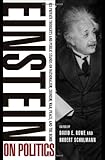
David E. Rowe, Robert Schulmann, eds. Einstein on Politics: His Private Thoughts and Public Stands on Nationalism, Zionism, War, Peace, and the Bomb. Princeton: Princeton University Press, 2007. xxxiv + 524 pp. $29.95 (cloth), ISBN 978-0-691-12094-2.
Reviewed by Antoine Capet (Université de Rouen)
Published on H-Diplo (January, 2008)
Everything's Relative
It is perhaps in order to start with a justification for this review of Einstein on Politics, a collection of Albert Einstein's political ideas edited by David E. Rowe and Robert Schulmann, in H-Diplo (as opposed to a list for physicists) for the younger generations. In ten chapters, Rowe and Schulmann include a wide range of Einstein's public and private thoughts and writing about nationalism, Zionism, war, peace, and the bomb, as the subtitle suggests, along with their own analyses of these documents. Today, Einstein is primarily remembered as the greatest physicist of the twentieth century, but when he died in 1955, he was also what we would now call a "media personality," one of world stature on at least two accounts. As a militant Zionist (though of a critical nature, as we will see), he took an active part in the great public controversies that surrounded Arab-Jewish relations almost from the time of the 1917 Balfour Declaration. As an implicit adept of the Clausewitzian continuum between diplomacy and war, he made no difference between his pronouncements against the nuclear arms race and his advocacy for a world government. Few people, least of all the present reviewer, are able to understand his contribution to fundamental physics. All his life, he denied that he was "the grandfather of the Bomb," as popular opinion labeled him, and an excellent plate in Einstein's Politics leaves no doubt about this perception, with its reproduction of the cover of the July 1, 1846 issue of Time magazine, showing Einstein's portrait with an atomic mushroom cloud bearing the inscription "E=mc2" behind him. Einstein's self-exculpation was somewhat disingenuous if we are to follow the editors' copious accompanying text, which is of exemplary clarity even if it does not manage to avoid repetitiveness. Only someone thoroughly versed in the complex evolution of nuclear physics and the links between theoretical and applied research in the field from the first formulation of his famous equation on energy in 1905 to the explosion of the first atomic bomb on July 16, 1945 in Alamogordo, New Mexico, can decide on his responsibility qua scientist. His main line of defense is that he did not imagine that the theoretical liberation of energy implicit in his equation would everbecome a practical proposition, at least in his lifetime.
Yet, the book includes two letters, one to President Franklin Delano Roosevelt (August 2, 1939) and one to his aides (March 7, 1940), that leave no doubt about his responsibility qua citizen. By the late thirties, he had become convinced by various sources that it, in fact, had now become a practical proposition, and that there was every reason to believe that Nazi Germany was busy developing a bomb based on nuclear fission. Though Einstein had gradually abandoned his initial absolute pacifism--an evolution that estranged him from many of his former pacifist friends, as very convincingly documented by the letters reproduced in the book--he evidently was caught in an excruciating dilemma, as he fully realized what the development of an atomic bomb meant, both from the point of view of its destructive power and from that of the changing nature of war, and therefore international relations. For the rest of his life, he pleaded that in conscience he could not have left Nazi Germany to develop the terrible weapon first. Hence, he personally intervened to convince the president of the mortal peril, as he saw it, if the United States did not join in what we now call the nuclear race--and made sure it won it. In a reply to the editor of Kaizo dated September 20, 1952, Einstein wrote: "My participation in the production of the atomic bomb consisted of one single act: I signed a letter to President Roosevelt, in which I emphasized the necessity of conducting large-scale experimentation with regard to the feasibility of producing an atom bomb" (p. 488).
In this letter, there was no indication of the conflict between loyalty to a state and loyalty to a people that he saw as one the perennial difficulties of being a Jew. He had been one of the first moral authorities of the world to denounce the rabid anti-Semitism of the post-1918 German right. Indeed, he had been one of its main targets as a scientist. It seems incredible today that some of the best physicists of the Prussian Academy of Sciences wrote learned treatises in refutation of the "Jewish" theory of relativity. In their eyes, Einstein's guilt was compounded when British astrophysicists wrote in 1919 that their observations of the bending of light rays in the proximity of the sun confirmed his theory. The German right, incidentally, was in good company, as the Bolsheviks also rejected it ("an attack that reached a high point in 1952 when I. V. Kuznetsov denounced Einstein's theory as absurd and beyond repair," as reported by Rowe and Schulmann [p. 457]). Thus, Einstein's theory of relativity--which, of course, very few people could discuss intelligently--became an issue of not only internal German politics, but also international politics. Many French scientists (fortunately not the great nuclear physicists Paul Langevin or the Curies) were reluctant to reintegrate a German scientist into the international scientific community by inviting him to conferences in France (the more so since he always lectured in German), while the British, already queasy over Versailles, were prompt to make advances to Einstein which redounded against him in Germany. His pleas in favor of internationalism in his "On the Contribution of Intellectuals to International Reconciliation" from 1920 or "On Internationalism" from 1921 made him even more suspicious to a German right withdrawing into fierce nationalism in the wake of its initial exclusion from the League of Nations. Einstein was very much aware of the German right's explanation of the defeat of 1918 and the subsequent peace settlement in terms of an international Jewish plot to destroy the German nation. The great British historian Eric Hobsbawm (born Hobsbaum of a British Jewish father and an Austrian Jewish mother) describes himself in his autobiography Interesting Times: A Twentieth-Century Life (2002) as a "non-Jewish Jew," implying that you do not have to be a believer to be a Jew. Einstein could have said the same of himself, since he had no faith, except in science, which led to "the cosmic religious experience," as he wrote about it in "Religion and Science" in 1930 (p. 231). He personally mocked what he perceived as defeatism in the face of anti-Semitism, in other words, the assimilationist efforts of his German "kinsmen," "brothers," or "brethren," as he repeatedly called other Jews in his writings. In "Assimilation and Anti-Semitism" from 1920, for example, he derided those who called themselves "German citizens of the Mosaic faith." Why do they not accept their "Jewish nationality," he asked (p. 143).
Here we come, of course, to a burning issue: the accusation of divided loyalty, or rather divided national loyalty, an accusation that still has a profound resonance today in many parts of the world. The accusation was not new: it was common at the time of the European Reformation. In itself, the expression Roman Catholic, as used by the new Protestants, implied allegiance to a foreign potentate. In late nineteenth-century France, the same devout Catholics were regarded with suspicion by the new republic, with the implication that they were ultramontains--literally, that they took their orders from beyond the mountains (i.e., beyond the Alps, in Rome). But, of course, it is the Jews who remained the principal subjects of this suspicion, discrimination, and persecution in early twentieth-century Europe, with various degrees. However, Einstein insisted that he never saw any anti-Semitism in Geneva (though that probably does not exonerate small-town Switzerland). For Einstein, assimilation was not only impossible but also undesirable. In the great internationalist brotherhood of mankind that was his lifelong ideal (and therefore already so in Weimar Germany), what is the point in calling yourself German (or whatever nationality)? What defined a common identity is a basic community of race and tradition, not the state in which you happen to have been born. Einstein used words and concepts that would be in breach of the law in many European countries today. In "Assimilation and Anti-Semitism," he writes that "Facial features already mark the Jewish child as alien," and he seemed to close the door to a perfect understanding between Jews and non-Jews: "a Jew and a non-Jew will not understand each other as easily and completely as two Jews," he wrote (p. 143). His ideal world was one in which every community was proud of its ancestry and traditions while showing equal respect to those of others, thus making power politics obsolete and leading to perpetual peace. Militant religions (including the Jewish one), proselytizing ideologies (like Bolshevism), and conquering nationalism had no place in this scheme of things.
Now, at the same time, Einstein was a convinced Zionist, and the book is full of his pronouncements on the subject. Rowe and Schulmann have no easy task trying to reconcile Einstein's militant internationalism with his equally militant Zionism. H-Diplo subscribers will remember the controversy over the United Nations Resolution 3379 of 1975 ("The General Assembly ... Determines that Zionism is a form of racism and racial discrimination"), which was widely supported by Western left-wing intellectuals. The gist of the editors' argument is that Einstein was part of the minority of Zionists who refused the idea of a Jewish state--all they wanted was free access to Palestine for all Jews who wanted to settle in the land of their ancestors, in perfectly peaceful coexistence with the Arabs already there. In his writings, Einstein was increasingly irritated by the British policy of "Divide et Impera" (divide and rule, p. 353) and after 1941-42 by the British refusal to let the Jews of Europe escape certain death in the hands of Nazi conquerors. As he argued before the Anglo-American Committee of Inquiry on January 11, 1946, "the difficulties between the Jews and the Arabs are artificially created, and are created by the English" (p. 340). His hopes of peaceful coexistence with the Arabs were dashed after 1946-47, but then, to the dismay of his old Zionist friends, he continued to believe that Jewish rule in Palestine did not make sense. In a letter from 1947 to Hans Muesham, for instance, he wrote: "If we had power it might be worse still. We imitate the stupid nationalism and racial nonsense of the goyim even after having gone through a school of suffering without equal" (p. 346). As probably the most famous living Jew on earth, he was offered the largely honorific presidency of the new state of Israel on the death of its first president, Chaim Weizmann, in 1952, but he politely declined the honor, largely for fear of having to publicly disagree with the hawkish leaders who he saw as the rising force in Israeli politics. His acceptance would, of course, have been in total contradiction with his well-publicized reservations about a Jewish state in Palestine. Rowe and Schulmann indicate that David Ben-Gurion, the prime minister, was greatly relieved: "If he accepts, we are in for trouble," he is reported to have said privately (p. 355).
In fact, it was Einstein who then was in trouble--with the American right. This was not the first time he was in trouble with the American right; the Woman Patriot Corporation had tried to prevent his third stay at the California Institute of Technology of Pasadena in 1932 on the grounds that he had a pernicious influence as an anarcho-Communist agent of world revolution. His only aim in the United States was to shatter church and state, they argued. Things were far more serious, of course, during the Cold War hysteria sustained by the House Committee on Un-American Activities, Senator Joseph McCarthy, and the FBI under J. Edgar Hoover, "whose staffers managed to compile over 1,500 pages of documents relating to his political activities over a twenty-year period" (p. 56). Though only a recent citizen of the United States (he took the oath in 1940), he voiced his concern on the difference between the theory and practice of American democracy in "On Political Freedom in the U.S.A." in 1945, not so much on the anti-Semitism that he also detected in American society as on "the still present dark shadow of racial prejudices, particularly toward Negroes" (p. 473). Public pronouncements like "I must frankly confess that the foreign policy of the United States since the termination of hostilities has reminded me, sometimes irresistibly, of the attitude of Germany under Kaiser Wilhelm II" in "The Military Mentality" from 1947 did not endear him to the cold warriors who seemed to him to be gradually gaining control of all the levers of the government (p. 478). As he wrote in a letter to Bertrand Russell dated February 16, 1955, a few weeks before he died, "this country has been ravaged by a political plague that has by no means spared scientists" (p. 501). Little did he know that that plague had only narrowly spared him: "By 1952 the FBI was working hand in hand with the Immigration and Naturalization Service, which was considering possible denaturalization and deportation proceedings against Einstein under the provisions of the 1940 Aliens Registration Act," the editors tell us (p. 59).
Just as the United States could be perceived as embodying all the contradictions of a democratic state, Einstein embodied all the contradictions of the moderate left-wing intellectual. He was a Zionist who refused a state that dominated the Arabs of Palestine (which baffled many Jews); a "citizen of the world" who also claimed to be a Zionist (which baffled many Arabs); an internationalist who never pardoned the Germans for their Nazi past and never set foot in Germany again after the war (unlike, say, Yehudi Menuhin, an advocate of reconciliation, who exonerated a man like Wilhelm Furtwaengler); a pacifist who dismissed conscientious objection in the face of Hitlerism (but led again the world peace movement against nuclear weapons after the war); a scientist who had objectively dirtied his hands exploring the nature of atomic energy but who strenuously refused to accept any responsibility for opening Pandora's box, however unwittingly; and a man with a profound dislike of the Soviet system but wary of the American anti-Communist zealots. Ironically, the apocryphal phrase "everything's relative," which seems so apt as a description of his own life action, was used both by latter-day agnostics of the left who admired him and opponents from the right who denounced the dangerous laxity and permissiveness that he thereby seemed to condone. Einstein was an important man, and Rowe and Schulmann edited an important book about him.
If there is additional discussion of this review, you may access it through the network, at: https://networks.h-net.org/h-diplo.
Citation:
Antoine Capet. Review of Rowe, David E.; Schulmann, Robert, eds., Einstein on Politics: His Private Thoughts and Public Stands on Nationalism, Zionism, War, Peace, and the Bomb.
H-Diplo, H-Net Reviews.
January, 2008.
URL: http://www.h-net.org/reviews/showrev.php?id=14001
Copyright © 2008 by H-Net, all rights reserved. H-Net permits the redistribution and reprinting of this work for nonprofit, educational purposes, with full and accurate attribution to the author, web location, date of publication, originating list, and H-Net: Humanities & Social Sciences Online. For any other proposed use, contact the Reviews editorial staff at hbooks@mail.h-net.org.

