



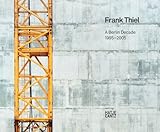
Frank Thiel. A Berlin Decade, 1995-2005. Translated by Maria Gurlitt-Sartori and Barbara Holle. Ostfildern: Hatje Cantz Verlag, 2006. 260 pp. EUR 49.80 (cloth), ISBN 978-3-7757-1864-6.
Reviewed by Eleanor Moseman (Department of Art, Colorado State University)
Published on H-German (December, 2007)
Critical Nostalgia: Temporal Flux and the Image of Berlin Emerging
In this sumptuously illustrated volume produced to accompany a traveling exhibition, German photographer Frank Thiel presents his viewers and readers with thought-provoking photographs of the new Berlin in a protracted state of emerging. Essays by David Moos and Robert Hobbs complement each other and the photographs themselves with scholarly attention to critical aspects of Thiel's project and his unique vision of urban transition.
David Moos, curator of contemporary art at the Art Gallery of Ontario, Toronto, introduces the reader to some of Thiel's recurring themes and aesthetic strategies in his essay, "Utopian Construction? The Work of Frank Thiel." Moos frames his discussion with reference to architects Mies van der Rohe and Buckminster Fuller, as well as theorists Michel Foucault, Thierry de Duve, and Andreas Huyssens. He constructs a backdrop of the regulatory gaze of "disinterested" observation (conjuring a Kantian version of Foucault's panopticon, a reference Robert Hobbs mines productively in his essay) to produce a strategic record of Berlin architecture as it emerges and passes into memory. Pausing at one of Thiel's recurring subjects, the author points to a photograph of a crane tearing down a pillar in an interior courtyard of the Reichstag. Moos notes Thiel's ability to mark a convergence in the building's long and complicated history. He quotes Mies's praise of capturing a building's emergence as more powerful than its completion. This in turn allows Moos to describe another recurring subject in the photographs: the (re)construction of the Potsdamer Platz, a site he describes as indicative of Berlin's complex relationship to capitalism, politics, and modernism. Moos sets Thiel's photographic style and his choice of subject into context with other German photographers, such as Thomas Struth and Candida Höfer, who both look to international urban subjects while framing them with Bernd and Hilla Becher's formalist aesthetic. He contrasts these photographers' formalist approach with the photographs of Günther Förg, whose utopian vision of modernist architecture Moos believes runs counter to Thiel's reserved observation of a city in transition.
Noting Thiel's biography in the context of his complicated relationship to Berlin and repressive East German state ideology, Moos points to Thiel's "manifest restraint" in capturing details of decaying architecture without succumbing fully to nostalgia or ideological commentary. He observes, "Thiel's ability to encode in photography the dialectical relationship between ideology and aesthetics displaces any prospect of sentimentality from his project" (p. 11). If an ideology is to be identified here, Moos believes that it may be whispered in the absence of certain structures among Thiel's subjects: for example, Daniel Libeskind's Jewish Museum (completed in 1998). I would add that other structures conspicuously absent from Thiel's project include sites of East German control, such as the remaining sections of the Berlin Wall or the Stasi prison and interrogation center in Berlin-Hohenschönhausen, which first opened to the public as a memorial site in 1994. Instead, Thiel turns a quasi-objective eye to subjects symbolic of both East and West, as Moos points out in his comparison of the photographic series on the Palast der Republik in East Berlin and the NSA surveillance field station at Teufelsberg in West Berlin. Moos notes that Thiel approaches his subject from a distance, then increasingly pins down the details, ending both series in close-up views of shattered glass (at Teufelsberg) and peeling paint (at the Palast). Moos underscores in this comparison what he implies to be Thiel's photographic critique of "utopian construction" referenced in his essay title. This critical gesture is enhanced, I believe, by Thiel's sequencing of the photographs in the series for this volume. For example, he places six views of the partially disassembled theater hall in the Palast der Republik immediately after a set of images of decay culminating in a detail of corroded black paint in the Palast itself. Here Thiel uses photography to expose the continuing controversy concerning the fate of the Palast, which occupies the site of the historic city palace, the proposed reconstruction of which has sparked heated debate. As Moos concludes, by committing his photographic eye evenly to subjects in both East and West Berlin, Thiel holds a series of pairs in dynamic suspension: time and place, present and past, architecture and aesthetics, memory and the future. Thiel, Moos argues, reserves comment on these dual aspects inherent in his subject and focuses his lens and the viewer's attention on the transitional moments of architectural change in Berlin.
In his essay, "Marking Time: Frank Thiel's Photographs," Robert Hobbs elegantly weaves together contexts and allusions both visual and historical. At the outset, he frames his discussion with reference to biographical details, including Thiel's educational background in mathematics and physics as well as his parents' careers in science in former East Germany. Hobbs presents key issues in the history of a divided Berlin as context for Thiel's imprisonment for political dissent (1984-85) and eventual deportation to West Germany (1985). Thiel eventually settled upon the pursuit of a career in photography after a short period of searching for direction in his new home. Hobbs cautiously refers to Thiel as a "documentary-type" photographer, a choice he explains in a postscript in which he acknowledges the complexity of Thiel's aesthetic and thematic framework. Citing Roland Barthes and Christian Metz, Hobbs discusses the theoretical backdrop for Thiel's contribution as a challenge to the predominant western understanding of photography as inherently belonging to the past. He hits upon Gilles Deleuze's theory of "transversal becoming" as a central theme in Thiel's work, especially in the one hundred thirty-one works from sixteen photographic series that comprise the current catalogue.[1]
A major strength of Hobbs's account of Thiel's body of work lies in his sensitive highlighting of the photographer's own statements. As evidenced in both the narrative and notes, Hobbs has maintained personal communication with the artist for the past several years. He combines enlightening passages from their correspondence with critical theory ranging from Walter Benjamin and Foucault to Abigail Solomon-Godeau and Deleuze. Hobbs reads Thiel's photographic series in part as a postmodern response to abstraction in painting; for example, in Jackson Pollock's skeins of paint and Gerhard Richter's 1970s color grids. He also demonstrates Thiel's response to the formal strategies of photographers such as Aaron Siskind and the Bechers, as well as photographers who recorded the transformation of mid-nineteenth-century Paris, among a host of other carefully chosen visual antecedents.
Hobbs's discussion of Thiel's early and current work takes into account the complicated history of Berlin and the artist's critical, yet occasionally ambiguous, relationship to the city. This stance is evident, for example, in the series The Allies (1994), for which Thiel photographed fifty low-ranking soldiers from each of the four powers that still maintained a presence in Germany at the time. These two hundred portraits--as well as the installation of a pair of them as a permanent installation at Checkpoint Charlie--are integrally related to an overwhelming sense of "critical nostalgia." This dynamic pervades Thiel's early photographs as well as the series featured in the present volume. It is not that Thiel longs for a return of East Berlin's past, as a variant of the "Ostalgie" so humorously taken up in Wolfgang Becker's hit film Good-bye Lenin (2003). Rather, Thiel remains sensitive to the rapid disappearance of markers of East Germany's past, a process he aims to "decelerate" by fixing his camera lens on those features of East Berlin that are destined for destruction and the new buildings surging up in their place. As Hobbs eloquently explains, Thiel's images of Berlin as included in this volume literally lay bare for the viewer/reader the very process of the city's re/emergence as a commercial and political center.
Although at first glance Thiel's vignettes of the city's "becoming" seem objective, his strategic framing of these images presents a subtle critique of the official slogan "Berlin wird" [Berlin is becoming]. As Hobbs points out, the fragmentation of Berlin into satellite neighborhoods has resulted in large part from city planners having neglected to ask themselves the full question: "Berlin wird ... was?" (pp. 16, 22). Thiel's photographs seem to ask the viewer to decide what Berlin is becoming. He explained his reasons for focusing in this project on what he calls "provisional landscapes in the process of transformation," stating that, "I wanted to photograph the city so that people would not know the final result. I suspected that some of the buildings might be more interesting during the process of construction than they would be when completed" (p. 22). The participatory role of the viewer implied in this statement combines with the memorializing function of Thiel's repeated capturing of buildings in a state of flux between "destruction and construction" to create a kind of photographic parallel to the "counter-monument" invoked by James E. Young in his study of Holocaust memorials.[2] In this sense, Thiel's photographs of disappearing structures of East Berlin, such as the Palast der Republik, stand in as a reminder of history where contentious arguments about the fate of East German buildings threaten to erase the memory of that culture.[3] The photographs thus become metaphorical question marks. Thiel's aesthetic strategy--namely, his choice of an often privileged camera angle, use of color and sharp documentary-like clarity, choice of titles akin to scientific classification labels, and even the monumental scale of the prints--allows his photographs to pose as open-ended reportage such that the viewer must decide for himself what critical stance can be taken to the destruction and/or construction of the buildings he targets.
Thiel's critical intervention in this project extends to his ordering of the photographs in the catalogue. His organizational strategy underscores the instability of time; rather than lay out the photographs chronologically or strictly within distinct series, Thiel weaves together exemplars from sixteen series, allowing time to loop back upon itself. Some of these series span the entire ten-year project (1995-2005), especially "Stadt 2 /xx (Berlin)." Photographs in this series present a visual symphony of rebar grids and foundation supports that surely fascinated this former student of math and physics. Other series that Thiel began early in the project led him to pursue related patterns, such as the series "Stadt 6 /xx (Berlin)," which captures the facades of buildings draped in sheer cloth during reconstruction [4]. Thiel then combines his interest in facade draping with his attention to grids in the series "Stadt 10 /xx (Berlin)," which features intricate networks of facade scaffolding. Thiel intersperses photographs from these series and others to highlight the parallel between the ravages of time and the destruction of edifices by decree, sometimes inverting the logical sequence to expose the artificial circumstances of a building's fate. For example, two photographs of the same building in East Berlin, "Stadt 5/20/C (Berlin)" and "Stadt 5/20/A (Berlin)" invert the chronological sequence of "before" and "after," simultaneously calling into question the need for destruction of this building while conjuring postwar images of Berlin in ruins after Allied air raids laid waste to the city's architecture. This visual parallel raises awareness of the silent destruction that, without critical interventions like Thiel's, may proceed without widespread recognition of the erasure of East German architectural history seemingly inherent in commercial and political efforts to renew Berlin as an international capital. By placing the "after" image ahead of the "before" image in the plates, Thiel points out this irreversible cultural loss, in keeping with a sense of "critical nostalgia" mentioned above.
Thiel closes the book and his project with a series of photographs detailing the disintegrating surfaces of (East) Berlin buildings; for example, decaying tarpaper and peeling paint offered up as contemporary versions of Siskind's Abstract Expressionist photographs. This move again highlights the passage of time when considered in conjunction with the set of photographs Thiel positioned at the beginning of the plates, namely wide-angle views of the Potsdamer Platz and the Reichstag under (re)construction punctuated by images of East German public buildings being torn down by heavy machinery. By foregrounding the two major commercial and political construction projects in the new Berlin, yet interrupting the image of heroic emergence with the silent destruction of East Berlin buildings, Thiel positions himself and the viewer/reader as a critical observer, unwilling to be swept up in the frenzy of building activities in the race to remake Berlin. By ending the project and the book with a sequence of images of decay, I believe Thiel is asking us to remember that the future remains unknown; the showcase buildings of the Potsdamer Platz and the Regierungsviertel may one day experience a similar fate of decay and demolition. Only time will tell.
Notes
[1]. In his communications with Hobbs, Thiel himself acknowledges his debt to Deleuze's theory of "becoming" (p. 22).
[2]. See James E. Young, The Texture of Memory: Holocaust Memorials and Meaning (New Haven: Yale University Press, 1993).
[3]. The defense against of loss of cultural memory is epitomized by the recently established "DDR Museum Berlin" on Karl-Liebknecht Strasse, which attempts to restage a slice of daily life in former East Berlin. This museal gesture speaks as much to a need for preserving commonplace objects and environments as a site of memory for former inhabitants of East Germany as it does to satisfy the curiosity of international (and German) tourists who may perceive East German culture as exotic (or perhaps extinct).
[4]. I find it noteworthy that in discussing Thiel's choice of subjects and his attention to construction drapery, both Moos and Hobbs avoid reference to Christo and Jeanne-Claude's Wrapped Reichstag, a project "realized" in 1995 and widely heralded as a much-needed caesura in the building's history. A conceptual parallel between the uses of drapery in both artistic projects seems to emerge given the underlying, albeit unspoken, critical dimension in using drapery as a metaphor. See Eleanor Moseman, "Monumental Drapery: The Aesthetic Evolution of the Wrapped Reichstag," Focus on German Studies 9 (2002): 27-42.
If there is additional discussion of this review, you may access it through the network, at: https://networks.h-net.org/h-german.
Citation:
Eleanor Moseman. Review of Thiel, Frank, A Berlin Decade, 1995-2005.
H-German, H-Net Reviews.
December, 2007.
URL: http://www.h-net.org/reviews/showrev.php?id=13973
Copyright © 2007 by H-Net, all rights reserved. H-Net permits the redistribution and reprinting of this work for nonprofit, educational purposes, with full and accurate attribution to the author, web location, date of publication, originating list, and H-Net: Humanities & Social Sciences Online. For any other proposed use, contact the Reviews editorial staff at hbooks@mail.h-net.org.

