



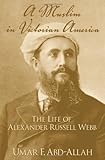
Umar F. Abd-Allah. A Muslim in Victorian America: The Life of Alexander Russell Webb. Oxford: Oxford University Press, 2006. ix + 388 pp. $35.00 (cloth), ISBN 978-0-19-518728-1.
Reviewed by John Kelsay (Department of Religion, Florida State University)
Published on H-Amstdy (December, 2007)
"The only biography of the first prominent American Muslim," reads the announcement on the Oxford University Press website. And, indeed, that may be the case. Umar F. Abd-Allah's study of Alexander Russell Webb, which began as a University of Chicago dissertation, takes the bits and pieces of a story related by others as a point of departure for this full-length exploration of the man who represented Islam at the 1893 World's Parliament of Religions. Most of those bits and pieces, as it turns out, have been related by Muslim Americans interested in placing their faith in the mainstream of American religious history. For these individuals, the fact that a man like Webb identified himself as both Muslim and American as early as the 1890s provides an example to which contemporary Muslims may recur. Thus, Sulayman Nyang, a Ghanaian émigré teaching at Howard University, speaks of a "Webbian tradition" of American Islam. Especially after September 11, some Muslims seeking an American identity find in Webb a prototype of an integrated self.
Given this interest, the first word a reviewer should use to describe Abd-Allah's scholarly study is "helpful." A Muslim in Victorian America is the story of a descendant of Scots-Irish immigrants, who came to identify himself as a Muslim and founded a mission dedicated to the propagation of Islam in the United States. As noted, Webb served as the spokesperson for Islam at the 1893 World's Parliament. He established interesting, if troubling, connections with Muslims in India and in late Ottoman Turkey. On these and other points, Abd-Allah provides much useful information. Given our current lack of solid information about the place of Islam in American religious history, Abd-Allah's scholarly work is really quite valuable. If and when someone writes a really good history of American Islam, I am sure that the author of that work will have ample reason to cite A Muslim in Victorian America.
That said, the second judgment to be made about Abd-Allah's study is that it leaves us with more questions than answers. We might profile Webb as follows: born and reared in upstate New York, from a family that was nominally Presbyterian. Webb's religious interests show the imprint of revivalism, in the sense that he was in search of an authentic religious experience, a conversion "from the heart." At the same time, Webb was influenced by transcendentalism and felt that "church-Christianity" (as he called it) was overly narrow. In short, Webb was a seeker, whose perspective suggests that each and every person ought to search out the truth for himself or herself, and follow whatever light is given.
This combination of tendencies led Webb to associate with Unitarians, as well as with people interested in theosophy. These associations proved to be long-term. At the time of his death (in 1916, at the age of seventy), Webb was still a member of the Knights of Pythias, and the local Unitarian minister presided at his funeral. Somewhere along the way, Webb became interested in Islam. It is not entirely clear where or when that interest developed, though over the long term the most evident sources of Webb's Muslim convictions were the writings of standard nineteenth-century Indian reformers: Sayyid Ahmad Khan, Chiragh Ali, and Sayyid Amir Ali. From these authors, Webb developed the idea that Islam is a kind of ideal monotheism, purified of Christian mystifications--for example, the doctrine of the Trinity. In this view, Islam also stood for a simple moral code, adherence to which Webb thought would resolve a number of tensions present in American life. Islam could thus serve as a resource by which Americans might fulfill their stated ideals of equality and liberty. Interestingly, Webb seems to have known very little about the ritual aspects of Muslim tradition. Food laws, for example, do not figure very much into his presentation. At the same time, he did have some notion of purdah as a system for regulating interactions between men and women, as well as an understanding that Islam permits men to have more than one wife at a time. Webb seems to have regarded these conventions as an aspect of Islamic wisdom, and thus that they might play a part in resolving problems in American social life, though it is not entirely clear how or why he thought this.
At the same time he was seeking an authentic religious experience, Webb supported himself through work as a journalist. By this means, he made political connections, and somehow--again, it is not entirely clear how--secured an appointment as the American ambassador to the Philippines. Webb's own account suggests that he saw this as a way to further his studies of Islam, and it does seem to be the case that Webb utilized the appointment to make connections with well-to-do Indian Muslims. These individuals financed a trip to the subcontinent, where Webb sought (and believed he had secured) funding for a Muslim mission to the United States. Upon his return to the States, Webb threw himself into this work, publishing a journal and a newsletter devoted to the promulgation of Islam. He also gave speeches and lectures around the country, with the presentations at the World's Parliament marking a high point in his efforts. For reasons that are unclear (again!), the financial support Webb expected from India never materialized. (Just to give a complete picture: Webb cleared the bottom floor of his farmhouse, redoing the rooms in anticipation of providing space for a number of Muslim missionaries, who were to come and work under his auspices. These individuals never came.) Given this failure, Webb could not continue his work and sought funding from other sources. At this point (mid to late 1890s), he made some connections with Turkish Muslims and began to serve as a kind of publicist for the Ottoman sultanate. In particular, Webb wrote tracts explaining the "truth" about reports of Ottoman discrimination against Armenians. This episode is, to say the least, a bit of an embarrassment for those presenting Webb as a proto-typical Muslim American. As well, the episode leads into the final chapter in Webb's life, in which one of his most important Indian Muslim contacts circulated rumors of financial improprieties, to which Webb gave answer in several interviews.
Already, one can see that there are many questions. How does one connect the various pieces of Webb's story? What caused the failure of financial support from India? Did Webb simply misunderstand the word of his contacts? How did a man like Webb--intelligent and talented, but not particularly extraordinary--become the U.S. ambassador to the Philippines? Why did Webb know so little about the ritual aspects of Islam?
Most of all, though, why did he choose Islam in the first place? As presented by leaders like William Quan Judge, Henry Steel Olcott, and above all Helena Petrova Blavatsky, theosophy was a movement directed at recovering a message that was at one and the same time present in and obscured by existing world religions. In the exoteric dimension familiar to most practitioners, a seeker would find many problems. Webb's criticisms of "church-Christianity" seem typical in this regard. Christian exclusivism, the doctrine of the Trinity, and other aspects of historic Christian practice did not make for authentic religious experience. Rather, such obscurantism inhibits the seeker, discouraging him or her from further religious pursuits. Interestingly, in comments on the Presbyterianism of his youth, Webb includes the "Immaculate Conception" in his list of problematic doctrines. Since no Presbyterian catechism or confession ever affirmed this notion, which in fact was only identified as an article of faith for Roman Catholics by Pope Pius IX in 1854, one assumes Webb is confusing the terminology of Marian devotion with the story of the Virgin Birth--a story repeated and affirmed in, among other places, the sura of Mary or chapter 19 of the Qur'an.
In Webb's view, however, the truth to which all religions bear witness is fully present in their esoteric dimension. Here, he was consistent with the teaching of theosophy. According to standard theosophical doctrine, "the religions of the world are branches on the tree whose trunk is the one ancient--once universal--wisdom religion. The religions are the tributaries of one great river. (But they borrow from each other to make the actual details much more complex.)"[1] However obscured by the passage of time or human error, at their heart, all religions bear witness to the secret doctrine, by which all human beings are united with one another, and with Being itself.
The connections between theosophy and a variety of other spiritual movements characteristic of mid-to-late nineteenth-century societies are obvious. Among those most familiar to a man like Alexander Russell Webb, American transcendentalism stands out. It is noteworthy that Abd-Allah comments on Webb's particular devotion to the poetry of Walt Whitman: "Webb liked to quote from Whitman's Leaves of Grass" (pp. 14-15), a text Abd-Allah interprets as testimony to the spirit of nonconformity, but which does, in fact, bear witness to the kind of universalism made possible by the "new context" of the United States. In this regard, Whitman's Democratic Vistas (1871) proclaims the faith that, in the United States, all things can be made new, including the ancient prophecies set forth by Jesus, Muhammad, and other spiritual teachers. In an American context, theosophy could take on special characteristics as, joined with exceptionalist themes, the new world became the place for hidden truths to be (re)discovered. As Jeremy Belknap, a Congregationalist pastor writing in 1792, proclaimed, the various nations would ultimately unite in the new world, and the "Jew, the Mahometan, the Gentoos, and the Disciples of Confucius [participate in] various experiments of happiness" (quoted, p. 279).
This spirit of experimentation took most theosophists, as well as most transcendentalists, in the direction of Buddhist or Hindu practice. The association of these two great religions with theosophy was so prominent, in fact, that Madame Blavatsky felt the need to declare that theosophy and Buddhism were not identical--that is, theosophy was the true way, and Buddhism like any other extant religion should be subjected to criticism, at least in its exoteric dimensions. Nevertheless, she held that in its esoteric aspects, Buddhism was at one with theosophy--as were all other world faiths. According to Abd-Allah, Webb's spiritual journey first led him to study Buddhism. It appears, however, that he began the study of Islam almost simultaneously. By the middle 1880s, Webb was in touch with the Indian teacher Mirza Ghulam Ahmad, the erstwhile "renewer of the age" foretold in Islamic tradition, and subsequently the founder of Ahmadiyyat (a movement regarded by many Muslims as heretical). Abd-Allah cites some of this correspondence, and it is quite touching as the testimony of a seeker. At the same time, the correspondence is revealing, suggesting a man who is looking for a way to make his mark in the field of religious practice. Webb writes that he understands Mirza Ghulam Ahmad to be a "follower of the esoteric teachings of Mohammed, and not what is known to the masses of the people as Mohammedanism" (p. 65). He seeks clarity on the question of whether it makes any difference, in terms of salvation, whether one follows Muhammad as opposed to Jesus. In the same letter, Webb writes:
"If, as you say, the Mohammedan is the only true religion, why could I not act as its apostle or promulgator in America? My opportunities for doing so seem to be very good, if I had some one to lead me aright at first. I have been led to believe that not only Mohammed but also Jesus, Gautama Buddha, Zoroaster and many others taught the truth, that we should, however, worship God and not men. If I could only know what Mohammed really taught that was superior to the teachings of others, I could then be in a position to defend and promulgate the Mohammedan religion above all others" (p. 65).
Webb wrote these words in 1887. In 1888, he took up his diplomatic post in the Philippines, and, according to Abd-Allah, converted to Islam shortly thereafter "without ever having seen a Muslim" (p. 66). Leaving aside the irregularity of this procedure (since, in Islamic jurisprudence, conversion normally requires recitation of the shahada in the presence of witnesses), one must nevertheless wonder at Webb's 1893 statement to the New York Times:
"I seek to introduce practical and not esoteric Mohammedanism, although I am as deeply interested in the one as the other. I am myself a member of the American Theosophical Society and a firm believer in the knowledge and honesty of the late Mme. Blavatsky. Theosophy and esoteric Mohammedanism are almost identical, but practical Mohammedanism is quite another thing. It is a sensible, pure, every-day religion which we believe to be far superior to Christianity" (p. 170).
As Abd-Allah sees it, these and other pieces of evidence support the view that Webb came to Islam gradually, as he moved from disinterest in religion to Buddhism to Theosophy and, finally, to Islam. Given the statement in 1893, however, this seems odd. Then, too, Webb maintained connections with theosophy until his death in 1916. Clearly, Webb made a commitment to Islam and saw in it a message that could contribute to the spiritual and moral development of America, and through that, to the world. But what sort of "conversion" is this? And why Islam, rather than the more typical Buddhist or Hindu options preferred by most theosophists?
Perhaps we should put this another way. The evidence presented by Abd-Allah does not suggest a straightforward story by which an American, seeking spiritual experience, moves gradually to a solid and mature commitment to Islam. Rather, it suggests that, in the environment of the late nineteenth-century United States, a person could identify with theosophy as a kind of universalism, a means by which all the ancient faiths might be set free from their historic accretions and restored to their role as bearers of a hidden truth by which humanity may live and flourish. Such a person might then come to understand his or her particular role within this restoration in terms of representing Islam (or Buddhism or Hinduism or, for that matter, Christianity or Judaism). In that connection, his or her adherence to Islam, in some sense, would be "vocational," rather than a matter of exclusive commitment.
At least, this seems possible, based on the evidence presented by Abd-Allah. Webb's affiliation with or choice of Islam raised many questions, not least for his theosophical colleagues. Olcott wondered about the matter; Judge felt the need to write an article in which he assured theosophists of Webb's continued adherence to the truths of the movement. Given these facts, one wonders whether the story of Alexander Russell Webb is best told in terms of an early example of American conversion to Islam, or rather in terms of a theosophist who believes that his "calling" involves the promulgation of facts about a major world religion, which must itself become part of the mix of faiths for which American is destined to serve as midwife. We should be grateful for Umar Abd-Allah's careful presentation of evidence about Alexander Russell Webb. We can also be grateful for the questions this presentation raises.
Note
[1]. "Checklist for Some Principles of Theosophy," Blavatsky Net Foundation, located at http://www.blavatsky.net/theosophy/theosophy-checklist.htm.
If there is additional discussion of this review, you may access it through the network, at: https://networks.h-net.org/h-amstdy.
Citation:
John Kelsay. Review of Abd-Allah, Umar F., A Muslim in Victorian America: The Life of Alexander Russell Webb.
H-Amstdy, H-Net Reviews.
December, 2007.
URL: http://www.h-net.org/reviews/showrev.php?id=13950
Copyright © 2007 by H-Net, all rights reserved. H-Net permits the redistribution and reprinting of this work for nonprofit, educational purposes, with full and accurate attribution to the author, web location, date of publication, originating list, and H-Net: Humanities & Social Sciences Online. For any other proposed use, contact the Reviews editorial staff at hbooks@mail.h-net.org.

