



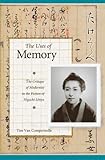
Timothy J. Van Compernolle. The Uses of Memory: The Critique of Modernity in the Fiction of Higuchi Ichiyo. Cambridge: Harvard University Press, 2006. xi + 258 pp. $39.95 (cloth), ISBN 978-0-674-02272-0.
Reviewed by Timothy Iles (Department of Pacific and Asian Studies, University of Victoria)
Published on H-Ideas (December, 2007)
Engaging the Past, Framing the Present: Modernity and Fiction
Timothy J. Van Compernolle sets himself an ambitious task when he attempts to place Higuchi Ichiyo (1872-96) "in the broader contexts of both modern institutions and the ideology of the modern" (p. 9). As Van Compernolle remarks on several occasions, Ichiyo is one of the most difficult of early modern Japan's women writers to situate not only within her own time but also within the evolving literary traditions of her country. This difficulty stems from factors both biographical and stylistic. It is to Van Compernolle's immense credit, however, that he acknowledges these difficulties and does an admirable job of overcoming them in his focused, insightful reading of Ichiyo's fiction.
Born just four years after the start of Japan's Meiji period (1868-1911), Ichiyo lived at a time of tremendous change. This period is conventionally known as the commencement of Japan's modern era, but this facile description in no way adequately describes the type of large-scale transitions Japan underwent, going from a primarily agrarian, isolated country to one of the world's most powerful colonial powers within forty short years. This description also fails adequately to describe the types of transitions that Japan's society underwent, going from a collection of individuals defined by their occupations, class, and clan affiliations, to a collection of individuals subjugated under the leadership of an emperor conceived of as divine. And, of course, this facile description does not begin to address the transformation of Japan's literature, accompanied, as it was, with a radical reassessment of the relationship between language and written expression. Changing technological, social, and political realities compelled Japan to re-evaluate its literary traditions, prompting many writers and intellectuals to advocate a complete re-creation of Japanese literature. Against this, however, we find a writer like Ichiyo, who remained, despite her popularity and critical appreciation, in many ways a marginalized figure, primarily for her gender, but also and more important for her insistence on writing in the forms and language of traditional literary output.
Van Compernolle wishes "to show especially that the Japanese literary tradition was for Ichiyo productive of new literary creation; the classical canon was a reservoir of tropes and paradigms that could be reshaped in an encounter with Japanese modernity" (p. 8). To do so, he engages a mature and reasoned analysis of Ichiyo's work, acknowledging that his agenda "can only be accomplished through a thoroughgoing critique of formalism" (p. 8). Van Compernolle aims for an understanding that "formal and linguistic design ... [is] inescapably intertwined with the surrounding social world" (p. 8). To achieve this goal, he centers his "study on the intersection of different kinds of discourse, and ... locate[s] the act of interpretation on the boundary between theme and rhetorical design, that is, between content and form" (p. 9). This brings both Van Compernolle and Ichiyo straight to the heart of the re-evaluation of Japanese modernity, which still presents itself as very much an active process.
As such, this monograph finds itself in good company. Several recent works that have continued the examination of Japan's experiments with modernity cover the issue from a variety of aspects, both methodological and thematic, but typically in broad terms. Such titles as Being Modern in Japan: Culture and Society from the 1910s to the 1930s, edited by Elise K. Tipton and John Clark (2000); Inexorable Modernity: Japan's Grappling with Modernity in the Arts, edited by Hiroshi Nara (2007); and Inventing the Classics: Modernity, National Identity, and Japanese Literature, edited by Haruo Shirane and Tomi Suzuki (2000) demonstrate the ways in which scholars are still attempting to conceptualize Japan's approach to the "modern." They also point to one of the drawbacks of the methods that many scholars take: their very breadth and generality prevent them from presenting compelling portraits of the ways in which individual intellectuals reacted to the types of changes taking place around them.
In his book, Van Compernolle avoids this by approaching one author who explicitly addressed the issue of transformation by presenting an "alternative path opened up to modern Japanese literature, a path that depend[ed] on the act of literary memory ... [and] the appropriation of the literary heritage in order to confront the present, with the consequent revision and renewal of the literary past in the process" (p. 15). This is an eminently sound approach to the problem of "revision and renewal," one which is not hampered by an insistence on a rigid theoretical dogmatism but rather is able to appreciate through textual criticism how Ichiyo's fiction "is best read as an appropriation of past literature in a hard-edged analysis of the human costs of modernization" (p. 15).
Van Compernolle structures his work around five chapters, each providing a close reading of one work by Ichiyo. This produces a focused and concentrated exploration not only of Ichiyo's characters, the "cast-aside figures of modernity" (p. 26), but also of her style and the intellectual content of her work (for example, the "theory of subjectivity" [p. 151] to be found in nascent form in one of her most important texts, Takekurabe [Child's Play], from 1896). This structure of analyzing one work within each chapter is fluid and rich, but also tantalizing; it leaves the reader wanting more, especially of Ichiyo's writing in the early and middle periods. The question of development hangs over this volume. I, for one, would have appreciated more discussion of the process through which Ichiyo went as an author to emerge, as Van Compernolle quite rightly describes her, as a writer who "takes part in the communal project of fashioning ... [fiction] into an instrument of social analysis and critique" (p. 26).
Another question that hangs over the work is one which Van Compernolle addresses but, again, at least to me, only tantalizingly. And this, of course, is the question of gender. Van Compernolle is quite right to read Ichiyo as "an inspiring pioneer to many women writers" (p. 15), and to argue that "a woman writer could take part in the process of transforming the nature of fiction through acts of literary memory" (pp. 23-24). However, Van Compernolle's study would have been aided by a greater consideration of the ways in which Ichiyo either represented or differed from other women writers in Meiji Japan. I certainly do not suggest that Van Compernolle should be recreating the type of work done by other scholars looking at Meiji women writers, who typically examine generalities across a handful of authors. There are several recent works that do this well and accomplish much along the way, such as Women Writers of Meiji and Taisho Japan: Their Lives, Works, and Critical Reception, 1868-1926 by Yukiko Tanaka (2000), Lost Leaves: Women Writers of Meiji Japan by Rebecca L. Copeland (2000), or Telling Lives: Women's Self-writing in Modern Japan, edited by Ronald P. Loftus (2004). Nonetheless, given Van Compernolle's goal of contextualization, it is not unreasonable to hope for more in this specific area.
Nonetheless, Van Compernolle's study is scholarly and polished, his analysis is provocative and insightful, and his writing style is highly readable. It is a very worthwhile engagement with a very worthwhile writer, and brings much to the ongoing discourse on Japanese modernity. The strengths of this study vastly outweigh its few weaknesses, making it a necessary addition to Japanese literary studies.
If there is additional discussion of this review, you may access it through the network, at: https://networks.h-net.org/h-ideas.
Citation:
Timothy Iles. Review of Compernolle, Timothy J. Van, The Uses of Memory: The Critique of Modernity in the Fiction of Higuchi Ichiyo.
H-Ideas, H-Net Reviews.
December, 2007.
URL: http://www.h-net.org/reviews/showrev.php?id=13936
Copyright © 2007 by H-Net, all rights reserved. H-Net permits the redistribution and reprinting of this work for nonprofit, educational purposes, with full and accurate attribution to the author, web location, date of publication, originating list, and H-Net: Humanities & Social Sciences Online. For any other proposed use, contact the Reviews editorial staff at hbooks@mail.h-net.org.

