



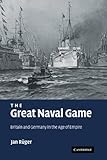
Jan Rüger. The Great Naval Game: Britain and Germany in the Age of Empire. Cambridge: Cambridge University Press, 2007. 356 S. $101.00 (cloth), ISBN 978-0-521-87576-9.
Reviewed by Jeremy Black (Department of History, University of Exeter)
Published on H-Albion (December, 2007)
Showing the Fleet
"The maintenance of naval supremacy is our whole foundation. Upon it stands not the Empire only, not merely the great commercial prosperity of our people, not merely a fine place in the world's affairs. Upon our naval supremacy stands our lives and the freedom we have guarded for nearly a thousand years." Winston Churchill's remarks, as First Lord of the Admiralty, at the Lord Mayor's Banquet on November 9, 1911 would have surprised few of his listeners. The sea and ships offered potent images of national mission and strength. Henry Newbolt's popular collections of poetry--Admirals All and Others Verses (1897) and The Island Race (1898)--linked maritime destiny with manly patriotism, as did Alfred, Lord Tennyson's The Revenge (1880). Rudyard Kipling in his Seven Seas (1896) and A Fleet in Being (1899) displayed a shift in interest away from India and towards a maritime concept of empire. Less poetically, over 2.5 million visitors thronged the naval exhibition on the Thames embankment in London in May to October 1891. Three years later, the Navy League was formed in order to orchestrate public pressure for naval strength.
This was part of the competitive navalism of the period, and Rüger, lecturer in history at Birkbeck College, London, is skillful in bringing out the navalism and the competition between Britain and Germany. He focuses on the rituals of fleet reviews and warship launches, and on discussing this staging of power in terms of the definition of national identity in a competitive forging. Thus, alongside practical points about naval development, this is a book about ritual, identity, and the imagination of "the other," one in which consumption, entertainment, and leisure are as significant and causative as government policy. Rüger indeed is particularly good at capturing the way in which the public celebration of the naval power was both forum and force for identity. As he points out, Charles Urban, one of the leading figures in the early British film industry, claimed in 1897 that naval topics ranked highly amongst the most popular subjects in cinematography, with pictures of "naval demonstrations" and the "launching of war vessels" in especially high demand. Cinema, like the press, helped ensure that such occasions could be seen by mass audiences, and helped to make them pubic occasions. Indeed, in 1911, Wilhelm II and the German naval leadership openly acknowledged the extent to which their fleet reviews had changed due to the influence of commercial and media forces, by giving a prominent role to press and pleasure boats.
In Britain, the staging of unity involved much reference to the notion of the island nation. The navy was presented as the natural boundary, spectacle,and defense for this nation. Rüger also shows how the naval stage played an important role in the construction of the empire, with fleet reviews, ship launches, and a range of other displays celebrating the navy as a symbol of imperial unity and strength. This naval staging of the empire expanded greatly from the 1880s, with an increasing frequency and scale of displays, their greater costs, and the transformation of old, and invention of new, ceremonies designed to foster imperial sentiment.
Rüger goes on to argue that this political theater was designed to display power and deterrence. He presents the Anglo-German antagonism as a dramatic game in which important culture issues were bound up with strategic and diplomatic developments. This is a profitable approach and this section is worthy of particular consideration. A lengthy epilogue discusses the fate of British fleet reviews from 1914. The pressures under which the theatre of naval power operated are discussed. More could have been made of the situation since the major fleet review of 1953. Hopefully Rüger will continue the subject in further work.
If there is additional discussion of this review, you may access it through the network, at: https://networks.h-net.org/h-albion.
Citation:
Jeremy Black. Review of Rüger, Jan, The Great Naval Game: Britain and Germany in the Age of Empire.
H-Albion, H-Net Reviews.
December, 2007.
URL: http://www.h-net.org/reviews/showrev.php?id=13931
Copyright © 2007 by H-Net, all rights reserved. H-Net permits the redistribution and reprinting of this work for nonprofit, educational purposes, with full and accurate attribution to the author, web location, date of publication, originating list, and H-Net: Humanities & Social Sciences Online. For any other proposed use, contact the Reviews editorial staff at hbooks@mail.h-net.org.

