



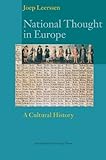
Joep Leerssen. National Thought in Europe: A Cultural History. Amsterdam: Amsterdam University Press, 2006. 312 pp. $32.50 (paper), ISBN 978-90-5356-956-6.
Reviewed by William F. Morris (Department of History, University of Illinois at Urbana-Champaign)
Published on H-German (November, 2007)
An Intellectual History Survey of Nationalism Masked as a Cultural History
The ambitious goal of Joep Leerssen's sprawling work is to provide "a cultural history of national thought in Europe" (p. 13). While Leerssen's book is more intellectual than cultural history, he nonetheless seems to have achieved his goal. His treatment of the concept of "nation" before the invention of nationalism is inspiring and his examination of the transition from democratic, enlightenment nationalism toward romantic "historicist" nationalism during the Napoleonic Wars is equally compelling, if far from unique. Sadly, however, Leerssen's argument loses force the further he delves into the nineteenth century. He quickly falls into the same "good nationalism" versus "bad nationalism" trap that he claims to abhor in his introduction. By the time his account reaches the First World War, Leerssen's treatment of national thought becomes one-sidedly pessimistic, and much of the comparative vigor and nuance that drove its earlier pages disappears.
First published as a survey handbook in Dutch in 1999, Leerssen's updated translation aims for a scholarly intervention beyond the undergraduate classroom. Reflecting its origins, the work largely reiterates a history of nationalism that will be familiar to any reader of Ernest Gellner, Eric Hobsbawm, or John Breuilly. Its introduction is a model of lucid prose, in which Leerssen succinctly, even brilliantly, outlines the bones of the historiography of nationalism in a scant twenty pages. The text proper begins by examining various "source traditions" in European and human history that prefigure national thought. After establishing this foreground, Leerssen pins the rise of modern nationalism to the Napoleonic years, when an enlightened, democratic nationalism briefly flowered under the French aegis. Napoleonic dictatorship, however, sparked a reaction not only among German intellectuals but also among intellectuals all over Europe, who developed a "romantic historicist" national tradition as a homegrown counter to French imperialism. In the second half of the nineteenth century, this second, "horizontal" brand of nationalism achieved dominance across Europe, resulting in nastiness, racism, and two world wars. For Leerssen, the twentieth century's history of atrocities constitutes the "aftermath" of the ascendance of xenophobic nationalism all over Europe in the late nineteenth century--a stain from which Leerssen does not believe nationalism can dissociate itself.
If Leerssen's organizational structure seems less than exciting, it is hardly his fault. He aims to write an introductory text to the study of nationalism and the historical contours of that study are quite simply well established. Whether the motivating force of the invention of nationalism was modernization, as Gellner has argued, or an awakening, of sorts, of older ethnic forms, as Anthony Smith contends, the time frame of that invention--roughly around the French Revolution--has never really been up for debate. Where Leerssen truly shines is not in his structure, but in his style. The book is quite simply a joy to read. "In order to understand nationalism and national thought in their own right, and not just as factors playing into a country's history," Leerssen maintains, "we must work comparatively and study various countries and cases" (p. 18). Throughout the book, Leerssen follows his own astute advice, drawing on his own extensive scholarly work to draw out telling examples from a wide range of locations, peoples, and languages. Indeed, Leerssen's work could be read as a study that gives insight on how to conduct comparative history correctly, because he consistently avoids cookie-cutter comparisons in favor of a more fluid, organic approach. His examples are always well chosen and detailed enough that he should avoid the ire of experts in the various national fields with which he dabbles--always a problem in comparative studies. The book is also amply illustrated, though here Leerssen's focus on text betrays him, as his readings of images are often short and halting. Even his long examination of the Völkertafel gracing the paperback's cover--a fascinating source by any estimation--could have been much fuller.
The primary strength of Leerssen's work lies in his analysis of intellectual trends. Since his goal is to "trace nationalism as something that emanates from the way people view and describe the world," linguists and philologists constitute his main subjects (p. 14). As a literary scholar, Leerssen is obviously most comfortable when dealing with these people and his examination of them is consistently superb. In particular, his portrayal of the years 1795 through 1815 when "the pressurized atmosphere of the Napoleonic Wars" created the necessary ingredients for imagining human society "as naturally divided into nations, each with their different culture and character, each deserving a separate nation-based sovereign, each commanding the overriding allegiance of their members" makes for convincing reading (p. 102). His portrayal of the German reaction to the French Revolution, from early enthusiasm to vehement hatred under the Napoleonic occupation, is quite engaging even if it is largely familiar. German turn-of-the-century scholars like Johann Gottfried Herder, Ernst Moritz Arndt, and Jakob Grimm essentially invented modern nationalism, according to Leerssen, and his portrayal of the way in which they "remedied ... the political crisis of the present ... with a cultural reflection on the enduring past" is at once detailed and accessible (p. 120).
An additional strength and an area in which Leerssen can rightly claim to be making somewhat of a new scholarly contribution, lies in his treatment of "source traditions." This mixed collection of folk tales and long-standing western traditions, running the gamut from medieval views of the wilderness to Charles Montesquieu's treatment of national spirits, constitutes the "root system" of national thought (p. 101). Leerssen's argument here is not new, but his framing is, for he effectively rescues the history of national thought before the advent of nationalism from the specter of Anthony Smith (whose argument that nations have pre-modern origins has long been disingenuously criticized). Whether describing how "national myths sprang up to glorify the manliness of primitive tribes" (p. 50) after the rediscovery of Publius Cornelius Tacitus, illuminating how eighteenth-century philosophers came "to see their character, their individuality, in those aspects in which they differ most from others" (p. 64), or showing how Jean-Jacques Rousseau and Emmanuel Joseph Sieyès posited "the nation" as a new form of legitimacy to counter France's decadent aristocracy and monarchy, Leerssen clearly illustrates the ways in which national thought became thinkable at all. Because he proceeds carefully with a keen eye for historical continuity, Leerssen's arguments on this topic are some of the most convincing and thought-provoking in the book. They do not smack at all of the "primordial ethnie" which has always made Smith's arguments unpalatable to the modernist consensus in nationalism research.
Although Leerssen's discussions of nationalism's great thinkers are usually detailed and engaging, they also constitute one of the work's greatest weaknesses. Through his almost exclusive focus on the likes of Walter Scott, Jakob Grimm, Count de Gobineau, and Ernst Renan, Leerssen belies his claim to see nationalism as "the way people view and describe the world" (p. 14). The "people" Leerssen refers to are essentially the elite, privileged few and his model of the spread of national thought is primarily a trickle-down one. Perhaps as a consequence, his treatment of the late nineteenth and twentieth centuries, an era defined by mass politics, seems lacking in comparison to his treatment of the eighteenth and early nineteenth centuries. Although a single chapter, entitled "The Nationalization of Culture," deals with more general forms of national spectacle, it seems a shame to relegate so many diverse elements of national identity formation--state rituals, renamed public streets, new museums and exhibits, new national currencies--to a mere twenty pages. While it was no doubt influential, one wonders whether Gobineau's view of humanity is any more important in the development of French national consciousness than required military service and shared national newspapers. The process through which peasants became Frenchmen, à la Eugen Weber, is almost entirely absent here. Being a keen scholar, Leerssen has already pre-built a defense against precisely this accusation, maintaining that his philologist subjects "were in large measure the go-betweens, the transmitting agents, from one sphere to the other" (p. 185). This might be so, but if Leerssen really wishes to write a "cultural history" of national thought in Europe, surely non-elite Europeans must be given a voice somehow.
In addition to neglecting "the people" in his work, Leerssen's treatment of the late nineteenth and twentieth centuries is overwhelmingly one-sided. The overriding story presented is one of things gone terribly wrong, as nationalism moves from a liberating ideology toward an oppressive, aggrandizing one. The early twentieth century amounts to no less than nationalism's darkest hour, as the "[r]omantic celebration of cultural difference, and the Revolution's assertion of popular sovereignty, moved into the authoritarian and corporatist extreme right of the political spectrum [and] became the driving force of the massed fanatics led by Mussolini, Hitler, and their imitators" (p. 218). Is the history of nationalism really so bleak? The Allied soldiers who fought and eventually defeated Adolf Hitler and Benito Mussolini's "massed fanatics" were often motivated by nationalism themselves. What of nationalism's other positive features, such as its roles in undergirding civic equality in democratic states or in inspiring anti-colonial resistance movements after World War II? Despite Leerssen's claim, those resistance movements were no less motivated by nationalism than their earlier European or Latin American counterparts. At the end of his book, Leerssen loses sight of nationalism's many-sidedness in a rush to paint the entire phenomenon with the black brush of fascism, a patent disservice to the carefully constructed, variegated arguments he presents earlier in the work.
This book stands out as an excellent intellectual history survey, crisply written and concise. While the work is likely to be of limited use to specialists, it would nonetheless be ideal as undergraduate reading and could easily become one of the assignments of choice for lower level courses on the history of nationalism.
If there is additional discussion of this review, you may access it through the network, at: https://networks.h-net.org/h-german.
Citation:
William F. Morris. Review of Leerssen, Joep, National Thought in Europe: A Cultural History.
H-German, H-Net Reviews.
November, 2007.
URL: http://www.h-net.org/reviews/showrev.php?id=13892
Copyright © 2007 by H-Net, all rights reserved. H-Net permits the redistribution and reprinting of this work for nonprofit, educational purposes, with full and accurate attribution to the author, web location, date of publication, originating list, and H-Net: Humanities & Social Sciences Online. For any other proposed use, contact the Reviews editorial staff at hbooks@mail.h-net.org.

