



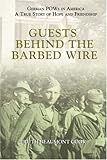
Ruth Beaumont Cook. Guests behind the Barbed Wire: German POWs in America, a True Story of Hope and Friendship. Birmingham: Crane Hill Publishers, 2006. 624 pp. $29.95 (paper), ISBN 978-1-57587-260-5.
Reviewed by Derek Mallett (Department of History, Texas A&M University)
Published on H-German (November, 2007)
The Importance of Local History
Chronicling the history of German prisoners of war in the United States during the Second World War began in earnest with Arnold Krammer's Nazi Prisoners of War in America (1979), an overview of American policy and treatment of German POWs across the United States. Subsequent scholars have analyzed the topic by focusing on a particular state, including state studies of Florida, Utah, Texas, and Missouri, or even of one particular camp. Ruth Beaumont Cook exemplifies this emphasis on local history by focusing solely on Camp Aliceville, Alabama, and its relationship with the residents of the Alabama town.
Cook begins with U.S. authorities surveying land for a suitable camp site in Pickens County, Alabama, and the rumors swirling around the town of Aliceville about what kind of prisoners would occupy this new camp. She proceeds to introduce many of the new camp employees that came to Aliceville, both military personnel and civilian contractors, and how they interacted with local residents. Cook notes the lively social scene that developed between the handsome young members of the American military guard units charged with watching the German POWs and the young ladies of Aliceville, who welcomed the attention from the exciting strangers in town. She goes on to discuss the economic impact of the camp, describing local business people, their relationships with the prisoners they hired to alleviate the local labor shortage, and the boon to the economy provided by the infusion of money into this small town of fifteen hundred residents.
The story then shifts to the North African desert, where Cook acquaints the reader with several of the German soldiers who would eventually find themselves prisoners in Aliceville's much-anticipated internment camp. She details their captures, their often traumatic Atlantic crossings, and their long train rides to west-central Alabama. Finally, after introducing so many of the characters and providing sufficient background, the prisoners arrive in Aliceville and Cook begins developing what becomes her central, if muted theme--the friendship that develops between citizens of two nations on opposite sides of the war and the hope such relationships inspire for avoiding future conflict.
Cook's argument differs little from that of most scholars who have analyzed America's World War II prisoner of war camps. The American authorities' strict adherence to Geneva Convention rules and the friendships this government policy fostered "through the barbed wire," so to speak, are not new ideas. The importance of Cook's work is the comprehensive local history that she provides. Her extensive use of oral history interviews to document the experiences of all the individuals she discusses is remarkable. Moreover, she weaves succinct but well-written explanations of the ongoing national and international issues and events of the Second World War with the numerous biographical sketches and discussions of local issues.
Guests behind the Barbed Wire does not, however, offer much to World War II or prisoner of war scholars. Cook provides a narrative history without much analysis of some key issues in this research area, which include questions about the extent of Nazi intimidation of other prisoners in the camp; the merit of the American policy of allowing German noncommissioned officers to discipline their own men; differences between new American guards and the original guard companies, which were transferred to Europe--specifically whether the new guards were "4-Fs"--those deemed unfit for combat duty, and if so, how this status affected the camps and guard/prisoner relationships. In chapter 13, entitled "Balloons and Perspectives," she lightheartedly relates the pranks of some German prisoners in the camp, a la Hogan's Heroes, while seemingly losing sight of the fact that by this point Camp Aliceville was housing only uncooperative NCO prisoners. How influential was Nazi ideology in the camp at this point in time?
In an otherwise exhaustively researched account, Cook also appears to have neglected most of the Camp Aliceville records from the National Archives in College Park, Maryland. Her use of the records of the Provost Marshall General's office is limited to copies of some camp inspection reports housed in the Aliceville Museum. The records in the National Archives include numerous other files from the PMGO (Record Group 389), as well as those from the Armed Services Forces (RG 160) and the War Department General Staff (RG 165).
Furthermore, at times the local details Cook provides reach the point of superfluity. I am not certain that providing the names of all eleven of the first team players for the 1943 Aliceville High School Yellow Jacket football team, the newly elected cheerleaders and drum majorette, details of Bobbie Kirksey's wedding dress, or the personal reminiscences of Mary Lu Turner Keef's fifth-grade gift exchange contributes to a story about German prisoners of war in Alabama. In fact, considering Cook's additional focus on wartime experiences of young men from Aliceville who fought in both the European and Pacific theaters, Guests Behind the Barbed Wire is more a history of Aliceville, Alabama, during the Second World War than it is a study of the Aliceville POW camp.
Ultimately, this book will interest readers with a general interest in World War II, as well as those particularly interested in prisoner of war experiences or Alabama history. Cook is a very good writer and certainly provides a very fluid, enjoyable book. It is superb as a chronicle of the history of World War II-era Aliceville, Alabama, and as a contribution to the overall record of German POW experiences in the United States during the Second World War.
If there is additional discussion of this review, you may access it through the network, at: https://networks.h-net.org/h-german.
Citation:
Derek Mallett. Review of Cook, Ruth Beaumont, Guests behind the Barbed Wire: German POWs in America, a True Story of Hope and Friendship.
H-German, H-Net Reviews.
November, 2007.
URL: http://www.h-net.org/reviews/showrev.php?id=13889
Copyright © 2007 by H-Net, all rights reserved. H-Net permits the redistribution and reprinting of this work for nonprofit, educational purposes, with full and accurate attribution to the author, web location, date of publication, originating list, and H-Net: Humanities & Social Sciences Online. For any other proposed use, contact the Reviews editorial staff at hbooks@mail.h-net.org.

