



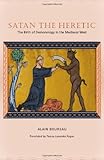
Alain Boureau. Satan the Heretic: The Birth of Demonology in the Medieval West. Chicago: University of Chicago Press, 2006. xi + 255 pp. $30.00 (cloth), ISBN 978-0-226-06748-3.
Reviewed by Sean L. Field (Department of History, University of Vermont)
Published on H-Catholic (November, 2007)
Lucifer's Liberation
Alain Boureau's Satan Heretique: Naissance de la demonologie dans l'Occident Medieval(1280-1330), first published by Editions Odile Jacob in 2004, is now available in an English translation prepared by Teresa Lavender Fagan. One of today's most important and prolific French medievalists, Boureau is probably best known to American audiences for The Myth of Pope Joan (French version 1988; English translation 2001) and The Lord's First Night: The Myth of the Droit de Cuissage (1995; translation 1998). As readers of these earlier works will know, Boureau is a master at pulling apart systems of belief, examining them from every angle, and then reassembling them in unexpected and illuminating ways. Those who have not perused his more recent (and untranslated) books, however, may be surprised by the deep knowledge of thirteenth-and fourteenth-century scholastic texts exhibited here.[1] Boureau's study of the "birth of demonology" demonstrates, above all, the importance of rummaging around in the world of scholastic argument. Seemingly arcane academic debates suggested new ways of seeing the world, brought new subjects to the forefront of intellectual discussion, and produced unforeseen and far-reaching consequences for European society.
Boureau's starting point is a consultation requested of ten theologians by Pope John XXII in 1320.[2] This was a crucial moment, because John sought a link between heresy, the invocation of demons, and reverencing the devil. Were those who invoked demons to be treated as heretics? Traditionally the church had accorded Satan only limited powers to fool the weak-minded. Indeed, in 1258 Alexander IV had expressly directed inquisitors not to concern themselves with the practice of magic and similar superstitions. John, therefore, was seeking to justify a new approach, one that ultimately led to learned belief in the witch's Sabbath, the emergence of witch-hunting in the 1430s, and two centuries of demonic obsession. Boureau shows that at least one of the pope's experts, the Franciscan Enrico del Carretto, constructed a new explanation for the effectiveness of sorcery carried out through the use of images baptized or hosts consecrated in the name of Satan. What is the cause of such an evil spell worked through an image? If it is surely not God, then is it the image itself? Or the Devil? Enrico argued for the latter, not because Satan is literally present in the image, but because he functions "as the signified in the sign" (p. 60). Normally, wrote Enrico, a sacrament is a sign directed towards God "that effects what it represents" (p. 61). But when a Christian sacrament, such as baptism, is redirected through devotion to the Devil, then the baptized image becomes the site of a pact with Satan that can, for instance, effect the death of the person represented by the image. This meant that an act such as sticking pins in a satanically baptized image could not just be treated as superstitious magic, because it necessarily implied worshipping the Devil and was thus by definition heretical and subject to the jurisdiction of future inquisitions.
Boureau, however, is not satisfied to leave his readers with a straightforward demonstration of the genesis of this new argument. What constellation of changes allowed this shift to take place? In answering this wider question, Boureau moves from linear explanation to contextual exploration, ranging far and wide across the intellectual landscape of the period he identifies as the "demonological turning point"--1280 to 1330. The links between each element are sometimes hazy, but the intention is to build up a cloud of causality, a cluster of changes that swirl around the image of satanic power, combine in unforeseen ways, and allow new formulations to coalesce. Thirteenth-century theologians, for instance, increasingly described the sacraments as pacts with God, just as political pacts and contractual associations became more prominent as social institutions and the battle between Boniface VIII and Philip IV spawned an obsession with conspiracies and evil pacts. Similarly, demons and exorcisms took on new significance in several of the canonization trials of the early fourteenth century while "discernment of spirits" debates formed around would-be saints such as Clare of Montefalco. Perhaps most significantly, in the late thirteenth century scholastic thinkers began to take demons and possession as privileged sites in which to debate questions about will, reason, and the nature of the human person. In several contexts Boureau returns to the tension between solutions supported by Thomas Aquinas and those favored by Franciscan neo-Augustinians, above all Peter of John Olivi (who emerges every more clearly from Boureau's work as the great intellectual innovator of the last decades of the thirteenth century). Where Thomas limited the freedom of demons, a Franciscan approach "liberated them from numerous constraints" (p. 101) and preserved their free will. Where Thomas argued on Aristotelian grounds for the unified personality (or substantial form) of each human being, Franciscans saw a plurality of forms fed erated together in every person. This debate, which Boureau traces via a fascinating intellectual history of the sleepwalker, enabled the argument that "certain people, through a supernatural exception, have a double or multiple personality" (p. 161), thereby opening up increased intellectual space for demonic possession. And as Peter of John Olivi's repeated presence in these debates illustrates, these abstract questions about demons could be mixed with Joachite expectations concerning the coming of anti-Christ and the necessary concomitant rise in demonic activity. Thus by 1320 fragile and fragmented human beings seemed more open to supernatural invasion, more pervasively surrounded by strong-willed demons, and more readily tempted by Satan than they had a half century earlier.
To some degree, Boureau's approach widens the gendered analysis offered by such scholars as Nancy Caciola and Dyan Elliot (both of whom he credits), who have tended to see similar changes adhering more strongly to churchmen's perceptions of women, and have suggested the subsequent links between these developments and the early witch hunts.[3] This gendered analysis has the benefit of being able to then follow the intervening rise of controversial female visionary-political figures such as Birgitta of Sweden, Catherine of Siena, and Joan of Arc, and the suspicions and backlash that their activities caused. Boureau, by contrast, is content with a brief hypothesis for why a whole century intervened between the "mutations" of 1280-1330 and the rise of witch-hunting in the 1430s: "the new demonology brought only plausible arguments and produced a complex and conditional statement...When the time of danger approaches, demons have a huge potential for destroying the Christian community through individuals who are sensitive to supernatural influence and are able to form themselves into heretical and avowed networks of accomplices of Satan" (p. 202). Moreover, popes had been reluctant to delegate too much power to inquisitors or others; only with the rise of the conciliar era were judicial campaigns launched that were effectively framed by these new ideas linking Satan to heresy.
Boureau's works are always challenging in their formulation and rarely linear in their development. Veteran translator Teresa Lavender Fagan has generally handled his dense prose well. There are a few slips; it is unfortunate that one is on the very first page, where the third sentence is put into the past tense rather then the present perfect and thereby implies that Boureau is discussing medieval "specialists on Thomas [Aquinas's] life," when it is modern scholars to whom he refers. And surely Bernard Silvestris was "one of the rare convinced Platonists" (platoniciens convaincus) of the twelfth century, not "one of the rare Platonists convinced of this period of rebirth" (p. 98). Nevertheless, Fagan and the University of Chicago Press have presented an attractive, engrossing translation, which will be well worth the time of anyone interested in medieval intellectual, religious, and cultural history, and to scholars interested in the papacy, witch-hunting, and Catholic mentalities more generally.
Notes
[1]. See in particular Theologie, science et censure au XIIIe siecle: le cas de Jean Peckham (Paris: Les Belles Lettres, 1999), and La religion de l'etat: La construction de la Republique etatique dans le discourse theologique de l'Occident medieval (1250-1340) (Paris: Les Belles Lettres, 2006).
[2]. Boureau has edited and annotated the complete consultation in Le Pape et les sorciers: Une consultation de Jean XXII sur la magie en 1320 (manuscrit B.A.V. Borghese 348) (Rome: Ecole Francaise de Rome, 2004). Some of the material from the introduction to this book is reused in chapter two of Satan the Heretic.
[3]. Nancy Caciola, Discerning Spirits: Divine and Demonic Possession in the Middle Ages (Ithaca, NY: Cornell University Press, 2003); Dyan Elliott Proving Woman: Female Spirituality and Inquisitional Culture in the Later Middle Ages (Princeton: Princeton University Press, 2004).
If there is additional discussion of this review, you may access it through the network, at: https://networks.h-net.org/h-catholic.
Citation:
Sean L. Field. Review of Boureau, Alain, Satan the Heretic: The Birth of Demonology in the Medieval West.
H-Catholic, H-Net Reviews.
November, 2007.
URL: http://www.h-net.org/reviews/showrev.php?id=13884
Copyright © 2007 by H-Net, all rights reserved. H-Net permits the redistribution and reprinting of this work for nonprofit, educational purposes, with full and accurate attribution to the author, web location, date of publication, originating list, and H-Net: Humanities & Social Sciences Online. For any other proposed use, contact the Reviews editorial staff at hbooks@mail.h-net.org.

