



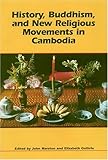
John Marston, Elizabeth Guthrie, eds. History, Buddhism, and New Religious Movements in Cambodia. Honolulu: University of Hawaii Press, 2004. 272 pp. $25.00 (paper), ISBN 978-0-8248-2868-4; $60.00 (cloth), ISBN 978-0-8248-2666-6.
Reviewed by Erik Davis (Religious Studies Department, Macalester College)
Published on H-Buddhism (November, 2007)
It used to be a common misperception that Cambodia had no history outside of the supposedly "Indianized" civilization of Angkor and the European colonial modernity imposed by the French. It was assumed that without these gifts of history from outside, Cambodia would have stagnated. Models of the past therefore treated the period between the end of Angkor and the beginning of the French Protectorate as a "Dark Age," a period underlining the notion that there was nothing essentially Cambodian about the Cambodian past. The presumed dark age of Cambodia was mirrored by a dark age in foreign studies of Cambodia, the latter a result of the thirty-year civil war and the geopolitical battles that discouraged fieldwork, if not actively punishing it. This edited volume, History, Buddhism, and New Religious Movements in Cambodia, helps to rectify this situation.
Earlier there was a lack of scholarship in Cambodian religion--whatever existed was usually written in French, or depicted Cambodian Buddhism as a degenerate or heretical religion. Cambodian religion was seen as being interesting mostly for its deviations from South Asian authenticity (for instance, see the works of F. Bizot). With the recent publication of several excellent works on Cambodian religion (e.g., works by Penny Edwards, Anne Hansen, and Ian Harris), that gap too has begun to be filled. History, Buddhism, and New Religious Movements in Cambodia contains ten essays, which are sometimes uncomfortably heterogeneous, a fact that is perhaps due to the enormous void they are attempting to fill. One vital theme runs through all the essays: religion is not merely a shadow of Cambodia's history, but possibly its matrix. The book is, as Ashley Thompson writes in the first chapter, "about history in the making, when the object of historical study is also in the process of 'doing' history" (p. 13).
The book is organized into four sections. The first, "Cambodian Religion and the Historical Construction of the Nation," includes three uniformly excellent essays. The first, by Thompson, makes short work of the notion of a static Cambodian dark age and focuses on the national unification accomplished under the reign of sixteenth-century king Ang Chan. It was he, according to Thompson, who mobilized the symbolism of Maitreya, the Buddha of the future, to conjure past glory as a legitimate inheritance, and future greatness as a promise. The temporal dimension of this promise was symbolized in the funerary monument of the st?pa.
Anne Hansen's essay on the relationship of Khmer identity and Therav?da focuses closely on the institution of the Buddhist Institute in Cambodia. She tracks the path of early Cambodian nationalism, and the cultural creativity unleashed by the coincidence of religious and national concerns. She demonstrates that the connection between Khmer nationalism and Buddhism is neither merely invented--for it draws on real histories and traditions--nor a function of an eternal or essential relation, for it was forged in an identifiable and institutional crucible at a particular point in history.
The first section ends with Penny Edwards's essay. Where Hansen concentrates on the production of a particular form of nationalism, Edwards concentrates on the concept of the nation as "an intellectual and conceptual framework through which certain members of the sangha were able to synergize the disenchanting projects of modernity with their visions for the moral rectification of Khmer Buddhism" (p. 66). While these latter two authors have published full-length treatments of the same material, which should be read by anyone interested in the subject matter, these articles continue to provide a welcome and brief introduction to the arguments, and could be very profitably used in university-level courses.
The second section, which deals solely with the "Icon of the Leper King," an enigmatic figure of worship and kingship, stands apart somewhat uncomfortably from the rest of the book. Originally conceived as a single co-authored article, the two essays in this section were eventually split apart. Thompson's second essay here breathes in European scholarship on the "king's two bodies" and Foucault's theories of government to examine inscriptions and representations of the leper king as an icon of national and personal healing. The connection to contemporary kingship at the end of this chapter will undoubtedly inspire further studies. Hang Chan Sophea's more ethnographic study of the cult of Yay Deb is less successful, but nevertheless serves as an interesting counterpoint since it proposes Yay Deb as a sort of Cambodian queen to the Leper King's king.
The third section, "The Ethnography of Contemporary Cambodian Religion," begins with Elizabeth Guthrie's work on contemporary female ascetics, called Tun Ji. This is a welcome addition to the ethnography of women's special religious practices, but is somewhat marred by its frame, which posits a supposed decline in gender equality that is not, to my knowledge, supported by the current state of knowledge on the topic.
Didier Bertrand's piece contributes to our understanding of the way in which culturally embedded concepts of power are produced through a sort of dual mediumship, both between spirits and humans, and between Buddhist and non-Buddhist practices. He demonstrates the guiding influence of Buddhist norms even in the most non-Buddhist practices, without subsuming the latter to the former (p. 165).
Finally, Marston's excellent piece deals with a lay ascetic who claimed to be able to transform objects into purified stone or metal, through ascetic powers gained in forest meditation. Marston places this ascetic's practice in the context of social change (it flourished in the period surrounding the UN Transitional Authority in Cambodia), but also demonstrates how the beliefs the ascetic drew on were rooted in conceptions of a broader and more durable type.
Marston's essay also serves as a useful transition to the final section, "The Transnationalism of Cambodian Religion." This is one of the few areas that had engaged sustained scholarly attention prior to the 1990s, due largely to the relative accessibility of these populations compared to Cambodians living in Cambodia (for instance, Ebihara et al. 1994). Still, these two pieces do not retread old territory.
Kathryn Poethig's contribution on the Dhammayatra describes the "Dharma Walks" organized annually by recently deceased monk Maha Ghosananda, an event she characterizes as transnational both because of Ghosananda's residence in the United States, and because of its intersection with the transnational concerns of the Engaged Buddhist movement.
Terri Yamada's article breathes fresh air into the study of transnational Cambodian Buddhism. She insists on returning an analysis of power to rituals of healing, showing that a ritual in Long Beach, California, intended to heal a communal rift among Khmer-Americans there, was also imbricated with the "political aspirations, politics, and personal spiritual life" of the person who organized it (p. 220).
Edited volumes tend to suffer from a tendency toward a fracturing of focus and a certain topical heterogeneity, and this volume is no different. The editors could perhaps have brought about a greater degree of focus. However, History, Buddhism, and New Religious Movements in Cambodia offers multiple and novel glimpses into Cambodian religion, bringing new methods to discussions, and unveiling periods and intersections that have been characterized as "dark" for too long. This collection of essays can be used successfully for courses in Buddhism in Southeast Asia.
If there is additional discussion of this review, you may access it through the network, at: https://networks.h-net.org/h-buddhism.
Citation:
Erik Davis. Review of Marston, John; Guthrie, Elizabeth, eds., History, Buddhism, and New Religious Movements in Cambodia.
H-Buddhism, H-Net Reviews.
November, 2007.
URL: http://www.h-net.org/reviews/showrev.php?id=13877
Copyright © 2007 by H-Net, all rights reserved. H-Net permits the redistribution and reprinting of this work for nonprofit, educational purposes, with full and accurate attribution to the author, web location, date of publication, originating list, and H-Net: Humanities & Social Sciences Online. For any other proposed use, contact the Reviews editorial staff at hbooks@mail.h-net.org.

