



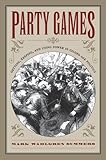
Mark Wahlgren Summers. Party Games: Getting, Keeping, and Using Power in Gilded Age Politics. Chapel Hill: University of North Carolina Press, 2004. xiv + 352 pp. $27.50 (paper), ISBN 978-0-8078-5537-9; $70.00 (cloth), ISBN 978-0-8078-2862-5.
Reviewed by Gillis Harp (Department of History, Grove City College)
Published on H-SHGAPE (November, 2007)
The Party's Over
The political culture of Gilded Age America was so different in many respects from our own day that accounts of it often take on an almost surreal character. The sheer intensity of partisanship and the popular frenzy of campaigns appear strange to twenty-first-century readers. It is difficult for many today to relate to Terrence V. Powderly's complaint that if a particular campaign had continued any longer, "I believe every man, woman, and child in the country would be stark, staring mad" (p. 5). Mark Wahlgren Summers's Party Games: Getting, Keeping, and Using Power in Gilded Age Politics is an insightful and extensively researched exploration of this foreign world of Gilded Age politics.
Summers divides his subject's historiography into two broad interpretive schools: popularizers (such as Matthew Josephson and Ray Ginger), who highlight the corruption of the era, and academic historians (including Joel Silbey and Michael McGerr, among others), who celebrate the grass roots, mass-participatory character of the political system and the negative consequences of reform. Summers concludes that both sides neglect one critical point: "In the last analysis, it was the politicians who owned the [political] system, shaped it to serve their own party needs, and did what they could to keep trespassers off" (p. x). Accordingly, this monograph explores how politicos drove "as many voters to the polls as possible ... and how that affected the shape of Gilded Age politics and set limits on the possibilities for change" (p. xii). Beginning with the memorably nasty presidential contest of 1888, the author shows how the excitement and frenetic activity of the campaign was also carefully directed by party leaders into channels deemed most politically advantageous. Partisanship was based in part on the deep beliefs that the two parties' constituents had nurtured for decades. While Republicans understood themselves as the party of "ordered progress," Democrats championed individual liberty. Negative reference group voting further intensified these positive partisan identities. Like the armies they were often compared to, the major parties required "organization, discipline and aggression" to win at the polls (p. 34). The real test of discipline and verve (so evident in the campaign parades of the period) came on election day when managers made certain that partisanship translated into tangible ballots cast. Yet fervent partisanship did not necessarily produce effective government by those elected. Summers maintains that this "culture of partisanship" helped make politicians ineffective at actually governing (p. 49).
Party newspapers played a critical role in cultivating a mass following and promoting strong partisanship; they bolstered the two-party system and helped to marginalize alternatives. Editors often chose not to cover third party candidates or ignored their platforms. Political outsiders were portrayed either as deadbeats, cranks, or failures. Meanwhile, vote buying was a more direct and unethical way of manipulating the electorate, but one that enjoyed considerable acceptance in most sections of the country. Here, Summers recognizes that historians face a quandary. Their sources (especially a thoroughly partisan press) probably exaggerated the practice. But it clearly was widespread, even if it may not have changed the final outcome dramatically. As the 1880s dawned, both genteel reformers and white supremacists sought to disfranchise certain voting groups, with the most violent manipulation and intimidation taking place in the South. Party Games chronicles how malapportionment and gerrymandering in many states produced one-party domination in particular regions and nearly debarred third party efforts entirely.
Summers contends that many historians have not accurately understood the political influence of money in general and of corporate interests in particular. At first glance, the dollar amounts the parties raised for state and national campaigns seem to have been relatively small, but the decentralized federal system makes an overall assessment difficult. "Contributions came from business men, more than from businesses," notes Summers (p. 148). The former often had political aspirations and sought simply to advance their personal interests, rather than some generic corporate advantage. The railroads were the most notorious in using money for political purposes. Nevertheless, while they definitely influenced policy, their influence was circumscribed by the larger political system. It was politically advantageous for party leaders periodically to heed the popular outcry against railroad monopolists "out in the open, where voters were paying attention, the mainstream parties were too dependent on their constituents to be relied on by any one set of corporate interests" (p. 174).
The structures and habits of the American party system conspired to make a third party challenge difficult, if not impossible. "Outsider movements" did prompt the two major parties to address some class-based issues (p. 176). For their part, Republicans (like their Whig forebears) stressed the need for inter-class cooperation, while the Democrats usually were more candid about the unavoidable nature of class divisions. The parties often simplistically attributed class conflict to protective tariffs or unrestricted immigration, though many party spokesmen appear to have made the argument from sincere convictions. Meanwhile, working class voters did not view the cultural concerns of the traditional parties as peripheral distractions, but rather as genuine priorities with concrete policy implications. The author maintains that American workers managed to shape party positions, since many politicians were genuinely concerned not to alienate urban labor, at least not overtly.
Summers concludes that "neither businessmen nor idealists [i.e. reformers] controlled the political system," but that "politicians owned and dominated it," employing their considerable power to shape "it to suit themselves" (p. 229). The complex reality of two-party politics helps to explain the spectacular rise and collapse of the Populists at the close of the century. Many a potential Populist decided to stick with his traditional party because of its offer of strategic concessions and the potential to exploit its institutional advantages. "Unable to make policy or control the debate, unable to promise spoils or the emotional rush of victory," Summers observes, "Populism came out of the 1896 election an emotional wreck" (p. 273). The system worked well but, despite enviably high levels of voter participation, it mainly benefited the professional politicians who ran it.
Party Games provides a cleverly written and impressively researched analysis of the rich panoply of Gilded Age politics. Given the book's emphasis on how party elites shaped the political system to serve their interests, it might have benefited from a greater engagement with political scientists who explore how parties function. In the tradition of elite theory, Denise Baer and David Bositis's Elite Cadres and Party Coalitions (1988) comes to mind, as does Joseph Schlesinger's Political Parties and the Winning of Office (1994) in the rational choice school. Further, Summers's handling of the nature and role of republican ideology is not always satisfying. For instance, when discussing the parties' penchant for conspiratorial thinking and hysterical warnings about the republic's imminent demise, more attention might have been paid to the deep historical roots of such language in the American republican tradition. Although the author aptly describes the "force of fear" in Gilded Age politics, he rarely traces its descent from the republican discourse of the Revolutionary, Early National or Jacksonian eras.
Party Games remains, nevertheless, a fresh, perceptive and well-documented exploration of an important subject that will help readers make much better sense of the alien planet of Gilded Age political life.
If there is additional discussion of this review, you may access it through the network, at: https://networks.h-net.org/h-shgape.
Citation:
Gillis Harp. Review of Summers, Mark Wahlgren, Party Games: Getting, Keeping, and Using Power in Gilded Age Politics.
H-SHGAPE, H-Net Reviews.
November, 2007.
URL: http://www.h-net.org/reviews/showrev.php?id=13870
Copyright © 2007 by H-Net, all rights reserved. H-Net permits the redistribution and reprinting of this work for nonprofit, educational purposes, with full and accurate attribution to the author, web location, date of publication, originating list, and H-Net: Humanities & Social Sciences Online. For any other proposed use, contact the Reviews editorial staff at hbooks@mail.h-net.org.

