



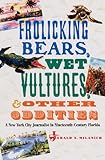
Jerald T. Milanich, ed. Frolicking Bears, Wet Vultures, and Other Oddities: A New York City Journalist in Nineteenth-Century Florida. Gainsville: University Press of Florida, 2005. 320 pp. $24.95 (cloth), ISBN 978-0-8130-2848-4.
Reviewed by Gene Costain (Department of Communication, University of Tampa)
Published on Jhistory (November, 2007)
Let me start with a minor quibble about Frolicking Bears, Wet Vultures, and Other Oddities. In my view, the title is a poor anchor for this superb sampling of nineteenth-century journalism. Later on, we do encounter the wet vultures and bears, but they are not central to the main theme. The book redeems itself with its subtitle: A New York City Journalist in Nineteenth-Century Florida. This book is all about the twenty articles that Amos Jay Cummings wrote about life in Florida between 1873 and 1893. Long before the former New York politician and war hero covered these eccentrics, he was a disciplined and accomplished journalist in many other areas. This book is like a Russian doll, with a story within a story, satisfying in that way because we get the key background information leading off each chapter, which sets up his laconic articles so well. It is also clear that his journalism is always the key attraction.
The book's editor, Florida archeologist Jerald T. Milanich, reprints Cummings's articles and adds his own cogent introductions and contextual material. Cummings writes about eccentric gator hunters, ferocious local politics, and the indefatigable citrus grove farmers. He brought intelligence and verve to being a sharp social observer, probably because he was also a former politician, Civil War veteran, adventurer, and humanist.
In the first chapter ("Florida's Orange Groves"), Cummings writes about a mélange of ethnicities and provides a demographic roll call unique to old Florida. He looks at a rugged people who developed the orange groves. Here he writes a passage about their wretched poverty and the sartorial habits of one memorable character: "When he was out of clothing he made a pair of breeches out of corn sacking. For a shirt he cut out three holes near the bottom of a corn sack, and ran his head and arms through the holes. He lived and died without eating a beefsteak, drinking a glass of lager, or handling a shirt collar" (p. 34).
Another survival technique for early Floridians was salvaging assorted goods from the ships that frequently sank just off of the coast. These people were called "wreckers" and were very active off what is now known as the Space Coast in central Florida. The shipwrecked goods were an integral part of survival and a major market for a variety of valuable materials. Cummings points out that it was well known at the time that most of the domestic pets, the state's first cats and dogs, were the wind-soaked survivors of these shipwrecks (pp. 45-46).
As a fascinating footnote on the animals, a few marooned pets also became a key part of a gator hunter's tool kit. Cummings tells a few harrowing tales related to the many alligator hunters in the state. The reporter also pointed out that unlucky stray dogs and ducks became the favorite meal of the indiscriminate and self-serving alligators. A good hunter used that information to his advantage by draping his own dog over the saddle while on a gator hunt. One key passage Cummings recorded dealt with the average alligator's rather passive habit of accumulating a high-protein meal: "The monster opens his enormous mouth and keeps his jaws apart until the inside of his mouth is black with the insects. Then he brings his jaws together with a snap, he runs his tongue around inside his mouth and swallows his winged visitors. He will keep this up until his appetite is satiated" (p. 56).
The intrepid Cummings worked hard at depicting a world of misfits and tropical malcontents. He was both enamored and repelled by what he witnessed, but wanted to avoid the vapid Chamber of Commerce view that was starting to be prevalent in the era's books about Florida. One of his observations would gladden the heart of a modern-day environmentalist. Cumming's argued more than a hundred years ago that an environmental civil war was being waged in Florida. The journalist was stunned at the carnage and wanton introduction of incompatible plant life to the state.
He also writes about the violent urban political scene, quite often a place of Darwinian struggle over scarce resources that might have shocked a Tammany Hall politician further north. Cummings takes us well beyond the rustic dreams often promoted in the era's sanguine promotional books, and in doing so provides his readers with a clear-eyed exposure to the painful machinations of Reconstruction. Horace Greeley, Cummings's former New York Tribune boss, said that Cummings was one of the best journalists of his period. That did not stop Greeley from firing the reporter over some misdeed during his tenure.
This collection is a marvelous way to examine journalism as it was practiced in the nineteenth century. It also provides the researcher with a glimpse of how big issues like Reconstruction were handled when they were dealt with by a journalist who was at the top of his profession.
If there is additional discussion of this review, you may access it through the network, at: https://networks.h-net.org/jhistory.
Citation:
Gene Costain. Review of Milanich, Jerald T., ed., Frolicking Bears, Wet Vultures, and Other Oddities: A New York City Journalist in Nineteenth-Century Florida.
Jhistory, H-Net Reviews.
November, 2007.
URL: http://www.h-net.org/reviews/showrev.php?id=13817
Copyright © 2007 by H-Net, all rights reserved. H-Net permits the redistribution and reprinting of this work for nonprofit, educational purposes, with full and accurate attribution to the author, web location, date of publication, originating list, and H-Net: Humanities & Social Sciences Online. For any other proposed use, contact the Reviews editorial staff at hbooks@mail.h-net.org.

