



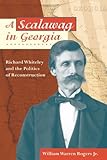
William Warren Rogers, Jr. A Scalawag in Georgia: Richard Whiteley and the Politics of Reconstruction. Urbana and Chicago: University of Illinois Press, 2007. x + 269 pp. $40.00 (cloth), ISBN 978-0-252-03160-1.
Reviewed by J. Michael Martinez (Department of Political Science and International Affairs, Kennesaw State University)
Published on H-CivWar (November, 2007)
Richard Henry Whiteley is not widely known today, even among students of Reconstruction in American history (1865-77). Yet, in his time and place, he was that rarity in Southern politics: a Georgia man who had served the Confederate cause during the Civil War only to embrace Union ideals after the cessation of armed hostilities. Political scientist V. O. Key Jr. once remarked that in "its grand outlines the politics of the South revolves around the position of the Negro."[1] Whiteley recognized this axiom long before Key's time, and he lamented the fixed social position of the races. Accordingly, he sought to replace antipathy toward blacks with a commitment to equal opportunity. That he failed says less about his commitment to the American creed than it does about the turbulence of his times.
Even before Reconstruction, Whiteley was an unusual man who had overcome long odds to fashion a professional life in his southwest Georgia community. The Irish immigrant-turned-Southern-gentleman became a lawyer during the antebellum era, no mean feat for a foreigner who had been a naturalized citizen for less than one decade. Before passing the bar, he moved to Bainbridge, Georgia, a small town 240 miles west of Savannah, where he enjoyed a successful legal career and immersed himself in politics. He accomplished much during his fifty-nine years, but perhaps his most important role was as a Southern Republican congressman during Reconstruction.
According to William Warren Rogers Jr., a professor of history at Gainesville State College and author of A Scalawag in Georgia, Whiteley's career was emblematic of the sad fate awaiting Southern Unionists in the 1860s and 1870s, when they were denounced as "scalawags," an epithet linked to the little town of Scalloway in the Shetland Islands infamous for its scrubby, poor quality cattle. The well-known Reconstruction historian Eric Foner has written that many white Southerners viewed scalawags as "the local leper of the community" and castigated them as "'white negroes' who had betrayed their region in the quest for office."[2]
Born in northern Ireland on December 22, 1830, the future scalawag was six years old when his family set sail for Charleston, South Carolina, in 1837. Whiteley grew up near Augusta, Georgia, working in the textile mills and displaying a "disciplined drive and keen intelligence" that caught the eye of John Schley, scion of a prominent Georgia clan. Schley, who Rogers labels an "unpretentious aristocrat," taught his young ward much about the business world and undoubtedly influenced the development of Whiteley's strong work ethic and his openness to new people and ideas (p. 7).
By the late 1840s, Whiteley was ready to step into the adult world and make his way in business and politics. On November 29, 1849, one month shy of his nineteenth birthday, he married Margaret Eliza Devine of Greensborough, Georgia, another Irish immigrant. The couple eventually produced ten children; tragically, only five survived childhood.
Never one to succumb to melancholy, Whiteley swore his citizenship oath in Athens, Georgia, on February 8, 1854, and moved to southwest Georgia the following year. Although he knew much about textiles, the ambitious young fellow decided that studying law was the surest way to earn a good name and ensure financial solvency, both of which were important to a self-made man. After passing the oral examination to be admitted to the bar in 1860, he began practicing law and took his place as a community leader.
While Whiteley struggled to establish a prosperous legal practice, national events deteriorated rapidly. He considered himself a moderate, fearing that secession would come to no good end, but he could not turn his back on his adopted region when war erupted in spring 1861. He enlisted in the First Georgia Infantry Regiment and served with Hardee's Rifles, a company named for a well-known Georgia military leader, William J. Hardee. The company later was mustered into the Fifth Georgia Infantry Regiment and served in Pensacola, Florida, as well as in many places along the Trans-Mississippi. As the war progressed, Whiteley saw fighting at Shiloh, Perryville, and Murfreesboro. He eventually won a promotion to major (a title that would stay with him into the postwar years) and served as the ranking officer of the Second Georgia Sharpshooters Battalion. In May 1865, following the Confederate surrender, the major was paroled in North Carolina.
Despite his service to the Confederate States of America, Whiteley was not embittered by Appomattox. Recognizing that the South had lost and secession was no longer a viable option, he desired nothing so much as to repair the wounds of war by promoting commerce in southwest Georgia, a rural area suffering from a poor, depressed economy. To promote economic recovery, he pushed for the extension of the Atlantic and Gulf Railroad to Bainbridge.
From 1868 to 1876, he campaigned for Congress five times, ultimately serving in the United States House of Representatives for five years during the 1870s. He was a Republican in a state populated by numerous unreconstructed Confederates fearful of Republican military rule and overtly hostile to efforts to elevate the black race. Whiteley recognized, as did many of his Republican brethren, that the South could recover from the war rapidly if political leaders focused more attention on improving the economy and less attention on subjugating former slaves. As Rogers observes, "Whiteley's was a persistent but increasingly isolated voice. At one point, he asked: 'Are we not one people?' The answer, for the time being, was a resounding no" (p. 211).
During the 1860s and 1870s, many white Southerners were still reeling from their defeat. Humiliated by the loss and resentful that newly emancipated slaves--"freedmen," in the parlance of the day--walked the streets and no longer seemed to know their place in the region's rigid caste system, whites longed for the end of federal occupation so the rightful order of Southern life could be restored. If freedmen were too uppity and Northern interlopers, derisively labeled "carpetbaggers," were anathema, worst of all was the white Southerner who betrayed race and region by embracing the reconstituted Union and its attendant social egalitarianism. Like most scalawags, Whiteley found himself increasingly marginalized as the nation grew tired of enforcing harsh Reconstruction policies. By 1874, he had lost virtually all political support in Georgia as well as his seat in Congress. Despite a spirited campaign two years later, Whiteley never returned to Washington, D.C., as a national officeholder. He spent his twilight years living in Colorado and apparently suffering through what today would be labeled a nervous breakdown. Whiteley had fathered an illegitimate child earlier in his life, but to most observers his long marriage to his wife seemed secure. That changed during the summer of 1884 when Margaret, suspecting her husband was involved in an affair, confronted him and his mistress, Mollie Strickland. Whiteley's reaction to his wife's confrontation exacerbated the scandal. He knocked Margaret to the ground repeatedly; apparently, it was not the first time he had battered her during their decades together. Local gossip increased after Margaret filed for divorce and Whiteley married his mistress within hours of the decree.
That Whiteley never fully recovered his reputation from his domestic meltdown is not in question. As Rogers notes, however, "Whiteley's significance lies in the part he played in politics after the Civil War" (p. 210). Rogers is correct to the extent that A Scalawag in Georgia recounts the major's life and times, and places them in the broader context of Reconstruction politics. The book provides needed insight into the difficulties encountered by a Southern man who harbored Northern sensibilities. Unfortunately, the chapters that deal with Whiteley's life and times after he left Congress and landed out West, while perhaps intriguing for aficionados of nineteenth-century biographies, detract from the discussion of Reconstruction. The work would have been more interesting for the casual reader if the emphasis had remained on Whiteley and his importance as an exemplar of the scalawag politician rather than his post-1875 triumphs and peccadilloes.
Nonetheless, despite this criticism, A Scalawag in Georgia presents an interesting window into the world of Reconstruction as seen through the prism of a Southern Unionist. It is a little book about a little man, who played a little, but integral, role in a much larger story--the story of America's painful rebirth of freedom.
Notes
[1]. V. O. Key Jr., Southern Politics in State and Nation (New York: Knopf, 1949), 5.
[2]. Eric Foner, Reconstruction: America's Unfinished Revolution, 1863-1877 (New York: Francis Parkman Prize Edition, History Book Club, 2005), 297.
If there is additional discussion of this review, you may access it through the network, at: https://networks.h-net.org/h-civwar.
Citation:
J. Michael Martinez. Review of Rogers, William Warren, Jr., A Scalawag in Georgia: Richard Whiteley and the Politics of Reconstruction.
H-CivWar, H-Net Reviews.
November, 2007.
URL: http://www.h-net.org/reviews/showrev.php?id=13809
Copyright © 2007 by H-Net, all rights reserved. H-Net permits the redistribution and reprinting of this work for nonprofit, educational purposes, with full and accurate attribution to the author, web location, date of publication, originating list, and H-Net: Humanities & Social Sciences Online. For any other proposed use, contact the Reviews editorial staff at hbooks@mail.h-net.org.

