



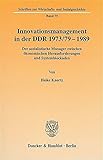
Heike Knortz. Innovationsmanagement in der DDR 1973/79-1989: Der sozialistische Manager zwischen ökonomischen Herausforderungen und Systemblockaden. Berlin: Duncker & Humblot, 2004. 288 S. EUR 72. 00 (cloth), ISBN 978-3-428-11459-7.
Reviewed by Timothy Dowling (Department of History, Virginia Military Institute)
Published on H-German (October, 2007)
An Imperfect Storm
Reading Heike Knortz's slim volume on innovation management in the German Democratic Republic (GDR) is like experiencing a hurricane. Early warning signs suggest that it could be a rough ride and indeed, much of the early going is a struggle to stay upright. In the center, however, in a calm, almost beautiful space, everything suddenly seems clear. Then a final, much weaker flurry darkens the skies again, leaving everything damp and confused.
The warning signs are that this is a work concerning the economic history of the GDR--a field fraught with ambiguity--and that it is Knortz's Habilitationsschrift. This combination makes the first seventy-five pages dense and difficult for anyone not expert in both economic theory and the history of the GDR. Knortz provides a brief grounding in theories of management and property rights that will be of little use to anyone not specialized in these topics. The language is virtually impenetrable, and the charts and tables Knortz supplies make little sense. Almost half of every page, moreover, is taken up with citations from sources ranging from Joseph Schumpeter to Vladimir Lenin, which the reader is asked to compare with what Knortz has written. While this may have been necessary for the academic degree, it adds little or nothing to the work as a whole.
Things pick up, however, when Knortz finally gets to her real subject. Interesting information on the effects of the 1973 oil crisis on the economy of the GDR leads naturally into the discussion of Petrochemicalkombinat Schwedt, where managers sought to alleviate the productivity problem through innovation. Though Knortz does not provide a great deal in the way of analysis, there is not much need for it; this is truly one case where "the facts speak for themselves." Knortz has done an excellent job of sifting through SED and Kombinat archives to present a clear picture of not only what happened "on the ground," but also of the rationale behind it. The story is easily recognizable in outline to anyone possessing even a passing familiarity with socialist planned economies: a perfectly good theory is applied wholesale to a real-life situation, and the results are less than perfect.
Knortz takes the reader through the irrational "rationalization" of the work force at PCK Schwedt systematically, in simple and direct language, with brilliant results. Even a non-economist can see how ideology affects decision-making, how plans conflict with human nature, and how these factors combine to send even the best-laid plans down blind alleys. Without invoking either sarcasm or pity, Knortz exposes the shortcomings of management at all levels of the enterprise through her selection of documents and facts. In this section, moreover, the charts, tables, and graphs Knortz provides do serve as visual aids, making clear any trends and results that might still be obfuscated in management jargon.
Sadly, though, the final section once again lapses into vagaries and uncertainty. Knortz successfully demonstrates that while the rationalization process was eventually successful at PCK Schwedt, success did not transfer to other plants and industries in the GDR. Little analysis is offered as to why this transfer failed, or why the success at Schwedt was significant. After many dense and footnote-laden pages discussing the interplay between politics and management, Knortz serves up some rather unsophisticated conclusions: "Immerhin scheiterten nämlich Prozessinnovationen nicht an den skizzierten Entscheidungsstrukturen, wie das Beispiel in Schwedt gezeigt hat, sondern daran, dass die SED regelmäßig ihre Verfügungsrechte nicht wahrnahm" (p. 252). No one familiar with the GDR or planned economies will be in the least bit surprised by this, or by the rest of Knortz's final analyses.
This work, therefore, is of limited value. Economists looking for a case study of how a planned economy manages innovation--or fails to--can use the middle sections to good advantage. Historians seeking to demonstrate the hollowness of East German economics can likewise use PCK Schwedt as an example. The jargon, burdensome theoretical structure, and lack of clarity of the remainder of the work, however, render the work almost unreadable at points and assigning it to even graduate students would make for rough going. For those willing to either brave the storm or dispense with the framework, however, there are rewards.
If there is additional discussion of this review, you may access it through the network, at: https://networks.h-net.org/h-german.
Citation:
Timothy Dowling. Review of Knortz, Heike, Innovationsmanagement in der DDR 1973/79-1989: Der sozialistische Manager zwischen ökonomischen Herausforderungen und Systemblockaden.
H-German, H-Net Reviews.
October, 2007.
URL: http://www.h-net.org/reviews/showrev.php?id=13790
Copyright © 2007 by H-Net, all rights reserved. H-Net permits the redistribution and reprinting of this work for nonprofit, educational purposes, with full and accurate attribution to the author, web location, date of publication, originating list, and H-Net: Humanities & Social Sciences Online. For any other proposed use, contact the Reviews editorial staff at hbooks@mail.h-net.org.

