



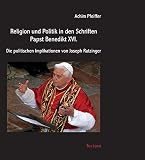
Achim Pfeiffer. Religion und Politik in den Schriften Papst Benedikt XVI: Die Politischen Implikationen von Joseph Ratzinger. Marburg: Tectum Verlag, 2007. 127 pp. EUR 29.90 (cloth), ISBN 978-3-8288-9227-9.
Reviewed by Martin Menke (Department of History, Rivier College)
Published on H-German (October, 2007)
When Universal Truth Meets Political Reality
Achim Pfeiffer's work on the political implications of Benedict XVI's theology was completed in its original form before the College of Cardinals elected Cardinal Ratzinger pope. Thus, Pfeiffer refers to former Cardinal Ratzinger as Benedict XVI only at the end of the work. For simplicity's sake, this review will follow that practice. One would expect a study of such a broad topic to take up more than 115 pages, however; the subtitle of the original Diplomarbeit submitted at the University of Duisburg-Essen reveals the more limited scope of the work. Pfeiffer has chosen to focus on the implications of Ratzinger's theology for the proper role of church and state in general, and in particular for abortion and liberation theology. Pfeiffer does not explain why he chose these topics, nor does he offer enough analysis to explain how Ratzinger's views of them are rooted in the same theological approach to church-state relations. Also, Pfeiffer does not link the historical roots of church teaching on church-state relations with the controversies surrounding abortion and liberation theology.
Pfeiffer devotes half the book to a discussion of the theoretical foundations of Ratzinger's thinking, followed by two shorter sections on abortion and liberation theology, respectively. Pfeiffer argues that one can understand Ratzinger's theology of church and state best by considering that his formative years and primary theological training took place in Germany. Therefore, Pfeiffer argues that Ratzinger embraced the German model, in which the church is a sovereign institution but cooperates with the state in providing social services and also plays a role as a guardian of public morality. Unfortunately, Pfeiffer does not support this argument throughout his work. In his section on abortion, he focuses exclusively on Germany without explaining how Ratzinger's German mentality shaped his theological approach to the topic.
First, Pfeiffer offers a discussion of theological and political foundations, in which he discusses the relationship of God and man, the nature of God, and the role of philosophical truth in Christian theology. It is unfortunate that Pfeiffer did not have the benefit of Ratzinger's speech on the topic given at Regensburg University during his most recent visit to Germany. For Ratzinger, claims Pfeiffer, theology is akin to a natural science, in which established facts cannot be changed at will. More importantly, Ratzinger does not consider faith subject to majority will. He asserts that "Christianity teaches absolute truth and values and thus stands in strict contrast to the necessary skepticism of relativist democracy" (p. 22). Furthermore, Ratzinger distinguishes freedom from license. As a "foundation" for Pfeiffer's later arguments, this section is too brief to offer any real insight into Ratzinger's thought or to distinguish Ratzinger's thought from catechetical teaching on these topics.
Pfeiffer proceeds to discuss the relationship between church and state. He argues that the state is based on majority will but still subject to ethical principles. The church, as the community of God's people and as the really-existing grace of God on earth, reminds the state of moral principles not subject to majority will (p. 46). Through Christ, all humans belong to the people of God. In the modern era, the concept of the people (Volk) has become politicized and defined as in opposition to the hierarchy. This definition has affected the church, in which the people of God often are defined as being in opposition to the church hierarchy, which is an inaccurate understanding of the universal church to which all belong.
In many regards, the first half of the book is deeply frustrating. Pfeiffer does not offer enough detailed explanation for those less familiar with Ratzinger's particular views or even the Catholic Church's teaching in general to gain the foundation Pfeiffer promises. For those more familiar with Catholic teaching and current debates in Catholic theology, nothing new to ponder is included.
In the second half of the book, Pfeiffer moves on to his two case studies: termination of pregnancies and liberation theology. First, Pfeiffer discusses the particularly German problem of pregnancy counseling. As Pfeiffer correctly notes, German law provides a unique construction in that, according to Article 218 of the criminal code, terminating a pregnancy is unlawful in every case, but is free from prosecution in the first twelve weeks of pregnancy if the woman can produce a certificate of counseling from a government-approved agency, which until recently included the Catholic Church. After a reform of Article 218 in 1995, the German Catholic bishops met to consider their continued operation of pregnancy counseling centers and issuance of counseling certificates. Upon seeking counsel from authorities in Rome, among them then-Cardinal Ratzinger, the bishops believed they had found a way to continue issuing counseling certificates without violating the church teaching that ending pregnancy is a mortal sin. The bishops decided to continue issuing the certificates with an additional notation that the issuance itself did not legitimate or condone any subsequent abortion. In 1998, John Paul II mandated an end to this practice, but Cardinal Ratzinger called on the bishops to expand their pregnancy counseling with the goal of preventing as many abortions as possible. Beginning on January 1, 2001, the Catholic Church in Germany no longer issued any counseling certificates, without or without the additional notation.
Pfeiffer argues that the German bishops had to submit to the wishes of the pope and Cardinal Ratzinger in order to maintain the universality of the church embodied in the Roman pontiff, even though German public opinion thought the bishops ought to oppose the pope's request. Pfeiffer goes on to posit the question of whether abortion is actually compatible with Articles 1 and 2 of the German constitution, which consider the life and dignity of the human person inviolable. Ratzinger certainly thought it was not (p. 74). According to Ratzinger, to continue issuing counseling certificates would have put the credibility of the church in question. Ratzinger also wondered what a woman's freedom to choose would be worth if it entailed robbing someone of his freedom. Pfeiffer misses the opportunity to explain clearly how the question of pregnancy counseling represents an instance in which the church stands for the Gospel and for absolute moral truth in contrast to the state, whose policies are determined by a majority of legislators chosen by majority public opinion.
While the question of abortion remains fairly current, the question of liberation theology has lost much of its urgency, partially because of changes in Latin America and partially because church authorities effectively have quashed this particular theological viewpoint. Nonetheless, Pfeiffer offers a brief and undifferentiated summary of liberation theology's development, particularly in the works of Leonardo Boff and Gustavo Gutierrez. Ratzinger was one of Boff's doctoral advisors, but not the one who initially denounced Boff's work as heretical. Ratzinger, by then Prefect of the Congregation for the Faith in Rome--the church's keeper of dogmatic rectitude--only became involved when Boff turned to him for advice. In response, Boff was summoned to Rome and eventually lost all ecclesiastical functions and was banned from teaching or speaking as a Catholic theologian for a year. Ratzinger accused advocates of liberation theology of overemphasizing the historical Jesus at the expense of the transcendent Jesus. Ratzinger feared that a one-sided consideration of Jesus as a political revolutionary who demanded all his followers take up a preferential option for the poor would lead Christians to too close a synthesis with Marxist analytical rubrics and Marxist dogma. When Boff rejected the church hierarchy in favor of grassroots decision-making and Gutierrez quoted Karl Marx, Rosa Luxemburg, Vladimir Lenin, and Nikolai Bukharin, they had gone too far for Ratzinger and John Paul II. While Pfeiffer himself does not make this clear, liberation theology violated church teachings about the nature of the church as a whole of God's people and about the prohibition of violence as a means to promote social change. Most importantly, Boff and Gutierrez seemed to have adopted Marxism's understanding of salvation in the sense of the perfect society no longer as something transcendent to be achieved after death, but as something to be achieved through revolutionary action on Earth. It would have been interesting for Pfeiffer to address Ratzinger's understanding of original sin, which is mentioned early in the book, in the context of liberation theology, since the permanence of original sin itself makes any earthly perfection impossible.
If the criticisms mentioned above were not sufficient to raise questions the value of this work, then Pfeiffer's conclusion would. First, he argues that salvation must not be connected with politics for "outside the Church [which politics is by definition] there is no salvation" (p. 112). This statement, left unexplained by Pfeiffer, is reminiscent of Father Feeney's claims to this effect, which led to his excommunication during the last years of the papacy of Pius XII. Without mentioning Carl Schmitt or acknowledging the sensitivity of German Catholics to the term, Pfeiffer argues that Ratzinger rejects "political theology," for rendering immanent the transcendent Kingdom of God. In his personal commentary, Pfeiffer argues "there is but one Jesus, the Christ, who is the Messiah. Thus the Catholic Church, not as an institution, but as the community of the faithful, represented by the Pope as God's representative on Earth, is the one true, Catholic, apostolic, and universal religion"(p. 113). This personal profession of faith is not helpful for scholars, Catholic or not, since it removes the entire work from the scholarly theological domain to the realm of faith. (One wonders whether this personal commentary was added for publication once the Diplomarbeit had been accepted or whether the examiners accepted this conclusion.) Combined with the author's failure to make clear the analytical and conceptual connections between the foundational part of the work and the two case studies, Pfeiffer's very personal conclusion renders the work ineffective.
If there is additional discussion of this review, you may access it through the network, at: https://networks.h-net.org/h-german.
Citation:
Martin Menke. Review of Pfeiffer, Achim, Religion und Politik in den Schriften Papst Benedikt XVI: Die Politischen Implikationen von Joseph Ratzinger.
H-German, H-Net Reviews.
October, 2007.
URL: http://www.h-net.org/reviews/showrev.php?id=13777
Copyright © 2007 by H-Net, all rights reserved. H-Net permits the redistribution and reprinting of this work for nonprofit, educational purposes, with full and accurate attribution to the author, web location, date of publication, originating list, and H-Net: Humanities & Social Sciences Online. For any other proposed use, contact the Reviews editorial staff at hbooks@mail.h-net.org.

