



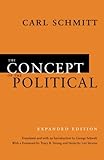
Carl Schmitt. The Concept of the Political. Chicago: University of Chicago Press, 2007. xxxi + 126 pp. $15.00 (paper), ISBN 978-0-226-73892-5.
Reviewed by Robert D. Rachlin (Vermont Law School)
Published on H-German (October, 2007)
A New Chicago Edition of Carl Schmitt's Seminal Work
Carl Schmitt (1888-1985), the so-called "crown jurist of the Third Reich," articulated a vision of politics dominated by the distinction between friend and enemy. For Schmitt, this distinction was not merely an attribute of the political. It was foundational; it served as a prerequisite, the condition sine qua non of the political, which, in turn was a logical precursor of the state. This key concept is declared in the first sentence of The Concept of the Political: "The concept of the state presupposes the concept of the political" (p. 19). This foundational work is now available in an "expanded edition" from University of Chicago Press. Readers are likely to bring to it not only questions about its status as a justification for National Socialism and as a reflection of the many contradictions in Schmitt's life, but may not be able to avoid making connections between his thought, the increasingly authoritarian nature of democracies, and events in contemporary politics. For Leo Strauss, whose comments on Schmitt are included in the book, Schmitt's critique of liberalism was itself "in the horizon of liberalism" (p. 122). Readers are challenged by the work, and indeed by Schmitt's life, to decide this matter for themselves.
The division of the world into allies and opponents is likely to resonate with many readers; it also squared conveniently with the notions of the National Socialists. Schmitt was, of course, not the first to understand the political utility of the friend/enemy antithesis. From Cato the Elder to the Crusaders, from the American demonization of the "Hun" to their criticism of "godless communism," extending to Islamicist use of the term "the Great Satan," moments of crisis lend urgency to such characterizations. As Oren Gross and Fionnuala Ní Aoláin have noted, "counter-terrorism measures often actively produce and construct a suspect community. One is either with 'us' or with 'them.' There is no middle way."[1] For Schmitt, however, the idea of the enemy was more than an instrument of politics or policy. It was antecedent to the very existence of the state.
The fundamental status of this concept did not prevent Schmitt, in his Nazi reincarnation, from using the idea of the enemy as a theoretical basis for identifying the Jews with that baleful role (or hamper leaders of the Third Reich in doing so, either). But it is important to avoid confusing Schmitt's opportunistic use of the friend/enemy concept in service of the NSDAP with his exposition of it in The Concept of the Political. This notion of the need for national unity bolsters Schmitt's considerations on the topic of war. Although government exhortations to war are almost always couched in terms of humanity, peace, and justice (p. 54), the fact of war, for Schmitt, owes its sole rational justification to the need to overcome a threat to national existence. Schmitt is punctilious, to the point of redundancy, in rejecting the notion of a just or unjust war, citing Grotius's dictum: "I do not include justice in the definition [of war]," rendered by Schwab as "Justice is not included in the definition [of war]" (pp. 49-50).[2] In an apparent, though not explicit, reference to Woodrow Wilson's resort to the slogan "war to end all wars," Schmitt scorns the idea of "demand[ing] of men that they wage war, kill and be killed, so that there will never again be war" (p. 48). The idea is derided further at the end of the book: "A war waged to protect or expand economic power must, with the aid of propaganda, turn into a crusade and into the last war of humanity" (p. 79). (In the original, letzten Krieg der Menschheit is set in scare quotes. Omission of the scare quotes in the translation denatures the irony.) War is thus completely abstracted from normative justifications. Schmitt leaves unanswered an obvious follow-up question: is there a rational place for laws of war?
In order to answer this question, we must remember that much of Schmitt's work can be understood as lexicography. War is assigned a particular meaning in Schmitt's dialectic, regardless of its use in popular discourse. The same applies to the idea of democracy. What we call "a democracy," Schmitt would call a "liberal constitutional state." In a Schmittian democracy, spheres of social activity normally thought of as nonpolitical can integrate with the political, as long as one or more such spheres intensifies to the extremity of furnishing a casus belli in regards to some other internal or external group of people (p. 38). Schmitt lists as examples religious, cultural, economic, legal, and scientific areas of activity. In a Schmittian democracy, all of these realms are potentially political. Thus, democracy is unattainable if society is sharply divided, to the point of possible warfare, on issues of great moment. A workable society requires that the population be, in Schmitt's terms, "homogeneous."[3] Homogeneity implies a sharing of important cultural values. This unanimity rests, in turn, on a common religion, common socioeconomic precepts, and common ethnicity. For Schmitt, democracy is not inconsistent with a dictatorship. If such a unified society elects to be governed by an autocrat, the choice is "democratic." Indeed, for Schmitt, the truly democratic state is the total state (pp. 22-23), in which all important spheres of life are integrated with the governance of the state.[4]
Democracy, for Schmitt, must be sharply distinguished from liberalism (p. 69). Liberalism has no political persona of its own, but combines with diverse political movements as time and circumstances warrant. Founded on the primacy of the individual, liberalism has no "political" goal, in Schmitt's sense of the word; it simply seeks to maximize individual freedom, utilizing the state as an instrument for this purpose. What, in Schmitt's view, remains of the individual? Schmitt acknowledges that a political entity need not "necessarily determine every aspect of a person's life" or that a centralized system should not destroy every other organization or corporation (pp. 38-39). Schwab seizes on this statement in a footnote, asserting that "Schmitt has consistently maintained this idea and thus has never entertained the thought of a totalitarian state" (p. 39). But Schmitt's statement is nothing more than a truism, since no state, however autocratic and monolithic, can, in the nature of things, control "every aspect" of the lives of its citizens. Schwab may infer too much from Schmitt's acknowledgement of the obvious. Unless "totalitarian" has a different meaning to Schwab than in common parlance, it is difficult to reconcile Schwab's footnoted apologia with Schmitt's fervent support of Hitler and the Third Reich.
In light of these problems, then, a representative parliamentary government, for Schmitt, is doomed to failure. Weimar demonstrated the fruitlessness of a government beset by factionalism and clashing political and economic philosophies. Schmitt's later embrace of Nazism, while in large part undoubtedly opportunistic, can also be understood as the logical outcome of the views he championed in the Weimar period. Schmitt could see the Hitler dictatorship as a shining example of "democracy" in a Germany progressively homogenized by the elimination of divergent religious, ethnic, and political elements of the population.
Schmitt's significance for modern political thought includes his theory of the state of emergency (Ausnahmezustand), a condition that arises when the very existence of the state and its constitutional order are threatened by external or internal forces. In the state of emergency, legal norms are set aside as a new "sovereign" assumes power. Schmitt begins his other foundational work, Politische Theologie (1922), with the famous statement: "Souverän ist, der über den Ausnahmezustand entscheidet."[5] The existence of states of emergency, états de siege, and other challenges to national stability and the effect that such a condition should or should not have on the legal order have been subjects of widespread scholarly interest for many decades. The relevance of the subject to current political debates about the powers of the national executive vis-à-vis the challenge of transnational terror organizations requires no elaboration. Despite efforts by international judicial bodies such as the European Court of Human Rights to limit the extent to which signatory states may "derogate" from human rights treaty obligations in cases of national emergency, the "margin of appreciation," in fact, deference, accorded sovereign declarations of such emergencies remains wide, especially in the case of nations whose democratic credentials are not suspect.
Admittedly, the state of emergency plays no prominent role in The Concept of the Political. Schmitt makes a glancing reference to it when he says that an internal national grouping capable of driving the nation toward the extreme friend/enemy antithesis becomes "sovereign in the sense that the decision about the critical situation, even if it is the exception, must always necessarily reside there," that is, in that defining grouping (p. 38). Nonetheless, a taxonomy of Schmitt's political theory must place the state of exception and the friend/enemy antithesis in close relationship. Moreover, although nothing in The Concept of the Political explicitly foreshadows the Nazi legislative and extra-legal initiatives against the Jews, Schmitt makes it clear that "in critical situations" a state must be prepared to identify and designate the "domestic enemy" (inneren Feind) and deal with this enemy by extraordinary means, including "special laws" (Sondergesetze) (pp. 46-47). "Sondergesetze" has a disquieting resonance in the context of such Nazi terms as "Sondergericht," "Sonderkommando," and "Sonderbehandlung." While Schmitt's personal attitude toward the Jews may not have entirely conformed to Nazi views, it is easy to see how smoothly Schmitt was able to glide from the general to the specific, from Weimar to the Third Reich, when the political occasion emerged. Additionally, the dialectic between the rule of law and the imperatives of national security, real or invented, is as lively today as in Schmitt's time.
While most readers of this edition will find themselves occupied in studying these questions of historical and contemporary political philosophy, the book is no less interesting for the light its statements shed on Schmitt's own life. An ongoing problem for readers of Schmitt's notions of friend and enemy, for instance, has been their relationship to Western, Christian morality. In Römischer Katholizismus und politische Form (1923), Schmitt analyzed the government of the Roman Catholic Church, which he called a "complexio oppositorum"--a complex of opposites, antinomies, and contradictions. This epithet described Schmitt himself. Schmitt broke with the Church when it refused to annul his first marriage. Yet the break was never complete. In later, postwar years, Schmitt appeared to reconcile with the Church. In The Concept of the Political, Schmitt was at pains to distinguish his vision of the friend/enemy distinction from that of the Christian Bible, which commands that one love one's enemies. Schmitt pointed out that the Latin for "enemy" used in the Vulgate was inimicus, not hostis. The corresponding Greek was ekhthros," not "polemios." In each case, the biblical word for enemy denotes the personal antagonist, not the national or political foe: "Never in the thousand-year struggle between Christians and Moslems did it occur to a Christian to surrender rather than defend Europe out of love toward the Saracens or Turks" (p. 29). For Schmitt, enmity "does not mean competition, nor does it mean pure intellectual controversy nor symbolic wrestlings in which, after all, every human being is somehow always involved.... The friend, enemy, and combat concepts receive their real meaning precisely because they refer to the real possibility of physical killing" (p. 33).
Such caveats aside, the contradictions in Schmitt's life and work were not confined to the Church. His treatment of former colleagues who fell out of favor was similarly problematic. Before Hitler came to power, Schmitt enjoyed collegial relations with Jewish scholars. He was instrumental in obtaining a Rockefeller grant for Leo Strauss to study in Paris. Schmitt owed his first academic appointment to a Jew, Moritz Julius Bonn. Afterwards, he abruptly severed his relations and correspondence with Jews, later championing the Nuremberg Laws. When he chaired a conference of legal academicians entitled Das Judentum in der Rechtswissenschaft, with presentations such as "Jewry in Economics," "Jewry in Competition Law," "Jewry in Civil Trial Law," "Jewry in Criminal Law," "Jewry and Criminality," and "The Influence of Jewish Theorists on German Public Law Theory," his opening and closing lectures elaborated on a sentence from Mein Kampf: "Indem ich mich des Juden erwehre, kämpfe ich für das Werk des Herrn."[6] [
Moreover, he seemed repeatedly at pains to stay on the side of power. Schmitt wrote the bulk of his numerous theoretical writings during the Weimar period and even criticized the National Socialists in his role as counselor to the Weimar government. Still, he stood in line to join the Nazi party only three months after Hitler's accession to power, joining the party the same month as Martin Heidegger. While he had counseled Kurt von Schleicher, the last Weimar chancellor, when Hitler ordered the "Night of Long Knives," during which Schleicher and his wife were murdered, Schmitt quickly published an article in a German legal journal with the jaw-dropping title, "Der Führer schützt das Recht," justifying and lauding the brutality.[7] He also wrote articles enthusiastically supporting the Enabling Acts. The contradictions in Schmitt's life and views did not escape the SS; in 1936 he was attacked in its official organ as a sham antisemite, Catholic, and closet Hegelian. Afterwards removed from his official positions, Schmitt was permitted to continue teaching, thanks to the influence of Hermann Göring and Hans Frank. Although the SS denuncation was a severe blow at the time, it may have helped to spare him a trial after the war. During his interrogations at Nuremberg in April 1947, Schmitt cited the SS "defamation" as evidence that he was not to be blamed for Nazi brutalities.[8] Readers of the book should have an interesting time fitting its theoretical content into their picture of this complex thinker and his works.
Those reviewing translations often consider it de rigueur to quibble. Undoubtedly the same could be done here. Minor disagreements over terms fade, however, in light of the superb job Schwab has done rendering Schmitt's long, multi-clausal German sentences into concise, pellucid English. There are some casualties along the way. Schmitt deploys sardonic humor based on puns from time to time. This does not always come through in the translation. How does one convey the flavor of "Tauschen und Täuschen sind oft nahe zusammen"? Schwab's "exchange and deception are often not far apart" (p. 77) doesn't quite capture the tone, but, frankly, I can’t think of a cleverer way to put it.
The edition is expanded from earlier ones only in its inclusion of supplemental material not in the 1996 Chicago edition, which featured the same elegant, readable translation by George Schwab. Tracy B. Strong, in his foreword, focuses on the current debate about Schmitt, frequently citing the journal Telos, which has spilled much ink on the philosopher. The current edition also contains a translation of Schmitt's Das Zeitalter der Neutralisierungen und Entpolitisierungen (1929), translated as The Age of Neutralizations and Depoliticizations, which was incorporated in the 1963 German edition of Der Begriff des Politischen, published by Duncker and Humboldt, along with a 1963 foreword by Schmitt himself. The translated text appears identical to that of the 1996 edition. Both the 1996 and the current Chicago editions include a translation of Leo Strauss's Notes on Carl Schmitt: The Concept of the Political (1995). Schmitt's foreword to the German edition was, unfortunately, not translated and included in the current edition. In it, Schmitt declares that his task in writing the book was to provide a theoretical framework for an unfathomable problem (p. 9). Although Schwab faithfully translates most of Schmitt's notes, he acknowledges omitting "a long note by Schmitt on examples of enemy declaration" (p. 47). The omission is unfortunate, as Schmitt there buttresses the case for extra-constitutional treatment of dissident or disruptive internal elements, drawing on Greek, Roman, German, and Revolutionary French history. In the omitted note, Schmitt specifically mentions "religions ... that are presumed to fall short in peaceful or legal attitudes" (Religionen ... [für die] der Mangel friedlicher oder legaler Gesinnung vermutet wird), a theme that would be relevant to the questions outlined in this review.[9]
Notes
[1]. Fionnuala Ní Aoláin and Oren Gross, Law in Times of Crisis (Cambridge: Cambridge University Press, 2006), 220.
[2]. "Justitiam in definitione [sc. belli] non include." De Jure Belli ac Pacis, bk. 1, ch. 2, sec. 3.
[3]. Carl Schmitt, The Crisis of Parliamentary Democracy, trans. Ellen Kennedy (Cambridge: MIT Press, 1985), 4.
[4]. One can infer that Schmitt would regard the radical Islamist ideal of a caliphate ruled by religious leaders administering shari'a as an expression of democracy, provided that the relevant population as a whole endorses it. Casual use of the term "democracy" might explain the bewilderment and dismay generated among Western political leaders when popular elections led to the installation of a Hamas majority in the Palestinian government. Schmitt would see the United States, not as a democracy, but as a liberal, representative, parliamentary constitutional state. The uneasy coexistence in the United States of diverse, often antagonistic, religious, socioeconomic, and partisan groups is inconsistent with the homogeneity that, for Schmitt, is the prerequisite of a democracy. While it is doubtful that such antagonisms would lead to a war-generating "Ernstfall," the widespread and persistent use of bellicose characterizations (such as "war on the family," "culture wars," "war on Christmas," "war on terror," "war on drugs," "war on poverty," and so on) in our quotidian political conversation suggests at least the potential of group-on-group violence.
[5]. Carl Schmitt, Politische Theologie (Berlin: Duncker and Humblot, 2004), 13.
[6]. Adolf Hitler, Mein Kampf (Munich: Franz Eher, 1934), 70.
[7]. Carl Schmitt, "Der Führer schützt das Recht," Deutsche Juristen-Zeitung 39 (1934): 945-950.
[8]. Carl Schmitt, Antworten in Nürnberg (Berlin: Duncker and Humblot, 2000), 55.
[9]. Carl Schmitt, Der Begriff des Politischen (Berlin: Duncker and Humblot, 2002), 47.
If there is additional discussion of this review, you may access it through the network, at: https://networks.h-net.org/h-german.
Citation:
Robert D. Rachlin. Review of Schmitt, Carl, The Concept of the Political.
H-German, H-Net Reviews.
October, 2007.
URL: http://www.h-net.org/reviews/showrev.php?id=13761
Copyright © 2007 by H-Net, all rights reserved. H-Net permits the redistribution and reprinting of this work for nonprofit, educational purposes, with full and accurate attribution to the author, web location, date of publication, originating list, and H-Net: Humanities & Social Sciences Online. For any other proposed use, contact the Reviews editorial staff at hbooks@mail.h-net.org.

