



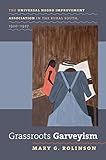
Mary G. Rolinson. Grassroots Garveyism: The Universal Negro Improvement Association in the Rural South, 1920-1927. Chapel Hill: University of North Carolina Press, 2007. xii + 286 pp. $22.50 (paper), ISBN 978-0-8078-5795-3; $59.95 (cloth), ISBN 978-0-8078-3092-5.
Reviewed by James C. Giesen (Department of History, Mississippi State University)
Published on H-NC (October, 2007)
Unmasking Southern Garveyism
Marcus Garvey was a man of active verbs. As the leader of a worldwide movement of Africa-descended peoples that counted millions of followers during its heyday in the 1920s, Garvey spurred, shifted, rallied, and inspired. Perhaps as a result of his persona--his penchant for appearing in public wearing a bejeweled uniform and plumed hat and his legendary ability to light fires in crowds with his oratory--much of the previous scholarship on his movement and its influence on 1920s America centers on the man himself. Understanding Garveyism has meant getting to know Garvey. Within the few works that have attempted to identify and explain Garvey's followers and their motivations, the lens rarely veers from the urban North.
Mary G. Rolinson has written an insightful, thought-provoking work that should change both of these conceptions. Grassroots Garveyism not only uncovers thousands of Garvey followers in the rural South, it tells a history of the movement from the perspective of these men and women. It is a story about the attractiveness of black nationalism, economic independence, and self-determination to poor, landless, agricultural workers who lived hundreds of miles, and seemingly years and years, from the lights and sounds of the Harlem Renaissance. This book challenges more than historians' understandings of Garveyism, however. It complicates what we know about the rural South itself, the political, religious, and social organizations that were based there, and the movements that would rise from the region three decades after Garvey's star had faded.
One of the book's central ideas is that historians have mischaracterized Garveyism as both short-lived and unique. Rolinson attempts to lengthen the period of the movement's influence by placing it within, rather than separate and distinct from, a longer strand of African American thought. "Very little of Garvey's ideology was original" (p. 3), she writes in the introduction, and its influence "did not disappear after [his] deportation from the United States in 1927" (p. 1). In fact, much of Rolinson's findings about the movement in the South during the 1920s centers on how Garvey's followers rectified their previous connections to Booker T. Washington, the NAACP, and Christian churches with Garveyism's visions of black nationalism, "African redemption," and economic independence (p. 151). Not only did Garvey himself tune his appeal for southern ears in particular, but black southerners were prepared for his rhetoric by listening to Booker T. Washington and Bishop Henry McNeal Turner. Garvey's "missionary, sacred, and emigrationist" stances echoed the appeals of the Christian evangelicalism that African Americans in the South already knew well. It was not a great leap from Washington's vision of industrial education and development for black southerners to Garvey's vision of a separate black society and economy. The connections between these "antecedents," as the book's first chapter is called, and Garvey went beyond ideology. Rolinson traces individuals and families who followed these various leaders for a prolonged period.
Not only were there followers of Garvey in the South, Rolinson has found persistent pockets of activism in certain locales. The book centers early organization for Garvey's Universal Negro Improvement Association (UNIA) in Virginia, Florida, and the Carolinas, but concentrates mostly on the organization's growth in cotton-dense subregions of the Deep South including southwestern Georgia, the Arkansas Delta, and the Yazoo-Mississippi Delta. While comparing support for Garvey between these otherwise similar regions, Rolinson never loses touch with the fact that these were constantly changing places in the 1920s. Perhaps more importantly, she reminds us that each southern place had recently been home to African Americans who now celebrated Garvey in the cities of the North and Midwest. Understanding these places, then, means getting a better sense of the attraction to Garvey in both the South and North.
Readers with a particular interest in the Tar Heel State should not be dismayed by the book's main focus on areas to its south. In fact, Rolinson's section on North Carolina Garveyism reflects both the book's strengths and its one important weakness. The UNIA had forty-seven active chapters in the state (of 423 total in all of the former Confederacy), not only in Charlotte, Durham, and Greensboro, but in smaller and more remote places like Asheville, Spring Hope, and Jamesville. Rolinson concentrates, however, on what she calls the "Winston Salem/Raleigh corridor," where, she argues, tobacco growing and processing created a "rich recruiting ground for disgruntled black laborers" (p. 60). It was not only tobacco workers who flocked to the UNIA, however. "In no other southern state," Rolinson claims, "was urban and black middle-class participation as pronounced as in the Tar Heel State" (p. 61).
But what was it about work in tobacco fields or R. J. Reynolds' factories that made Garvey's vision particularly attractive to black North Carolinians? Rolinson painstakingly charts the rise of UNIA organizing in North Carolina and other states, but readers are not given a firm sense of what immediate work, political, or social realities drove men and women to align with Garvey. Rolinson explains who the organizers were and sheds light on how these regional leaders adapted and moderated their rhetoric for North Carolinians, but beyond the fact that these men and women faced racism and economic injustice, there is no explanation of the specific conditions for their endorsement of Garveyism. Indeed, the sections on the cotton-dense areas of the South also leave the reader longing for an explanation for what it was about work with the white staple crop that made Garveyism appealing. Was all of this agricultural and industrial work equally objectionable and was Garvey's vision of salvation uniformly attractive no matter one's environment or employment? In the end, however, this is more a criticism of what the book is not (a detailed history of what drove the black communities in these places) than what it is.
Historians of the South in the early twentieth century will have much to learn from Grassroots Garveyism, but the book's historiographical impact should also be felt by scholars examining the later period. Rolinson's work endorses two trends in histories of the modern civil rights movement: the effort to uncover roots of the 1960s fights in an earlier period, and to move the focus from national and regional leaders to grassroots people. Rolinson convincingly traces the legacy of Garveyism in certain places from the 1920s to activism after World War II. Where there was a large number of Garveyites in the earlier period, she argues, there was organization and protest in the later one. Rolinson also tells the story of Garveyism's importance from the perspective of locals who supported the movement. Her work cross-references census records with extant UNIA membership files (found in 1970 in an abandoned Harlem building and now housed at the Schomburg Center), painting a fascinating portrait of the men and women who joined the organization.
Rolinson's greatest contribution with this book may be her insistence that scholars place poor, often landless rural black southerners within a long intellectual tradition. These are people, Rolinson claims, who scholars have rarely "taken seriously as thinkers and agents of their own destiny" (p. 8). As the book successfully demonstrates, those who joined the UNIA certainly had absorbed the ideologies of black movements that preceded Garvey and have left a legacy that survives today.
If there is additional discussion of this review, you may access it through the network, at: https://networks.h-net.org/h-nc.
Citation:
James C. Giesen. Review of Rolinson, Mary G., Grassroots Garveyism: The Universal Negro Improvement Association in the Rural South, 1920-1927.
H-NC, H-Net Reviews.
October, 2007.
URL: http://www.h-net.org/reviews/showrev.php?id=13714
Copyright © 2007 by H-Net, all rights reserved. H-Net permits the redistribution and reprinting of this work for nonprofit, educational purposes, with full and accurate attribution to the author, web location, date of publication, originating list, and H-Net: Humanities & Social Sciences Online. For any other proposed use, contact the Reviews editorial staff at hbooks@mail.h-net.org.

