



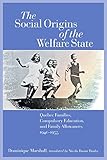
Dominique Marshall. The Social Origins of the Welfare State: Québec Families, Compulsory Education, and Family Allowances, 1940-1955. Waterloo: Wilfrid Laurier University Press, 2006. 280 pp. $32.95 (paper), ISBN 978-0-88920-452-2.
Reviewed by Tamara Myers (Department of History, University of British Columbia)
Published on H-Childhood (October, 2007)
The Second World War years were pivotal for the formation of the Canadian welfare state, as decades of historiography suggest. In particular, early 1940s policymakers took seriously the idea that responsibility for the welfare of the family was to be shared by the public authorities, including the federal and provincial governments. Carleton University professor Dominique Marshall's The Social Origins of the Welfare State provides a richly detailed historical analysis of the implementation of some of Canada's most important social programs of that era. She examines the Quebec government's implementation in 1943 of compulsory education and the impact of the 1944 federal Family Allowances program on Quebecois families. The focus on Quebec is critical: previously a French colony that remained largely French-speaking and Catholic, with welfare provision firmly in the hands of private interests (especially religious orders), this Canadian province is perhaps best known in welfare studies as coming late to compulsory education but is also the only jurisdiction in North America to recently offer $7-per-day daycare and the lowest tuition fees for post-secondary education in Canada.
This book is an English translation of the 1997 prize-winning publication, Aux origines sociales de l'État providence, a monograph based on Marshall's doctoral dissertation completed in the 1980s. The English version joins a small but growing set of monographs in the Studies in Childhood and Family in Canada Series under the auspices of Wilfrid Laurier Press. The original edition won tremendous acclaim for being innovative in tracing the political and ideological revolutions in social thinking that gave rise to the welfare state and a collective consciousness that poverty was the business of bureaucrats and the state. Most importantly, Marshall's exploration of the impact made on policymakers by families--including children--of the working class and of farming communities made this book essential reading. Even though technically not a new book, Marshall's contribution to the history of the welfare state and the family remains significant and should be acknowledged for inspiring other important studies of the family's engagement with the state at mid-twentieth century, such as Magda Fahrni's Household Politics: Montreal Families and Postwar Reconstruction (2005).
Shaped as it was by 1980s and 1990s concerns over the battering of the welfare state at the hands of deficit-obsessed governments, this book draws our attention to the political debates and actors that shaped early thinking on such issues as universality and children's rights. While compulsory schooling remains firmly entrenched for teenagers, mid-twentieth-century arguments favoring accessibility--low or no tuition fees--in higher education were abandoned by governments in the last ten years and "baby bonuses," as Family Allowance came to be called, withered in 1992 into a "non-universal tax credit." Given the recent political hostility to welfare programs, returning to an era when state responsibility for the welfare of its citizenry was not a disparaged idea, is edifying.
The Social Origins of the Welfare State opens with a chapter analyzing the impetus for social legislation at the provincial level (compulsory education) and at the federal level (Family Allowances Act). Superficial histories of these innovations usually attribute their success to political leaders (Premier Adelard Godbout and Prime Minister Mackenzie King, respectively) although Marshall deftly illustrates how myriad groups (feminists, labour unions, etc.) played a critical role and how earlier political and social processes and actions had already given importance to children's status and rights, opening the door to the possibility of large-scale social policy innovation. Timing did matter, however, as the war provided opportunity for governments to intervene--although not without contestation--in the economy. Godbout's government benefited from the support of labor, women's groups, and a growing progressive sector of the Catholic Church, permitting movement forward on women's suffrage, compulsory schooling, and labor-friendly legislation. According to the second chapter the implementation of legislation and principles into practice was a long and at times frustrated journey. In chapter 3 Marshall turns to the discourse surrounding children's universal rights and how new officials responsible for compulsory schooling or the family allowances program were affected by their introduction to the extent of poverty in the province. She points to the sometimes contradictory rights of citizens, families, and children and shows how working-class parents were asked to conform to an official sense of normalcy in exchange for new social benefits for their children.
Two middle chapters on the improvements in children's status as a result of these social programs and the exceptions to this positive outcome, respectively, are worth noting. Of course, one might expect that a monthly infusion of cash and compulsory education to age 16 might improve Quebecois children's lives at mid-twentieth century. Poor families used the income to buy children's clothing, for example, which in turn enabled them to attend school. She demonstrates though with powerful anecdotes the transformation and easing of family members' mutual obligations to each other as a result of improved education and standards of living. There were certainly exceptions, though. Not surprisingly the safety net did not catch all children, or their families. Nor did it eradicate vulnerability and poverty. Child labor continued, although now those whose families demanded exemptions from compulsory schooling were increasingly marginalized to a category beyond "normal" and faced shame and sometimes the wrath of social workers and juvenile justice authorities.
By way of conclusion Marshall examines linkages between the 1940s social policy developments and the Quiet Revolution of the 1960s, an era in which secularization, national determination for a Quebecois state, nationalization of industries (electricity, for example), and promotion of social equality including the unprecedented expansion of public post-secondary education took place. Here she charts the growing acceptance of universalism and entitlement, which helps in understanding contemporary developments in Quebec and its exceptionalism in welfare provision.
Since 1997 this book has been joined by an impressive array of book-length studies that complement and reinforce Marshall's findings. On the construction of the "normal" family in mid-twentieth-century Canada we have Mona Gleason's Normalizing the Ideal (1999); on the family's engagement with the state and social policy see Fahrni's Household Politics (2005); for a broad overview of welfare state development in Canada see Alvin Finkel's recent Social Policy and Practice in Canada (2006). Rereading this book in 2007, however, I am most struck by the ongoing importance of the theme of the emergence of a discourse on children's rights, a direction that Marshall herself has taken up in her recent work on internationalism and children's status. This book, one could argue, was a work of family history but it invites us today to think about the location of children's history relative to the histories of the family, the state, and human rights.
If there is additional discussion of this review, you may access it through the network, at: https://networks.h-net.org/h-childhood.
Citation:
Tamara Myers. Review of Marshall, Dominique, The Social Origins of the Welfare State: Québec Families, Compulsory Education, and Family Allowances, 1940-1955.
H-Childhood, H-Net Reviews.
October, 2007.
URL: http://www.h-net.org/reviews/showrev.php?id=13702
Copyright © 2007 by H-Net, all rights reserved. H-Net permits the redistribution and reprinting of this work for nonprofit, educational purposes, with full and accurate attribution to the author, web location, date of publication, originating list, and H-Net: Humanities & Social Sciences Online. For any other proposed use, contact the Reviews editorial staff at hbooks@mail.h-net.org.

