



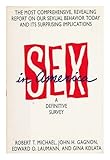
Robert T. Michael. Sex in America: A Definitive Survey. Boston: Little, Brown, 1994. viii + 300 pp. $22.95 (cloth), ISBN 978-0-316-07524-4.
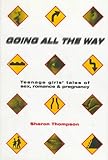
Sharon Thompson. Going All the Way: Teenage Girls' Tales of Sex, Romance and Pregnancy. New York: Hill & Wang, 1995. x + 340 pp. $24.00 (cloth), ISBN 978-0-8090-5021-5.
Reviewed by Jonathan L. Entin (Case Western Reserve University)
Published on H-PCAACA (October, 1997)
Sex seems ubiquitous in our culture. Examples abound in popular magazines, movies, and television programs; increasingly the subject has entered the political arena. Not only is the behavior of public officials scrutinized, but such contentious policy questions as abortion, AIDS, welfare reform, and gay rights implicate public attitudes about sex.
Despite our preoccupation with sex, we know surprisingly little about sexual behavior in the United States. These two books seek to address our ignorance. They focus on different segments of the population and reflect very different approaches; the contrasts between them are almost as revealing as the insights they offer.
Sex in America is a popularized report of the most comprehensive sex survey ever undertaken in this country. Journalist Gina Kolata joined her academic coauthors to make the data compiled from 90-minute interviews with more than 3,000 randomly-chosen adults accessible to the general public. (The full report, more than twice as long and entitled The Social Organization of Sexuality, was published simultaneously by the University of Chicago Press.) The findings are presented in engaging prose accompanied by easily understood tables and graphics, leavened with apt quotations and anecdotes from mass media.
The study suggests that Americans are more sexually conventional than is usually assumed. For example, married and cohabiting couples have sex more frequently than others, and they derive more physical and emotional satisfaction from sex than do the supposedly swinging singles. Although there are differences between men and women, sexual behavior and experience do not greatly vary along such socioeconomic lines as religion, race, and education.
Conventionality extends to our choice of sexual partners and practices, too. Sexual partners are overwhelmingly similar in terms of age, education, and race; the same pattern holds for religion, although not quite as strongly. These similarities reflect the different social networks that structure our lives and influence many of the choices we make. Nor is this explanation surprising, because most couples are introduced by friends, relatives, or colleagues. Meanwhile, whatever the sex manuals say, vaginal intercourse is the runaway first preference in sexual activity for all groups (no word on positions or auxiliary apparatus).
Many changes that have occurred seem less dramatic than common wisdom would have it. For instance, adolescents start having sex at earlier ages than their parents and grandparents, but the proportion of 20-year-old virgins is higher today than it was during the halcyon 1950s. And while the number of sexual partners has increased, this largely reflects delays in marriage; married couples of all ages are strikingly monogamous.
Perhaps the study's most surprising finding is the low incidence of homosexuality. Fewer than three percent of respondents identify themselves as gay, lesbian, or bisexual, and no more than five percent report having had a same-gender sexual encounter during adulthood (almost as many others did so only as adolescents). But the ambiguity of homosexuality as a concept is suggested by the related finding that about six percent find the idea of same-gender sex attractive but have never had the experience.
In light of these results, it is sobering to learn that this study was almost killed by hostile politicians. The survey was conceived as a way for federal health officials to obtain information that might help combat the AIDS epidemic, but when Congress refused to appropriate funds, the researchers had to rely on private foundation grants.
While Sex in America contains a wealth of information on an enormous variety of topics, national surveys emphasize aggregate data. The stories of individual respondents are necessarily subordinated. Going All the Way avoids statistics and relies on accounts provided by about 400 adolescent girls in unstructured interviews conducted by a journalist who admits to being "hooked on girltalk." But this is less an oral history or ethnography than a work of interpretive journalism in which the informants' voices are interspersed with the author's views on the experience of growing up female between 1978 and 1986.
The dominant theme that emerges from these conversations is the lack of joy in these teenagers' sexual lives. Many seek love, or at least a "meaningful relationship," but usually end up hurt or used, if not pregnant. Others regard sex as a means to some other end--popularity, power, or experience. The only ones who seem to derive genuine pleasure from sex are girls with adult lovers and lesbians with adolescent partners. The picture might have been even bleaker if Thompson had treated rape and abuse victims as a separate group, since it is clear that more than a few of her informants had endured such ordeals.
In some respects these findings are congruent with those of Sex in America. Adult women, it seems, are less likely than men to have wanted sex the first time they had intercourse and much more likely to have done so out of affection for their partner, but sizable numbers of women cited non-romantic reasons for their sexual initiation. Moreover, over one-fifth of adult women report having been forced to engage in some kind of sexual activity against their will.
Despite these similarities, we should be cautious in generalizing from Going All the Way. Thompson's informants were not a representative sample of teenage girls, and her conversations took place over nearly a decade during which profound changes occurred. Moreover, some of her interpretations are questionable. For example, although Thompson twice says that the Supreme Court has found differential treatment of girls and boys in juvenile court proceedings to be unconstitutional, the Court has never directly addressed the issue. She also implies that teenage motherhood would have all but disappeared were it not for restrictions on contraception and abortion. Yet Thompson presents no data on the impact of those restrictions, and several informants emphasized that they wanted to become pregnant.
These books break new ground. Sex in America is a landmark work, while Going All the Way listens to teenage girls when too many grownups want to talk at, not with, them.
Copyright (c) 1997 by H-Net, all rights reserved. This work may be copied for non-profit educational use if proper credit is given to the author and the list. For other permission, please contact H-Net@h-net.msu.edu.
If there is additional discussion of this review, you may access it through the network, at: https://networks.h-net.org/h-pcaaca.
Citation:
Jonathan L. Entin. Review of Michael, Robert T., Sex in America: A Definitive Survey and
Thompson, Sharon, Going All the Way: Teenage Girls' Tales of Sex, Romance and Pregnancy.
H-PCAACA, H-Net Reviews.
October, 1997.
URL: http://www.h-net.org/reviews/showrev.php?id=1370
Copyright © 1997 by H-Net and the Popular Culture and the American Culture Associations, all rights reserved. H-Net permits the redistribution and reprinting of this work for nonprofit, educational purposes, with full and accurate attribution to the author, web location, date of publication, originating list, and H-Net: Humanities & Social Sciences Online. For any other proposed use, contact P.C. Rollins at Rollins@osuunx.ucc.okstate.edu or the Reviews editorial staff at hbooks@mail.h-net.org.

