



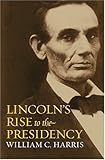
William C. Harris. Lincoln's Rise to the Presidency. Lawrence: University Press of Kansas, 2007. vii + 412 pp. $34.95 (cloth), ISBN 978-0-7006-1520-9.
Reviewed by Michael Taylor (Department of Social Sciences, Dickinson State University)
Published on H-CivWar (October, 2007)
All Too Human: The Restoration of an American Life
In a 1965 article for American Heritage, historian Henry Steele Commager wrote, "certainly of all the modern heroes it is Abraham Lincoln who lends himself most readily to mythology."[1] Indeed, his story is quintessentially American; he was of humble frontier origin and self-educated; he had a career in law and politics, with a rapid ascent to the leadership of his country; he provided a steady hand through the nation's most devastating conflict, and, then was assassinated in the afterglow of peace. Lincoln is both a national and global example that, in the United States, anyone can realize their ambitions--the tangible fulfillment of the American dream--through a combination of inspiration and determination. In turn, historians have immortalized the sixteenth president through a surfeit of books; filmmakers have romanticized the tale through a decidedly nationalistic lens; and, artists have rendered innumerable idealistic images both on canvas and in marble.
Yet, in the effervescence of myth the man himself is lost. Through the veneration of saints and rebuke of satyrs, the methodology by which most Americans have learned their history, the nuances that made the essential characters of the past relevant to the present--and, thus, vital to the future--are either obscured or lost completely. Once the innate, flawed humanity is excised from history, and replaced by lofty marbled images, the ability of each succeeding generation to comprehend the true magnitude of accomplishment is missing. In the thousands of volumes of Lincoln scholarship published in the seven generations since his death, this has been the case. Many have won prestigious prizes for their eloquence; nearly all have been venerated for their reverence; and, yet few have given us any new and vital insights into the human being Lincoln was.
This is why William C. Harris's new book, Lincoln's Rise to the Presidency is such a welcomed and necessary change. Rather than dwelling on the sixteenth president as the humble redeemer of America's fate, the author has chosen to introduce us to the human being. Lincoln inhabits every page with a breadth of emotion and depth of character that the more reverential biographies lack. Written in a clear and concise style, Harris has allowed the reader to experience his rough, shrewd, and determined main character and places him firmly within the context of then-contemporary issues. Furthermore, the author is not fearful of taking on the misconceptions, inaccuracies, and myths regarding his subject with a high degree of confidence and candor. This is because Harris, a scholar who has spent his career in careful and contemplative study of his subject, has extensively explored the available primary sources and allowed the record itself to influence his conclusions. At several junctures, the author corrects the assertions of such noted biographers as David Herbert Donald and Richard Carwardine. Though it is clear the author admires his subject, he is not afraid of confronting the flaws, shortcomings, and humanity of the sixteenth president--which is at the heart of his respect for Lincoln.
First, Harris's portrayal is of a man who was at once proud of his pioneer heritage (especially of his grandfather and namesake who had been one of the earliest settlers in what later became Kentucky), yet concurrently self-conscious of it (p. 7). As he gained a solid professional reputation, he actively distanced himself from the reminders of that past. Throughout the book Lincoln appears as a "man-on-the-make," who grasped every opportunity to improve his position in life and, as a result, was consistently irritated by the intrusion of that past upon his present. Of particular note was Lincoln's emotional detachment from his own father, even as Thomas Lincoln's death approached (p. 59). Finally, when he received the Republican nomination for the presidency, and the crowds touted a popular image of him as the "rail-splitter," Lincoln himself was "somewhat embarrassed" (pp. 197-98). As his reputation grew as a lawyer, the candidate was a man reluctantly tied to a background he had outgrown, and was irritated that his accomplishments as a lawyer and political leader were obscured by his most ardent supporters.
Second, Lincoln was a man with a passion for politics. From his service in the Illinois state legislature to his election as president of the United States, he was a man engaged in an "us-versus-them" struggle with political opponents (p. 146). Throughout the course of three decades of involvement in the political arena, his evolution from Whig firebrand to cool and calculating political master was nothing short of breathtaking. This is specifically evident in his two clashes with Stephen A. Douglas. During his campaign for the senate in 1858, Lincoln engaged in a series of debates, using those opportunities to clarify and correct his record and his stands on various issues, most notably slavery. Yet he also utilized these appearances to create a popular image of Douglas's "popular sovereignty" policy as a "don't care" position on slavery (p. 168). As the Republican candidate for president two years later, Lincoln found that the same strategy proved successful during the most heated of presidential campaigns (p. 195). Thus, contrary to popular mythology, Lincoln was a partisan party politician who operated effectively in the rough-and-tumble of 1850s national politics and triumphed over his rivals.
Third, Lincoln was also a complex human being whose public image was often in sharp contrast to the man he knew himself to be. Wholly driven by ambition, Lincoln sought to prove his worth not only to the world, but to himself. The price he paid, however, was his own ever-present sense of doubt that led to bouts of depression (p. 158). It is this constant internal struggle between the man Lincoln saw himself to be, and the man he strove to be, that provided a depth of character that allowed him to readily excuse flaws in others (p. 199). Yet he could also be vindictive when he reasoned that others were acting maliciously, irresponsibly, or in a manner that could destroy either the fragile tethers of the Union or his own political prospects (pp. 188-89). As such, in his dealing with both the public and his closest confidants, Lincoln was at once compassionate yet cautious, witty but sullen, and, warm but detached.
Finally, the most intriguing aspect of this work is the author's detailed, unfolding, and comprehensive analysis of Lincoln's complex position on human slavery. Throughout his life, Lincoln viewed slavery as a moral wrong and sought to assist its gradual end (pp. 128-29, 162-63). Yet, as a man who viewed Union as the last best hope to achieve that end, his support for the restriction of slavery to the states where it already existed set him apart from most Northern Whigs, radical Republicans, and abolitionists (pp. 72-73). This political realism was at the heart of his support of both the Fugitive Slave Act and for colonization efforts in which Americanized ex-slaves were to be resettled in Africa (pp. 63-65, 146, 163, 195). When the moment dictated, Lincoln could also modify his stance to conform to the expectations of his audience, while claiming consistency, as he did time and again throughout the 1858 Illinois Senate campaign against Douglas (pp. 132-33). Rather than take the approach that Lincoln's life was a search for the best opportunity to emancipate the slaves, Harris chose to expose the evolution of Lincoln's thought in a detailed fashion. In doing so, his subject is allowed to mature from an interest in sustaining the country to preserving it with the Emancipation Proclamation of 1863.
It is this approach to Lincoln's life that allows the reader to grasp the sixteenth president's true significance--he is the embodiment of the "American Dream." Overcoming all of the obstacles thrown at him from birth, Lincoln tirelessly labored to educate his mind, refine his talents, and better his station in life. Perhaps because he had scant formal education, Lincoln educated himself through a serious pondering of public affairs and, as a direct result, matured in his assessments as the nation's political fortunes crumbled. At crucial points in his career it was no accident that this man was ever-ready to take incremental steps with cautiousness and confidence. It was this unrelenting quest that provided the means by which he rose to the presidency and, through the grit and determination he had relied upon all his life, held the nation together by sheer force of his will. The pertinent lesson here is blunt: if this man could overcome his own innate humanity and situation to accomplish the remarkable, there is no reason why any American, no matter how dire the circumstance, could not do the same.
The Lincoln bicentennial occurs within a month of the next presidential inaugural. Inevitably, it will spawn a plethora of new books tracing the exalted life and endeavors of the sixteenth president--the vast majority of those books will be forgettable at best. They will be filled with graven images and legendary tales of the saintly man who saved the Union from the Southern secessionists. Again and again the tragic tale of his assassination will be recounted, in which, according to novelist/historian Robert Penn Warren, the "negative values of death are transmuted into overwhelmingly positive ones [because] the death has the aura of sacrifice."[2] In perpetrating the myth of Lincoln, one cannot help but ponder the incalculable disservice that will be done to his true legacy.
But one can hope that a few historians will produce works comparable to Harris's superb effort. Rather than perpetuating the marbled god, these scholars shall provide candid portrayals of a mortal with ample political skill whose ambition led him to seek the nation's highest office and, at the onset of crisis, to rise to the occasion. They will be accurate tales that reflect the best of what the United States and its people are capable of. This is the tale that can inspire succeeding generations towards greatness, to be the leader Lincoln was in life rather than in hallowed myth. If this be the case then this nation's greatest days are truly ahead.
Notes
[1]. Henry Steele Commager, "The Search for a Usable Past," American Heritage 16, no. 2 (February 1965): 91.
[2]. Robert Penn Warren, "A Dearth of Heroes," American Heritage 23, no. 6 (October 1972): 97.
If there is additional discussion of this review, you may access it through the network, at: https://networks.h-net.org/h-civwar.
Citation:
Michael Taylor. Review of Harris, William C., Lincoln's Rise to the Presidency.
H-CivWar, H-Net Reviews.
October, 2007.
URL: http://www.h-net.org/reviews/showrev.php?id=13660
Copyright © 2007 by H-Net, all rights reserved. H-Net permits the redistribution and reprinting of this work for nonprofit, educational purposes, with full and accurate attribution to the author, web location, date of publication, originating list, and H-Net: Humanities & Social Sciences Online. For any other proposed use, contact the Reviews editorial staff at hbooks@mail.h-net.org.

