



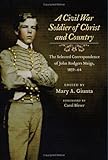
Mary A. Giunta, ed. A Civil War Soldier of Christ and Country: The Selected Correspondence of John Rodgers Meigs, 1859-1864. Urbana and Chicago: University of Illinois Press, 2006. xxii + 310 pp. $60.00 (cloth), ISBN 978-0-252-03076-5.
Reviewed by Chris Samito (Department of History, Boston College)
Published on H-CivWar (October, 2007)
One Family's Experiences with Growth and Loss during the Civil War
Among events that have transformed American life, government, and culture, few have wrought as many changes as the Civil War. In light of the magnitude and volume of these tremendous re-organizations, it is easy to lose sight of the personal impact the Civil War had on people. One way to fill this gap is to examine the lives and thoughts of select individuals and, in so doing, better understand the personal journeys they experienced during a cataclysmic event that left an indelible mark on nearly all it involved. An effective way of accomplishing this is to read the words and confidences of actual participants and feel these experiences through them. Through letters, we can witness, as close to firsthand as possible, the transformations people underwent as a result of the Civil War.
Editor Mary A. Giunta's A Civil War Soldier of Christ and Country: The Selected Correspondence of John Rodgers Meigs, 1859-1864 provides a window into a family coping with war. John Rodgers Meigs was the son of Union Quartermaster General Montgomery C. Meigs. After he graduated from West Point in 1863, John Meigs served as a military engineer and aide to Philip Sheridan in the Shenandoah Valley, where he was shot and killed in October 1864. By including John Meigs's letters, as well as those written to him by his parents and other relatives, Giunta allows readers an opportunity to witness a young man's maturation at West Point, and a family's struggle with his growth, active service in the field, and death for the Union. Collections of Civil War letters are usually one-sided because often, only letters sent home survived. Here, Giunta's work allows us a rare opportunity to read both sides of the written conversation between John and his family (something which this book's subtitle should acknowledge but inexplicably ignores). The value of an edited collection is defined by what its documents say, and the strength of these letters is what they tell us about families during the Civil War era.
John's mother, Louisa Rodgers Meigs, penned some of the most moving letters in this book. Saddened by her son's absence from the rest of the family during Christmas 1859, Louisa reminisced about past Christmases with her children, "waiting for the visits of 'Santa Claus,'" and she asked John not to open an accompanying package that she sent until Christmas Eve or morning, "so that we may all enjoy our Christmas at the same time" (pp. 50-51). Another prewar letter written by John's mother for his birthday contemplated that her boy had become a man, and Louisa reminded John that soon, he "will have arrived at all the dignities and privileges of manhood and the battle of life for you will commence. You must put on your Christian Armor and go forth into the strife" (p. 62). In the immediate aftermath of John's death, a poignant letter written by John's mourning mother contemplated his young life cut short, and described how she had obtained the clothes he wore on that fatal night. Louisa recounted that holding close John's hat, "which still retains the perfume of his hair," made her feel that he was still with her, and how his clothes told the story of his death: a cloak splattered with mud showed that he fell on a rainy night, and his jacket was "pierced with a bullet just over the heart" (pp. 244-245). Also particularly interesting are letters from John's father giving his young son personal advice, parental guidance, and modern-sounding admonitions that his college-aged son should write home more often.
On the other hand, the letters in this book provide little insight in to military or political events leading up to or taking place during the war. The bulk of the letters occur during John's time at West Point. John entered active service in June 1863 (p. 177) and died in October 1864 (p. 241). John saw little combat during his active service, and he died before having an opportunity to pen a substantive collection of letters which might have revealed the development of his leadership skills as an officer in the field, or have shown his further maturation and development as a result of the war. Meanwhile, the letters written by Montgomery Meigs included in this book do not say much in the way of commentary about the Union high command, and Meigs tells his son little about his experiences as quartermaster general.
That is not to say that the letters do not provide some interesting nuggets. John's aunt, in early 1861, showed an eager willingness to embrace legal changes as a result of the Civil War, predicting that "all this present trouble will be in the end, good for the whole U.S. & that we shall be more united than even under an amended Constitution, & that affairs will be so settled that the 'Irrepressible Conflict' will be a thing no longer in every one's heart and on everyone's tongue, but forever more in the dim past" (p. 92). John's grandfather, in August 1861, placed the Civil War in global perspective, expecting that it would invigorate the United States: "If we extinguish this civil war, we shall be more potent than Assyria or Rome, & we shall go forth breaking the chains of mankind perhaps as far as Thibet or China & Japan" (p. 109). On the whole, however, this book provides little that is new in terms of combat descriptions, vignettes of Union leaders, or commentary about the war's prosecution or political change during the Civil War era. The use of a glossary to identify people and places in this book, instead of footnotes, is awkward, and greater editorial commentary between the letters would have improved this book and placed into clearer context the events discussed in them. A more developed analytical introduction of the letters as well as what we can learn from them (by focusing on family life during the late 1850s and early 1860s) and what this specific collection of letters tells us about the impact of the Civil War on a family would have provided this book with a sharper focus. Nonetheless, on the whole, Giunta should be commended for making available a collection of letters that provides multiple voices from the same family and offers insight into how the Civil War affected its members.
If there is additional discussion of this review, you may access it through the network, at: https://networks.h-net.org/h-civwar.
Citation:
Chris Samito. Review of Giunta, Mary A., ed., A Civil War Soldier of Christ and Country: The Selected Correspondence of John Rodgers Meigs, 1859-1864.
H-CivWar, H-Net Reviews.
October, 2007.
URL: http://www.h-net.org/reviews/showrev.php?id=13646
Copyright © 2007 by H-Net, all rights reserved. H-Net permits the redistribution and reprinting of this work for nonprofit, educational purposes, with full and accurate attribution to the author, web location, date of publication, originating list, and H-Net: Humanities & Social Sciences Online. For any other proposed use, contact the Reviews editorial staff at hbooks@mail.h-net.org.

