



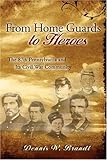
Dennis W. Brandt. From Home Guards to Heroes: The 87th Pennsylvania and Its Civil War Community. Columbia and London: University of Missouri Press, 2006. 312 pp. $42.50 (cloth), ISBN 978-0-8262-1680-9.
Reviewed by Andrew F. Lang (Department of History, University of North Texas)
Published on H-CivWar (October, 2007)
Ever since the guns were silenced in 1865, regimental histories have been a standard fixture of Civil War historiography. Whether written by the veterans themselves, amateur historians, or professional scholars, these works have served as a basic building block in the pursuit to understand better the great national tragedy. Often though, these histories become steeped solely in the military pursuits of a given unit. This is not the case with Dennis W. Brandt's From Home Guards to Heroes: The 87th Pennsylvania and Its Civil War Community. He employs a fresh approach to studying a regiment that will doubtless become the standard method for years to come. The author states that he has always been dissatisfied with George Reeser Powell's 1903 work, History of the 87th Pennsylvania Volunteers because the book is "lifeless" with "shallow" research (p. xii). Brandt ably succeeds in remedying Powell's perceived shortcomings by placing the regiment's history within the broader context of wartime South-Central Pennsylvania society. By utilizing a multitude of primary records (including every soldier's compiled service and pension records, extensive local records, as well as letters, diaries, and reminisces), Brandt offers the reader a chance to truly meet the soldiers, understand their experiences, and feel attached to their home communities.
The regiment, raised primarily in York County (with two additional companies from Adams County of Gettysburg fame), served just over a year in guarding the Northern Central Railway and saw action in their first major battle at Second Winchester, Virginia, on June 14, 1863. Following the Union victory at Gettysburg, in which the regiment was not present, the 87th was assigned to the Army of the Potomac's Third Corps, and later permanently attached to Brig. Gen. James B. Ricketts's Division of the Sixth Corps. The regiment, therefore, participated in Ulysses S. Grant's Overland Campaign, Cold Harbor, Petersburg, Sayler's Creek, and Appomattox, and consequently contributed to Philip H. Sheridan's Shenandoah Valley campaign of 1864; it also helped to prevent Jubal A. Early's attempt to capture Washington at the Battle of Monocacy.
Brandt's discussion of the regiment's battles and military campaigns is not what makes this book special, nor is that his intended purpose. Rather, the unique aspect of the study is Brandt's deft and intriguing thematic approach of presenting the regiment's attitudes, grumblings, interests, and experiences. His use of statistical analysis in painting a detailed picture of each company does not become monotonous, but instead, forces the reader to truly comprehend what life was like in the southern Pennsylvania farming communities. More important is Brandt's discussion of reasons why men from York and Adams Counties volunteered for service in 1861. Although the unit was from the North, their home communities bordered the slave state of Maryland. As such, the men were hardly influenced by any sort of abolitionist persuasion. Brandt maintains that no evidence exists that suggests that opposition to slavery served as a primary motivation in enlisting. Instead, those who originally made up the 87th Pennsylvania did so because they viewed secession as a threat to the Union and wanted to aid in suppressing the rebellion. On the other hand, some joined simply out of boredom at home, while others volunteered for the possibility of adventure. These motivations, of course, were not reserved only for the 87th Pennsylvania, and Brandt certainly recognizes this. The author argues that what made the regiment truly unique was the fact that 70 percent of the 1861 enlistees come from a community where the Northern Central Railway was present. Therefore, Brandt writes, "The regiment's [original duty] was to guard the rail lines, and men responded to the call" (p. 52).
Although men enthusiastically joined because of the possibility of protecting important facets of their home communities, the regiment was not "strained by the work" (p. 91). Brandt cites letters and diary entries from numerous soldiers who all consistently wrote about the boring and dull nature of their service. Further, he offers portrayals of soldiers who wrote about anything but the war, who included in their letters wonderful stories about fishing and even bragged that their service was so easy. Brandt correctly argues that "establishing unit esprit de corps was nearly impossible" during the first months of the war due to the nature of the regiment's railroad guard duty (p. 96). Finally, Brandt found that the regiment incurred a 25 percent desertion rate (throughout the entire war), which was three times greater than other northern units raised in 1861. Most desertions occurred during two key incidents: the regiment's first year of existence and immediately following the Battle of Second Winchester, in which the unit suffered heavy casualties. Brandt asserts that early in the war, age, geography (in terms of proximity to home), and even the possibility of class differences played important roles in the decision to desert. On the latter motivation, the author argues that men with higher incomes deserted less because of the negative impact it would place upon their communal standing. Even though Brandt propounds this argument, he ably notes that "however logical the income argument may sound, no income group deserted disproportionately to its head count, although financially advantaged men perhaps represent too small a percentage of participation to offer a significant sample" (p. 119). This latter statement indicates that the author refuses to let class conflict and differences in wealth influence his interpretations, and Brandt should be commended for his honest and unbiased analysis.
Brandt's work is the product of a ten-year long research endeavor into the 87th Pennsylvania, and the result is a crisply written and extremely detailed book. It appears, though, that he got to know "the boys from York" so well that he could not help including a multitude of vignettes and stories to bring his characters to life. In the end, this approach sometimes becomes distracting from the overall foundation of the book. It seems that the tome's plethora of anecdotes diverts the reader's attention away from the author's arguments and inherent purpose. This should not be considered a criticism because Brandt certainly knows how to write history and he should be commended on his undertaking. Regardless of this shortcoming (and the reviewer is hard-pressed to find more) Brandt has offered a refreshingly new approach to regimental histories and his book should become a standard model for future studies.
If there is additional discussion of this review, you may access it through the network, at: https://networks.h-net.org/h-civwar.
Citation:
Andrew F. Lang. Review of Brandt, Dennis W., From Home Guards to Heroes: The 87th Pennsylvania and Its Civil War Community.
H-CivWar, H-Net Reviews.
October, 2007.
URL: http://www.h-net.org/reviews/showrev.php?id=13644
Copyright © 2007 by H-Net, all rights reserved. H-Net permits the redistribution and reprinting of this work for nonprofit, educational purposes, with full and accurate attribution to the author, web location, date of publication, originating list, and H-Net: Humanities & Social Sciences Online. For any other proposed use, contact the Reviews editorial staff at hbooks@mail.h-net.org.

