

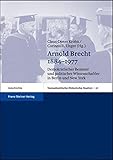
Claus-Dieter Krohn, Corinna R. Unger, eds. Arnold Brecht: Demokratischer Beamter und politischer Wissenschaftler in Berlin und New York. Stuttgart: Franz Steiner, 2006. 228 pp. EUR 38.00 (cloth), ISBN 978-3-515-08883-1.
Reviewed by Jason Tebbe (Department of History, Stephen F. Austin State University)
Published on H-German (September, 2007)
Saving a Forgotten Figure from Oblivion
Historians in general and historians of Germany in particular have recently become increasingly interested in transnational history and in tackling topics that do not fit neatly into the strictures of national history. For example, the historiography of the postwar period has seen many excellent examinations of the role of American popular culture in Germany.[1] However, we ought to remember that people as well as products moved across the Atlantic, and that they too can offer valuable windows into transnationalism.
One of those people was Arnold Brecht. A chancellery official with Social Democratic leanings during the Weimar period who fled the country after Hitler's takeover in 1933, Brecht settled in America and found a job at the New School for Social Research in New York. When the war began he consulted for the U.S. government, and after the war went back to Germany to assist in the rebuilding process and in the construction of the Federal Republic's Basic Law. Like the many other émigré scholars from Germany at the time, Brecht straddled the Atlantic Ocean and moved more than once between American and Europe.
Arnold Brecht has now received full biographical treatment in a collection of essays edited by Claus-Dieter Krohn and Corinna R. Unger. The editors make their purpose clear on the first page: they want to extend Brecht's undeservedly "forgotten" reputation. Although historians, including myself, too often resort to this justification for scholarship on obscure topics, by the end of the book the reader gets the impression that Brecht's life and work does indeed merit some further investigation.
The book alternates between biographical essays and those devoted to aspects of his thought. Volker Depkat begins with an analysis of Brecht's memoir, written during the 1960s. Not for nothing was its abridged English version entitled The Education of Arnold Brecht, and Depkat defines it as an "Erziehungsroman" that traces the effects that the manifold crises and breaks in Germany's twentieth century had on Brecht's political development. Depkat surmises that the experience of 1919 confirmed his belief in democracy, and that 1933 brought the problem of weighing the individual versus the collective into high relief. The second essay, by Barbara Burmeister, extends the biographical analysis and concerns Brecht's childhood and youth in Wilhelmine Lübeck. He appears to have had a rather typical upbringing for a child of the Hanseatic Bürgertum, which Burmeister argues sparked Brecht's devotion to liberal values as an adult.
The next chapter, by Heiko Holste, finally delves into Brecht's career as a government official in the Weimar Republic, specifically his role in the so called "Preußenschlag" of 1932, when then chancellor Franz von Papen took direct control of Prussia's state government. This power grab foreshadowed the one taken a year later by Hitler, and in general reveals the tenuous nature of German democracy and the Weimar constitution in the early 1930s. According to Holste, Brecht initially supported the move out of his belief in a more centralized German state but later saw his folly. The consequences of the Preußenschlag led Brecht to support a more federalist system of government in later life. Ultimately, a "technocratic" outlook had blinded him to the true nature of the Preußenschlag. Some of that mindset comes out in the essay that follows by Jürgen Koehler on Brecht's "Law of State Expenditures." This "law" was Brecht's biggest contribution to the field of political science, and it posits "a progressive parallel between state expenditures and population density" (p. 83). Brecht reached this conclusion after examining data from eighteen German Länder and nineteen American states. Koehler claims that although political scientists no longer think in terms of absolute "laws," Brecht's thesis still applies in certain contemporary circumstances.
The next two essays return to the biographical mode, the first being an account of Brecht's exile in America and activity at the New School for Social Research by Claus-Dieter Krohn. He places Brecht in the larger context of "refugee scholars" who fled persecution in Germany, but also points out some interestingly unique deviations from the norm in Brechts's case. Brecht was never forced to leave Germany, and he actually took vacations and research trips to Germany until 1939, which angered his New School colleagues. During these scholarly years he tried to figure out what went wrong with Weimar, examined the complications the New Deal faced with federalism, and wrote a prophetic article for the Harvard Law Review calling for the creation of a European "federation" after the war. Corinna Unger then examines his activities during World War II, particularly his role as an adviser to the U.S. government. In this capacity Brecht worked to make postwar Germany a Rechstaat, but unlike other émigrés such as Thomas Mann, he did not take part in propaganda broadcasts out of a sense of German patriotism. His continuing identification with his German identity set him apart from other émigrés, and possibly reflected the fact that his flight was one of choice rather than life-or-death necessity. After the war he immediately went back to Germany and involved himself in the rebuilding process. This activity included advocating a strongly federal German state and working to ensure that the civil service would be run on democratic principles by functionaries who would not betray the rule of law. Although Brecht wanted strict new standards for the civil service, like most Germans at the time he sharply criticized denazification and refused to accept any notion of collective guilt for the war.
The last two essays concern Brecht's later life. Michael Ruck's is particularly interesting as it details Brecht's ideas on the postwar "German question" and the Cold War in general. Above all, Brecht wanted a peaceful reunification of Germany, which he considered the key development for a peaceful resolution of the Cold War. Before the Korean War raised tensions he even advocated an organization that would bring together the central European states across the divide of the Iron Curtain. Not surprisingly, he maintained an extensive correspondence with Willy Brandt and supported the latter's Ostpolitik. The last essay, by Alfons Soellner, examines Brecht's magnum opus, Politische Theorie (1959). Despite winning many awards at the time of publication, Politische Theorie has faded into obscurity, something Soellner wants to rectify. He argues that its main value lies in its establishment of a middle path between absolute scientific truth and relative value. Furthermore, Soellner claims that Brecht hit on the dilemma of how modern states ought to distribute their resources well before John Rawls and others. Last, he poignantly finds Brecht's Kantian principles in need of revival in a world that too many interpret in terms of a "clash of civilizations." This last assertion fits with political progressives' other recent attempts to reclaim the Enlightenment tradition.[2]
In general, Arnold Brecht displays the benefits and drawbacks of collections of scholarly essays. Although the different essays allow for deep analysis of particular aspects of Brecht's life, their fragmented nature makes it difficult to get an overall feel for his life or importance. Considering the subject's fascinating biography and how he weathered the major upheavals in Germany's tumultuous modern history. a more narrative approach might have been more appropriate. The specialized nature of some the essays will also be off-putting to readers who lack a deep background in political science. For that reason and due to the obscurity of its subject, Arnold Brecht will not appeal to most students of modern German history. Nevertheless, the volume is of value for those interested in the high politics of the Weimar Republic, émigré German scholars in America, the history of social science, and debates over the "German Question."
Notes
[1]. Good examples include Heide Fehrenbach, Cinema in Democratizing Germany (Chapel Hill: University of North Carolina Press, 1995); and Uta Poiger Jazz, Rock and Rebels (Berkeley: University of California Press, 2000).
[2]. Stephen Eric Bronner, Reclaiming the Enlightenment (New York: Columbia University Press, 2006).
If there is additional discussion of this review, you may access it through the network, at: https://networks.h-net.org/h-german.
Citation:
Jason Tebbe. Review of Krohn, Claus-Dieter; Unger, Corinna R., eds., Arnold Brecht: Demokratischer Beamter und politischer Wissenschaftler in Berlin und New York.
H-German, H-Net Reviews.
September, 2007.
URL: http://www.h-net.org/reviews/showrev.php?id=13636
Copyright © 2007 by H-Net, all rights reserved. H-Net permits the redistribution and reprinting of this work for nonprofit, educational purposes, with full and accurate attribution to the author, web location, date of publication, originating list, and H-Net: Humanities & Social Sciences Online. For any other proposed use, contact the Reviews editorial staff at hbooks@mail.h-net.org.

