

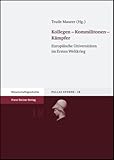
Trude Maurer. Kollegen – Kommilitonen – Kämpfer: Europäische Universitäten im Ersten Weltkrieg. Stuttgart: Franz Steiner Verlag, 2006. 376 S. EUR 47.00 (cloth), ISBN 978-3-515-08925-8.
Reviewed by Tracey J. Kinney (Department of History, Kwantlen Polytechnic University)
Published on H-German (September, 2007)
And So to Battle
Was the First World War a primal catastrophe, so great that every aspect of European society was profoundly transformed? Or, was the war, at most, an accelerant of changes well underway by the summer of 1914? These fundamental questions underlie the twenty-three German and English essays in this collection, on what editor and contributor Trude Maurer identifies as the long-neglected theme of universities in wartime. The wide-ranging essays, drawn from a conference, address the consequences of war for the university as an institution as well as the impact of war on the beliefs governing the universities and implications for teaching and study in Europe during and after the war. A number of the essays also draw attention to the connection between academic writings and the war effort, both the military effort and the so-called intellectual war. The collection is in many ways exploratory in nature, often indicating areas for further research, even as provisional conclusions are proffered. Above all, Maurer reminds the reader of Wilhelm von Humboldt's injunction that "die Wissenschaft als etwas noch nicht ganz Gefundenes und nie ganz Aufzufindendes zu betrachten und unablaessig sie als solche zu suchen [hat]" (p. 8).
Maurer's introductory chapter notes the need for social historians to address society as a whole in wartime, rather than focusing more narrowly on the state at war. Certainly, university students and their instructors were affected deeply by the events of the First World War, though the impact varied widely depending on, among other factors, proximity to the front lines and the nature of the state's response to the outbreak and progress of the war. Though the essays themselves cover widely divergent topics, a number of authors address the question of university reform during the war years; others concentrate on the wartime role of the professoriate; some examine questions of national versus collective identity in war; several authors address the transformation of Russian universities during the war; and, finally, three authors focus on the wartime role of three particular disciplines: physics, archaeology, and classical studies.
War as an instrument of (or catalyst for) reform is a recurrent theme in a number of these essays. Maurer notes at the outset that the war both endangered the universities and challenged them to rise to meet new opportunities. Andrea Wettmann concludes that, at least in the case of the German universities, the war brought great promise for modernization, but in the end only partial reforms due to institutional inertia. Similarly, Thomas Weber, in his examination of British universities, sees the war as rapidly accelerating changes already underway before 1914, including women's access, greater access to higher education in general, and a further impetus to the ascension of science over the humanities. Elizabeth Fordham notes an increase in the proportion of women studying at the Sorbonne, even as the prejudices of the male professoriate changed little; an acceleration of changes underway in academic priorities, with science once again moving to the forefront; and a strong impetus to continue these reforms in the postwar years. Detlef Busse's analysis of Ludwig Prandtl's work on aerodynamics concludes that the war lent new urgency to Prandtl's work, facilitating the creation of a model research institute with vastly improved facilities. Yet, in the process Busse questions whether Prandtl allowed the military to exploit his work in such a way that he ultimately lost his own role as the driving force behind further advancements.
The wartime role of the professoriate has long been an area of interest to scholars in particular of German history due to documents such as the "Manifesto of the Ninety-Three Intellectuals" (1914). Maurer argues in favor of the conventional view that the German university in wartime became a universitas militans, characterized by a near-total militarization of the professoriate and the student organizations. Drawing a straight line between later imperial militarization and the war years, Maurer claims that universities saw their responsibility as ensuring the "spiritual mobilization" of the German people for war; the professoriate, with a very small number of dissenters, viewed itself as a combatant fighting on the home front. Heavily influenced by Friedrich Meinecke, who claimed that "our militarism has become a part of our culture" (p. 67), Maurer's analysis seems to confirm the older arguments of George Mosse, Charles McClelland, Fritz Ringer, and others who saw the scholars of the late imperial period as the greatest defenders of the Kaiserreich and its values.[1] Jürgen von Ungern-Sternberg's examination of German archaeologists during the war likewise reinforces Maurer's conclusions.
In contrast, however, Eberhard Demm challenges the view of the professoriate as the "geistige Liebregiment der Hohenzollern" (p. 297) by examining the degree of influence actually wielded by the professoriate in wartime. Demm reveals not only a notable lack of influence on military and bureaucratic agencies, but also a considerable variety of opinion among professors themselves, at least with regard to Russia. Scholarly views ranged from aggressively annexationist plans, to the notion of Mitteleuropa, to the idea of a separate peace without annexation. Older arguments in favor of a uniquely German militarism are also challenged in Weber's article. While Weber does not doubt that the German professors of 1914 were aggressively militaristic, he notes an analogous response in Britain. Weber concludes that British academics similarly saw themselves as warriors in the battle for western civilization and that the militaristic values inherent in college sports had "conditioned students and Old Boys alike to do their patriotic duty" (p. 78). Weber further argues that British academics intensified the war of words by repeatedly claiming that the "good" Germany, the land of writers and thinkers, had been hijacked by the "bad" Germany of Prussian militarism. This claim, in turn, forced German academics to defend their country ever more aggressively. This notion of two Germanys, one barbarous and one enlightened, appears in several articles and could perhaps have been addressed in greater detail.
National identity emerges as a major issue in a number of the papers, whether in relation to foreign students in enemy countries, scholars who had considered themselves first and foremost as part of an international scientific community, or minorities within multi-ethnic empires. In the case of the latter, Sirje Tamul offers a fascinating examination of the University of Jur'ev in wartime. The university had been refounded during the Napoleonic wars on Germanic lines in order to bring western learning to Alexander's empire. In the late nineteenth century, the university underwent a Russification campaign, but remained suspect for its "Germanic influence." Nonetheless, when war broke out Jur'ev students responded enthusiastically, even as the material impact of the war made life at the university increasingly difficult. By 1915, the precarious position of the university led to the first discussions of evacuation and the first movement of rarities and manuscripts to the interior of Russia. Tamul notes that a number of Russian professors left Jur'ev for the interior during 1915 and 1916. Nonetheless, by 1917 the front line was approaching the university, creating a peculiar predicament for Jur'ev's remaining students. They could evacuate to Russia and a foreign culture, or stay and face potential German occupation. On September 6, a coalition of Baltic, German, Jewish, and Polish student organizations petitioned against the evacuation, arguing that Jur'ev must remain an Estonian institution. Thus, national identities had become the most important factor determining the student response (and that of the non-Russian faculty) to the threat facing them. Susan Morrissey's examination of the Petrograd student body also points to the emergence of "national" identities among Russian students, in contrast with the traditional view of a collective identity (studencestvo) transcending such differences.
Several authors address the issue of scholarly internationalism, especially in the sciences, versus wartime nationalism. In this case, the articles seem to reach similar conclusions. The experience of war produced a fundamental reorientation of prewar linkages and prewar attitudes towards international cooperation. During the war, new connections were established, especially between France and Russia, and France and the United States. In the aftermath of the war, further reorientations took place as, initially, Soviet and German scientists were excluded from international organizations and, more importantly, a new approach to international cooperation took shape. Henceforth, national interests would be strengthened through international ties. Both Elizabeth Fordham and Aleksandr Dmitriev conclude that researchers would now define themselves primarily as representatives of their nation and national scientific schools.
Nine of the articles presented in this collection directly address the impact of the war on Russian universities, and several others touch on related issues, providing an excellent opportunity to consider the Russian situation in a comparative context. The combined effects of war and revolution served to transform Russian universities and, at least in part, to achieve one of the major prewar goals of the Russian professoriate--the democratization of higher education. Before the war, however, as Dmitriev makes clear, the professoriate had sought to achieve democratization through greater university autonomy from government. After the February Revolution autonomy seemed to be all but conceded, but the October Revolution brought further upheaval. In the end, the universities were thoroughly democratized. Both Dmitriev and Evgenji Rostovcev agree that the Bolsheviks simplified admission procedures, abolished academic degrees, opened doors to female students, and established full equality of university teachers. However, these goals were achieved by removing any trace of autonomy from the universities themselves. Overall, Dmitriev and Rostovcev disagree as to whether the Soviet reorganization of education achieved or utterly negated the goals of the professoriate.
The collection benefits greatly from a valuable person and place index which, the editor notes, has not been created electronically. Therefore, the index references not only explicit occurrences of personal and place names, but also indirect mentions. This is an exceptionally useful resource, insofar as it allows the reader to follow common persons or places across a number of essays. A note is also included on the transcription of Russian and Polish names and places, as well as a clarification of the dating system utilized in the articles on Russia. For the most part, individual authors also draw attention to the difference between the Gregorian and Julian calendars when necessary. Though the level of documentation varies from one article to the next, it is, for the most part, comprehensive. One wonders if the very brief glossary might either have been expanded, or omitted entirely. The collection does contain a small number of typos and, in the case of the Wettmann article, a slight variation between the title listed in the table of contents and the title provided with the essay itself. However, these are relatively minor points, as the work as a whole represents a welcome contribution, both to the study of university history and to the much broader issue of the home front in wartime.
Note
[1]. See, for example, Walter Laqueur and George L. Mosse, eds., Historians in Politics (London: Sage, 1974); and Fritz Ringer, The Decline of the German Mandarins: The German Academic Community, 1890-1933 (Middletown: Wesleyan University Press, 1990).
If there is additional discussion of this review, you may access it through the network, at: https://networks.h-net.org/h-german.
Citation:
Tracey J. Kinney. Review of Maurer, Trude, Kollegen – Kommilitonen – Kämpfer: Europäische Universitäten im Ersten Weltkrieg.
H-German, H-Net Reviews.
September, 2007.
URL: http://www.h-net.org/reviews/showrev.php?id=13630
Copyright © 2007 by H-Net, all rights reserved. H-Net permits the redistribution and reprinting of this work for nonprofit, educational purposes, with full and accurate attribution to the author, web location, date of publication, originating list, and H-Net: Humanities & Social Sciences Online. For any other proposed use, contact the Reviews editorial staff at hbooks@mail.h-net.org.

