



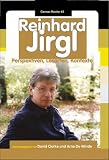
David Clarke, Arne de Winde, eds. Reinhard Jirgl: Perspektiven, Lesarten, Kontexte. Amsterdam: Rodopi, 2007. 278 pp. $75.00 (cloth), ISBN 978-90-420-2137-2.
Reviewed by Katrin Polak-Springer (Department of Germanic and Slavic Languages and Literatures, Rutgers University)
Published on H-German (September, 2007)
Reinhard Jirgl: A Shooting Star of Contemporary German Literature
Reinhard Jirgl has emerged as one of the key figures in German contemporary literature. Born in 1953 in East Berlin, Jirgl started writing in the 1970s, yet remained underground and practically unknown until after German unification and the Literaturstreit of 1989-90. Recently he has become a star of current German literature, having received renowned prizes and stipends such as the Alfred-Döblin-Preis in 1993, the Stipendium des Deutschen Literaturfonds in 2002, the Kranichsteiner Literaturpreis in 2003, and the Dedalius-Preis für Neue Literatur in 2004. David Clarke's and Arne de Winde's book is the first published compilation of essays on Jirgl. It presents the author's diverse approaches to his work and seeks to stimulate further research. The contributions are written in German with short English synopses and are supplemented by a well-structured bibliography compiled by Arne de Winde. The index includes a list of Jirgl's prizes and primary and secondary works about him.
Jirgl's works Abschied von den Feinden (1995) and Hundsnächte (1997) engage the public debate on East German nostalgia for the past and the GDR dictatorship, as well as on social injustice in the Berlin Republic. In Hundsnächte, criminals in positions of power before unification end up at the top of social hierarchy after 1990. Jirgl's novel Die Unvollendeten (2003)--a story about a Sudeten German family's futile struggle to establish a new home in the Soviet Zone and later GDR--is regarded as an important contribution to the public debates on German expulsions from territories in east-central Europe during and after the Second World War and their integration in the Cold War East and West German states. Generally, Jirgl deals with structural power and the elimination of the subject in postmodern society. In Mutter Vater Roman (1990), the author attacks the conventions of family and gender roles. Die atlantische Mauer (2003) addresses existential homelessness, migration, and globalization. His characters are torn between security and freedom, stasis and movement, home and the foreign. Domesticity and human relationships are associated with exploitation and mutual dependency, while breaking out, on the other side, eventually leads to death. Formally, Jirgl is associated with an arabesque, polyphonic style of writing. During the years of inner emigration, he developed his personal grammar and spelling, making use of an alphanumerical code, which resembles the universalism of mathematical formulas. His use of punctuation is reminiscent of the Spanish use of exclamation marks, and the written word imitates spoken language with all its dialects, emotionality, and incomprehensibilities. As a result, the reader's comprehension is constantly interrupted, while a whole new dimension of emotionality is added to the text. Jirgl's works have been compared to those of Alfred Döblin, Arno Schmidt, Uwe Johnson, Wolfgang Hilbig, and Heiner Müller.
The possibilities of interpretation and analysis are sheerly endless, while literary studies have just begun to recognize the author as, in Helmut Böttiger's words, a "symbol for something that in fact should not exist anymore; at least a great part of culture journalism was working hard to eliminate the last remains of it: the heavy and deep, the non-understandable German" (p. 13). First and foremost, this collection offers what the title announces: an introduction to the author's background and his themes, as well as an overview of different perspectives on them. Clarke starts out with a concise introduction, followed by Böttiger's Laudatio, held at the 2003 presentation of the Kranichsteiner Literaturpreis.
One of the most interesting and revealing perspectives presented in this book is that of the author himself. In "Gespräch in Briefen," Clemens Kammler and Arne de Winde discuss the most debated issues about Jirgl. In lengthy and detailed responses to their questions, the author evades clear yes/no answers, in accordance with his conviction about the general absence of truth. When questioned about a possible way for a contemporary author to evade the alternatives of assimilation to mass media or an esoteric counter-position, Jirgl writes, "any either/or situation appears uninteresting to me, since it leaves no room for the creative, but cements the social pressures--also those of an author--in fulfilling creative demand and the demand of economic survival" (p. 55). Jirgl's answers never resemble his personal reaction to the questions, but rather, like his novels, include ideas from philosophical, literary, and academic discourses. Some of the ideas explored in the interview are Michel Foucault's theory on discourse and power, Heiner Müller's fascination with antique myths, Ernst Jünger's ideas on death and memory, Oswald Spengler's pessimism of civilization, and W. G. Sebald's thesis about the taboo of allied bombings in German collective memory. A "tireless word-twister," Jirgl rejects comparisons to other authors and preconceptions about him as misunderstandings due to the linguistic imprecision of critics and journalists (p. 248).
The main part of the book consists of perspectives on Jirgl from specialists on GDR and German contemporary literature. The editors compiled a broad variety of interpretations and approaches. There are three essays on the novels Hundsnächte, Die atlantische Mauer, and Die Unvollendeten. Simon Ward interprets the first of these, set in the former death zone of the German-German border, as "posthistoire," specifically looking at motives of the ruin, the railway, and the desert. Christine Cosentino reads Die atlantische Mauer in terms of a changing image of the United States. Caren Dannemann analyzes Jirgl's relationship to the GDR state system, looking at the motifs of cannibalism and church rituals, which impose violence upon the subject. Similarly, David Clarke emphasizes the negative role of subjectivity in Jirgl's works, pointing out parallels between family and state relationships of power, which equally suppress the individual. Jirgl's peculiar style of writing is analyzed in an essay by Arne de Winde, who speaks of a "multi-dimensional space of reading and thinking" (p. 141). Clemens Kammler and Erik Grimm represent diverging views on the possibility of conservatism in Jirgl's works.
The editors hope that the different arguments presented in this book will be perpetuated in literary discourse and further debated. An English language volume on Jirgl remains to be written. Not a single publication in any language other than German is listed in de Winde's bibliography. The difficulties of transferring Jirgl's success to the non-German language world may consist in the sheer impossibility of translating his texts, many of which visualize the spoken word: "1=für=!Allemal."[1] The intentional effect of Jirgl's word-play and emotional punctuation is dissociation, making his texts difficult to read and to translate, a sign for a new type of national literature that abandons standardized high language and a connection to world literature in favor of a new subjectivity of writing.
Note
[1]. Reinhard Jirgl, Die atlantische Mauer (Munich: Carl Hanser Verlag, 2000), 53.
If there is additional discussion of this review, you may access it through the network, at: https://networks.h-net.org/h-german.
Citation:
Katrin Polak-Springer. Review of Clarke, David; Winde, Arne de, eds., Reinhard Jirgl: Perspektiven, Lesarten, Kontexte.
H-German, H-Net Reviews.
September, 2007.
URL: http://www.h-net.org/reviews/showrev.php?id=13613
Copyright © 2007 by H-Net, all rights reserved. H-Net permits the redistribution and reprinting of this work for nonprofit, educational purposes, with full and accurate attribution to the author, web location, date of publication, originating list, and H-Net: Humanities & Social Sciences Online. For any other proposed use, contact the Reviews editorial staff at hbooks@mail.h-net.org.

