



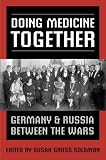
Susan Gross Solomon, ed. Doing Medicine Together: Germany and Russia between the Wars. Toronto: University of Toronto Press, 2006. 553 pp. $65.00 (cloth), ISBN 978-0-8020-9171-0.
Reviewed by Jeffrey Lewis (Undergraduate International Studies Program, Ohio State University)
Published on H-German (September, 2007)
Normal Science
Doing Medicine Together: Germany and Russia between the Wars is a solid piece of scholarship that makes use of the wealth of new archival materials available in the aftermath of the collapse of the Soviet Union to provide a detailed, intimate look at networks of interaction that emerged between Russian and German medical professionals during a time when both states tended to be seen as international pariahs. While the subject itself is not novel, the authors of this collected volume seek to offer a fresh perspective by looking below the state (or macro-) level perspective that has tended to inform the historiography of the topic in both Germany and Russia. By looking at individuals, institutions, and intellectual agendas the authors hope to present the story of cross-national scientific relations as an aspect of scientific and medical development in Russia and Germany as opposed to an offshoot of diplomacy or power politics (pp. 10-11). For the most part they succeed, although the book as a whole sometimes takes this empirical approach to extremes and becomes mired in excessive detail and description.
For an edited volume, the book is remarkably consistent and focused. It originated in the early 1990s in a series of annual symposia on German-Russian medical relations, and began to take shape formally in 2000 at a conference held at the University of Toronto. The authors display a ready familiarity with one another's work that makes the transition from chapter to chapter smooth and for the most part allows the book's themes to emerge clearly. Significant cross-referencing and an excellent index complete the integration of the chapters.
The book's eleven substantive chapters explore four major themes: "Choosing" scientific friends, scientific entrepreneurs across borders, bilateralism and internationalism, and scientific migration. All of the authors demonstrate an excellent command of the relevant primary and secondary sources. Indeed, on the whole the book draws upon a wealth of resources and is certain to be of interest to specialists in the field for this purpose. This depth, coupled with the consistency discussed above, means that at its best, the book is an example of what an edited work should strive to be--a coherent collaborative effort drawing upon the talents of multiple researchers for a common purpose.
Doing Medicine Together also demonstrates some of the defects of edited volumes. In order to give all eleven scholars a sufficient stage upon which to set their stories, the book comes in at 500 pages of text, including notes, and would have benefited from compression. Some of the length can be attributed to the inevitable repetition that emerges when eleven people discuss the same subject (although to the editor's credit, the repetition/overlap in the book is minimal), but the book also tends to devote attention to certain topics that is disproportionate to their broader significance. This is particularly true of section 2, which, as a treatment of scientific entrepreneurs, consists only of four chapters devoted to the same entrepreneur--German bacteriologist Heinz Zeiss.
Zeiss was a very interesting character; his first extensive work in Russia began in the early 1920s when he was a member of the German Red Cross's expedition to the Volga Germans (p. 45), but through his own initiative he turned this beginning into more than a decade's worth of interactions and network building with Soviet colleagues. At the heart of this collaboration, however, Zeiss remained an ardent German chauvinist and a shameless self-promoter (pp. 292-293), and in the end he could not disguise his contempt for his Soviet interlocutors. Over the long term his impact on German-Soviet medical relations was rather minor (pp. 167, 273). While Zeiss was certainly an interesting individual and exemplified the importance of individual initiatives in German-Soviet medical relations, a central theme of the book, the authors do not build a convincing case for devoting more than 160 pages of text to him.
My misgivings about this approach notwithstanding, the authors do use Zeiss effectively to demonstrate the centrality of individual biases and agendas even in such an unusual political climate. Whether at the individual or institutional level, the common denominator that emerges from these chapters is the pursuit of support and patronage and the promotion of self-interest. In a fascinating chapter, Nikolai Krementsov uses the case of the Seventh International Genetics Congress, originally scheduled to meet in the USSR in 1936 but rescheduled and moved to Edinburgh in 1939, to explore the interests of state patrons of science in Germany and the Soviet Union, and the pressures that these interests placed on the genetics community at the national and international levels. As genetics became increasingly politicized in these two states (as Rassenhygiene in Nazi Germany and "bourgeois science" in Soviet Russia), geneticists in these two countries had to balance carefully the quest for patronage at home with the search for scientific credibility among their colleagues in the United States and the United Kingdom, many of whom viewed such politicization with a skeptical eye. In his comparative study of brain research institutes in Moscow and Berlin, Jochen Richter shows how different international agendas within the same state could conflict with one another, thus undermining the idea that science was unified or consistent enough to be a part of macro-level politics. Both institutes shared a founder in the German Oskar Vogt. Vogt founded the Berlin institute first, then traveled to Moscow in the mid-1920s, where he established a twin institute, initially for the purpose of investigating Lenin's brain (pp. 333-33 6).
As the Moscow institute grew, Vogt's close contact with the Soviet government began to run counter to the agenda of the Kaiser-Wilhelm-Society for the Advancement of the Sciences (Vogt's parent organization in Germany), which sought to strengthen scientific relations with western states. Finally, self-interest drove cooperation between the most unlikely of partners. Michael David-Fox reveals that the Soviet organization VOKS (All-Union Society for Cultural Ties Abroad) worked extensively with a centrist/nationalist organization in Germany, the Gesellschaft zum Studium Osteuropas, a partner with whom it seemed to have very little in common. In the end, the glue that bound this relationship together "was each side's belief that it was successfully manipulating the other" for its own purposes rather than any true partnership (p. 122).
What emerges most strikingly from these eleven chapters is the complexity of individual motivations--incorporating not only scientific but also ideological and personal elements--and the need to subordinate or compromise certain of these elements for practical purposes. Deception and manipulation were integral, not extraneous to this human process. Of course, these same trends--competition, cooperation, self-promotion, and so on--are characteristic of what we think of as normal science more generally, and herein lies Doing Medicine Together's greatest scholarly contribution. It shows convincingly that even in the troubled and unsettled political climate prevalent in Germany and Russia between the wars, science as a human process proceeded relatively "normally," both within and across national borders.
If there is additional discussion of this review, you may access it through the network, at: https://networks.h-net.org/h-german.
Citation:
Jeffrey Lewis. Review of Solomon, Susan Gross, ed., Doing Medicine Together: Germany and Russia between the Wars.
H-German, H-Net Reviews.
September, 2007.
URL: http://www.h-net.org/reviews/showrev.php?id=13606
Copyright © 2007 by H-Net, all rights reserved. H-Net permits the redistribution and reprinting of this work for nonprofit, educational purposes, with full and accurate attribution to the author, web location, date of publication, originating list, and H-Net: Humanities & Social Sciences Online. For any other proposed use, contact the Reviews editorial staff at hbooks@mail.h-net.org.

