



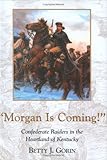
Betty J. Gorin. "Morgan is Coming"! Confederate Raiders in the Heartland of Kentucky. Louisville: Harmony House Publishers, 2006. xv + 452 pp. $25.95 (cloth), ISBN 978-1-56469-134-7.
Reviewed by Jacob Lee (The Filson Historical Society)
Published on H-CivWar (September, 2007)
John Hunt Morgan and the Civil War in South Central Kentucky
Confederate cavalryman John Hunt Morgan is one of the most recognizable Kentuckians from the Civil War era. The archetype of the southern cavalier, Morgan captured the South's imagination during the war, and he has continued to appeal to modern audiences attracted by his dash and daring. Betty J. Gorin's "Morgan is Coming!" Confederate Raiders in the Heartland of Kentucky is the newest study of Morgan and his raids into Kentucky. Although many of the same events are covered, Gorin's book differs from the multitude of previous works on Morgan's cavalry. In her introduction, Gorin, an independent historian and native of Taylor County, Kentucky, states that she is not producing a biography of Morgan. Instead, she emphasizes Morgan's actions as part of a broader study of the Civil War in the area around Taylor County, particularly Adair, Cumberland, Green, and Marion Counties.
Gorin begins her study with a description of Campbellsville, the county seat of Taylor County, as it appeared in 1860. She also offers physical and demographic information on the counties surrounding Campbellsville. In 1860, the five county area had a demographic breakdown between white and black much like the rest of the state. In the state as a whole, slaves made up approximately 20 percent of the population; a little more than forty-four thousand whites resided in Taylor, Adair, Cumberland, Green and Marion Counties along with more than ten thousand slaves. Like many Kentuckians, the residents of Taylor County hoped to preserve the Union while maintaining slavery and more than 80 percent of the votes in that county went for either Northern Democrat Stephen A. Douglas or Constitutional Unionist John Bell, eschewing the perceived radicalism of both Southern Democrat John C. Breckinridge and Republican Abraham Lincoln. Once the war began, most of the region sided with the Union. After the end of Kentucky's neutrality in the fall of 1861, federal troops established recruiting and training camps in the central part of the state and prepared to battle with Confederate forces. Gorin states that federals constructed no fewer than five military camps in Taylor County alone. For the rest of the war, Union soldiers remained in the area, guarding bridges, railroads, and other infrastructure necessary to supply the armies farther south.
Morgan is a constant presence in Gorin's narrative. Gorin adds little to current understandings of Morgan. The Morgan she depicts is much like the Morgan described by James A. Ramage in his biography, which is the standard.[1] However, Gorin offers new details about his military career in south central Kentucky. In 1861, Morgan was arrested near Campbellsville for conducting in illegal trade with the Confederacy. Before the war, Morgan and his brothers were prominent Lexington hemp dealers, and in September 1861, Morgan was captured taking a load of gray jeans south. After his release, he returned to Lexington, where he joined the Confederate sympathizers in the Lexington Rifles, a local militia unit that became the foundation of Morgan's cavalry. In late-1861, Morgan led these men to southern Kentucky, where he began raiding into federally controlled territory. One of the Confederate's first targets was the Pleasant Hill Meeting House, where Morgan had been held captive. In January 1862, Morgan and his men burned the building, which had since become a store house for Union supplies. Morgan came through Taylor County twice more in 1862, once in July and again in December on his famous Christmas Raid. Gorin recounts both raids in detail. The centerpiece of Gorin's work is the Battle of Tebb's Bend, part of Morgan's July 1863 "Great Raid" into Kentucky, Indiana, and Ohio. Near the beginning of his raid, Morgan encountered the command of Union Colonel Orlando H. Moore. Moore, with about two hundred troops, had fortified a position on the Green River at Tebb's Bend. Determined to defeat this small federal detachment, Morgan ordered repeated frontal assaults on the position. Despite having four or five times as many troops as Moore, Morgan could not break through the Union lines. In the end, Morgan lost the battle and depleted his command, which suffered (depending on the source) between 70 and 250 killed and wounded.[2] While her account of Tebb's Bend is the first detailed analysis of that battle, Morgan's actions in the fight confirm much of what historians already knew about the general. He was not a brilliant military mind, but was instead a brash commander whose bravado often resulted in military failure, especially in 1863 and 1864.
While Gorin focuses on Morgan, her interest also goes beyond him. Even Gorin's chapters about Morgan include extensive information peripheral to the raider, providing a good background for the stories about Morgan's raids. In addition, Gorin also includes chapters on Confederate guerrilla Henry Magruder, who operated some in that area, and Confederate General Hylan B. Lyon, who burned the Campbellsville courthouse on an 1864 raid.
Strictly narrative and aimed at a general audience, "Morgan is Coming!" does not add much to historiographical debates about Kentucky in the Civil War. Gorin's most important contribution to the literature is a detailed study of south central Kentucky during the war. The work is most useful for the information Gorin collected about Taylor County and the surrounding area. While the narrative is sometimes bogged down with excessive detail, Kentucky historians and genealogists will find the book to be a gold mine of information. In addition to the narrative, Gorin put together several appendices listing Taylor County soldiers in the Civil War, casualties of the Battle of Tebb's Bend, official reports related to the battle, and period correspondence from Kentuckians who lived around Campbellsville. Gorin also includes extensive illustrations of persons and places referred to in the text.
Scholars interested in Morgan and his raiders will be better served by the works of Ramage and Gary Robert Matthews, but Gorin provides a well-documented history of the cavalryman's career in the area around Taylor County.[3] However, Gorin also raises many questions. While readers will learn much about Confederate raiders and guerrillas in the area, one wonders about the effects of the Union troops stationed in Taylor County. How did they interact with the community? Almost 10,500 slaves lived in the five counties Gorin studies. How did the demise of slavery affect whites and blacks in the area? That being said, Gorin has produced an informative study of the Civil War in south central Kentucky.
Notes
[1]. James A. Ramage, Rebel Raider: The Life of General John Hunt Morgan (Lexington: University Press of Kentucky, 1985).
[2]. Gorin states that Basil Duke, Morgan's second in command, reported 36 dead and 45 wounded, while Moore estimated 50 killed and 200 wounded (p. 209).
[3]. Gary Robert Matthews, Basil Wilson Duke, C.S.A.: The Right Man in the Right Place (Lexington: University Press of Kentucky, 2005).
If there is additional discussion of this review, you may access it through the network, at: https://networks.h-net.org/h-civwar.
Citation:
Jacob Lee. Review of Gorin, Betty J., "Morgan is Coming"! Confederate Raiders in the Heartland of Kentucky.
H-CivWar, H-Net Reviews.
September, 2007.
URL: http://www.h-net.org/reviews/showrev.php?id=13552
Copyright © 2007 by H-Net, all rights reserved. H-Net permits the redistribution and reprinting of this work for nonprofit, educational purposes, with full and accurate attribution to the author, web location, date of publication, originating list, and H-Net: Humanities & Social Sciences Online. For any other proposed use, contact the Reviews editorial staff at hbooks@mail.h-net.org.

