



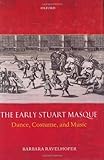
Barbara Ravelhofer. The Early Stuart Masque: Dance, Costume, and Music. Oxford and New York: Oxford University Press, 2006. xv + 317 pp. $99.00 (cloth), ISBN 978-0-19-928659-1.
Reviewed by Gayle Gaskill (Department of English, The College of Saint Catherine)
Published on H-Albion (August, 2007)
Dancing Diplomacy under James I and Charles I
Writing with impressive erudition and arch wit, Barbara Ravelhofer portrays the early Stuart masques as brilliant, multi-media events that portray historically, artistically significant visions of diplomatic harmony. Carefully costumed, choreographed, and rehearsed, these politically instructive allegories displayed courtly control and refinements from the early extravagant leaps of the Duke of Buckingham under James I through the later dainty steps of Queen Henrietta Maria, consort to King Charles I. They also drew international, aristocratic viewers to participate in the harmonious revels with simpler, more manageable dance steps. Ravelhofer's research is both thorough and original in a subject has until lately lagged behind burgeoning research in theater performance history. Underscoring the distinctions between masques and plays, she scrutinizes not only English scripts but dance notations, diaries, costume sketches, and account books of the Stuart courts and their continental counterparts. What is more, she personally practices the dances so she can time them and judge the effects of their performance on participants and onlookers alike. Thus she challenges the commonplaces of recent masque criticism and woos readers with her frank delight in her subject.
Though the masque came to England in the continental train of Henry VII, it truly flourished as a form of symbolic, diplomatic participatory instruction under the early Stuarts. No dancer himself, King James provided the enthroned royal presence for whom the court moved. At first, virile leaps and lifts of male dancers expressed Stuart optimism. George Villiers, Duke of Buckingham (1592-1628), a favorite of James and Charles, learned dance steps as he learned languages, and he kept French and Spanish dancing masters busy instructing him and his ambitious imitators. Young, tall, and athletic, Buckingham set a standard for the carefully rehearsed capering of masque displays. Sagely, Ravelhofer observes that Buckingham may have exercised a professional dancer's discipline over his body as part of his struggle to control the anxieties that attended his complex manipulations of influence networks and controversial diplomatic missions under an unstable royal patron.
Prince Henry (1594-1612) was another noted dancer, but his untimely death, followed by that of Buckingham, eventually left masquing responsibilities to Queen Henrietta Maria, and the form grew feminine as more stately French choreography developed graceful arm movements and gliding steps that emphasized the upper body and concealed the legs. As exhibitions of royal power, masques required aristocratic leadership, so when difficult dance steps demanded professional expertise, dancing masters acquired honorary titles, a practice that caused growing distaste among older, more sedentary courtiers who had inherited their titles with their wealth. Though masques also required conspicuously extravagant costumes, the author's research reveals those creations of silk and jewels remained in use as court dress long after their symbolic wings, armor, or animal epaulets had been snipped off. On all public occasions, courtiers dressed for display.
Ravelhofer illustrates her theories with detailed close readings of Ben Jonson's Masque of Queenes (1609), in which Queen Anne and legendary queens drove the cacophonous hags of rumor from the echoing House of Fame, and Jonson's Oberon (1611), the coming-of-age masque for a heroically costumed Prince Henry in the title role. By 1634, as Parliament began to gain the upper hand in England and the Thirty Years War absorbed European politics, the Stuart masques grew ever more earnest in efforts to promote King Charles's inherited agenda of Pax Britannica. Ravelhofer presents a close reading of Thomas Carew's 1634 masque Coelum Britannicum, led by King Charles. Figuring a new St. George amid Inigo Jones's stage designs, the King instructed the Olympian gods to reform their households on the principle of good manners before the very stars invited the King and Queen to exercise their British astrological influence over the earth. The court masque had become a piece of ironic nostalgia before the close of the decade ended the form.
Ravelhofer's research methods are thorough and imaginative, for she scrutinizes private diaries and letters, costume sketches, and expense records. Henrietta Maria's masque expenses, for example, were sometimes subsidized out of the King's Great Wardrobe. She contextualizes specific masques by examining their highly symbolic visual components as well as their scripted lines. The porcupine figures in Coelum Britannicum, for example, portray the late Sir Philip Sidney's outdated militancy, now supplanted by King Charles's more reasonable, peaceful Neoplatonic harmony. Even the word "Britannicum" signified the accord of Scotland, Ireland, and Wales with England in a show of national unity. Ravelhofer's careful footnotes and thirty-six-page bibliography reveal her thorough familiarity with current research into masque and theater history, and she wisely recognizes Stephen Orgel, David Lindley, and Andrew Gurr among many others.
Testing theory with practice, she considers the performance elements of her research. One of her footnotes thanks her own choreography instructor, and she provides photographs of recent masque performances. She consults a mask workshop, for example, to compare the respective values of leather and cardboard masks, and she notes the problems of perspective-drawn sets with vanishing points that look lovely until actual human maskers stand up in them and spoil the illusion by proportion. Inigo Jones solved the latter problem with a raked upper stage and flat lower stage. She considers feminist theories of the male gaze and female downcast expression not only as assertions of power differences but as dancers' practical attentions to their own movements.
Each of Ravelhofer's ten chapters opens with a lively anecdote and concludes with a summary, and she interlaces technical descriptions of dance moves with sensational, well-documented adventures. Dancing masters were occasionally captured by pirates, accused of murder, or left unpaid and pitiably desperate to return to France. She even includes a ghost story: one Francis Holles was rehearsing alone before a Whitehall performance when "the apparition of a fair lady joined him for the dance. This preoccupied him so much that he died soon after" (p. 129). Ravelhofer also makes wry comments on her subjects. She notes, for example, that early male masque costumes included stockings stuffed with bombast, "the early modern masculine equivalent to the Wonderbra" (p. 171), and she scorns those who sniffed at Queen Anne's daring self-display on the courtly stage. "The enormous scope of female performance under Henrietta Maria might not have been possible without Queen Anne's impertinent ankles" (p. 178). She modestly notes the limitations of any research in her multi-disciplinary field. Complex masque symbolism may have merely frustrated a viewer who stood near the back of the hall, who needed a pair of spectacles, or who grew confused in dim artificial light. International visitors may have lacked the language skills to grasp the dialogue, and even native speakers might have found themselves unable to hear or to catch complex classical and heraldic allusions. Nonetheless, to attend and participate in an aristocratic entertainment was a memorable experience whereby the early Stuart courts theatrically asserted their power, and Ravelhofer's thorough, sympathetic, and enthusiastic study of the masque in performance is well worth a reader's attention.
The author is a promising, versatile scholar, a lecturer in English Literature at the University of Durham, and a Research Associate of the Center for History and Economics at King's College, Cambridge. Palgrave is scheduled to release her second book, English Historical Drama, 1500-1660, in September 2007, a collection she has edited with Teresa Grant of the University of Warwick.
If there is additional discussion of this review, you may access it through the network, at: https://networks.h-net.org/h-albion.
Citation:
Gayle Gaskill. Review of Ravelhofer, Barbara, The Early Stuart Masque: Dance, Costume, and Music.
H-Albion, H-Net Reviews.
August, 2007.
URL: http://www.h-net.org/reviews/showrev.php?id=13522
Copyright © 2007 by H-Net, all rights reserved. H-Net permits the redistribution and reprinting of this work for nonprofit, educational purposes, with full and accurate attribution to the author, web location, date of publication, originating list, and H-Net: Humanities & Social Sciences Online. For any other proposed use, contact the Reviews editorial staff at hbooks@mail.h-net.org.

