



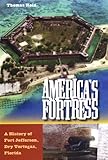
Thomas Reid. America's Fortress: A History of Fort Jefferson, Dry Tortugas, Florida. Gainesville: University Press of Florida, 2006. xii + 163 pp. $24.95 (cloth), ISBN 978-0-8130-3019-7.

Gregory A. Waselkov. A Conquering Spirit: Fort Mims and the Redstick War of 1813-1814. Tuscaloosa: University of Alabama Press, 2006. ix + 414 pp. $39.95 (cloth), ISBN 978-0-8173-1491-0.
Reviewed by Robert A. Taylor (Department of Humanities and Communication, Florida Institute of Technology)
Published on H-Florida (August, 2007)
Tales of Two Forts in Peace and War
Forts have always played a very significant role in the history of Florida. A quick glance at a map of the state shows numerous communities that begin their names with a reference to a fortification which often no longer exists. Such forts, be they substantial models of military engineering or hastily constructed bastions, had little worth if they did not provide security for their occupants and perform their military function. Their walls also in many instances served as nuclei for nearby settlements. Two such places, Forts Mims in modern day Alabama and Fort Jefferson in the Dry Tortugas, while on Florida's periphery, impacted the state's founding and development in several ways. Ironically one would be destroyed in a blaze of frontier violence, while the other would never be completely finished or tested in battle.
Gregory A. Waselkov's A Conquering Spirit: Fort Mims and the Redstick War of 1813-1814 is a modern treatment of a place and an event lodged in American memory as much as it is in American history. Most connect the action at Fort Mims to Walt Disney's Davy Crockett saga of the 1950s (this reviewer remembers hearing the tale of the Mims "massacre" from an audio biography of Crockett in the 1960s). The facts are that a force of over seven hundred Creeks of the "Redstick" faction stormed a fortified position named for settler Samuel Mims on August 30, 1813. In short order they overwhelmed its defenders. At least two hundred and fifty of the four hundred soldiers and settlers inside were killed and the site burned to the ground. This defeat shocked Americans across the country and fueled a cry for revenge that resulted in the so-called Redstick War. This campaign concluded with the crushing of Creek resistance, the securing for white settlement of a large section of the Old Southwest, and the elevation of Tennessee's Andrew Jackson to prominence as a military leader.
Waselkov's study spends far more space looking at the causes and consequences of the Fort Mims assault than on the actual attack, which is covered in roughly twenty-two pages. He sees Mims as a collision of cultures in the Tensaw region in present-day central Alabama. This area was indeed on the edge of wilderness and a flash point in an unstable borderlands area by 1813. Creek Indians struggled with internal problems as they faced pressure from American land-seekers, possible problems with the Spanish in Florida and British intrigue along the Gulf coast, and the ongoing presence of African-American slaves. Finally there was the plight of people Waselkov refers to as "metis." These ethnically mixed persons had trouble striking a balance between the two cultures and were never certain to which they truly belonged.
The influx of Yankee settlers after 1800 filled the greater Natchez region in what was then termed Mississippi Territory. In time frontiersmen spilled over into the Tensaw region along the banks of the Alabama River. Tensions reached new levels with the outbreak of war between the United States and Great Britain in 1812. Native Americans all along the frontier felt the tug of war and many saw an opportunity for an armed response to American demands for their lands. The movement led by Tecumseh and the Shawnee Prophet found many willing recruits in Creek towns, and the call for a complete rejection of white civilization appealed to many. Such Creeks took up the war club as Redstick warriors. Mixed-blood metis and full Creeks soon found themselves at odds, and a Creek civil war was a reality by 1813. Metis like Redstick leader William Weatherford opted for the traditional Creek position, while others did not, setting the stage for bloody conflict.
Isolated settlers of all stripes grew fearful of the Redstick onslaught and gathered together for protection behind temporary fortifications, such as the one constructed around the Mims plantation. Militia troops, along with wooden walls and new blockhouses, created an illusion of safety there. Unfortunately Fort Mims suffered from significant design flaws and a less than alert garrison. Its commander, the luckless major Daniel Beasley, missed strong clues that a Creek attack was imminent, and failed to even make certain that the fort's gates were secure.
The price was paid on August 30, 1813 when a wave of Redsticks rushed the fort and overran it in short order. Its defenders were cut to pieces in the sharp engagement, and over one hundred whites were taken captive. The author claims, with some justification, that the fall of Fort Mims was "one of the greatest victories in the history of Native American warfare" (p. 138). It certainly rates with the 1835 defeat of Francis Dade's column in Florida, and with the near destruction of the 7th Cavalry on the plains of Montana in 1876. However, like the battle of the Little Big Horn, the Redstick victory at Fort Mims proved fleeting as it only angered Americans and led to a mobilization of military forces tasked with seeking revenge.
As word spread across the country of events at Fort Mims militia units in Mississippi Territory, Georgia, and Tennessee mustered for action. The resulting Redstick War saw sweeps through Creek country that destroyed a number of Native towns whether they were on the warpath or not. In April, 1814 a defeated William Weatherford walked in to General Andrew Jackson's camp and surrendered the remnants of the Redsticks. Jackson, well on his way to legendary status, negotiated a stern treaty that cost the entire Creek nation at least twenty million acres of land. Some of the people displaced by this agreement made their way to Florida and joined the Seminoles.
Waselkov concludes that the memory of Fort Mims cast Native Americans as bloodthirsty savages in need of removal from proximity to white settlements. Such inhabitants should also pay by ceding their land to the United States in order for it to be used by proper "civilized " people. In time this line of reasoning would be applied to those Natives living on the Florida peninsula to the south, where the pattern of treaties, war, and removal would go on. While Fort Mims was not located in Florida proper, students of Florida history can profit from this book's ethno-historical examination of Creek and white society during the ever-shifting conflicts on the southern frontier at the time of the War of 1812.
No trace of Fort Mims survives today, but the same cannot be said of another fortification far to the south of the Florida mainland. In America's Fortress: A History of Fort Jefferson, Dry Tortugas, Florida, Thomas Reid takes a look at the origins and nineteenth-century history of probably the most elaborate coastal defense work ever constructed by the United States. Beginning in 1846 construction on the citadel went on for thirty years (government project indeed!) and was never totally completed. Originally intended to secure America's strategic position in the Gulf of Mexico, Fort Jefferson turned out to be of marginal military value. As the decades passed the U.S. Army Corps of Engineers had to become adept at creating justifications for funding the project.
Living and working at Fort Jefferson, according to Reid, was a tremendous experience for those soldiers, civilians, and African American slaves sent there in the antebellum era. Natural beauty went along with oppressive heat, foul water that was often in short supply, disease, and occasional hurricanes. These enemies, more than any foreign military force, were what troops truly faced there. Florida's secession in 1861 and the outbreak of civil war ended the fort's tropical idyll, and it along with Fort Taylor in nearby Key West would remain under Union control for the duration.
The bulk of America's Fortress, in fact four out of seven chapters, deals with Fort Jefferson's Civil War experience. Though never seriously threatened by the Confederates, building and funding for it never slowed during the war years. The fort's chronicle, in the author's words, was the ebb and flow of Yankee troops, some African American, in and out of the garrison. They constantly faced the threat of sickness, poor rations, and ill discipline caused by boredom and lackluster officers. But for most soldiers, a tour at Fort Jefferson was a rare opportunity to live and work on an exotic island. The war was far away from Jefferson's high walls, and the days there passed slowly for those behind them.
Fort Jefferson's main notoriety during the Civil War was as an infamous military prison. Its reputation, according to author Reid, as the American Devil's Island was born and grew during the 1860s. Many a Northern soldier shuddered at the thought of serving a sentence there at hard labor under the broiling Florida sun. The fort's prison population grew markedly from 1864 to 1865, with a peak of almost nine hundred inmates. At one point there were far more prisoners than guards, making escape attempts frequent and sometimes successful. Jefferson's most famous reluctant guests were several of the Lincoln assassination conspirators, including the famous Dr. Samuel A. Mudd. Controversy about conditions and alleged mistreatment of Mudd and his fellows tainted the fort's reputation even further as either a Unionist Bastille or simply a hellhole. Such allegations, which the author downplays, contributed to the conspirators' eventual pardon by President Andrew Johnson.
Fort Jefferson's postwar life as a military post was not destined to be a long one. Though construction continued right to the end, the last federal garrison left the key in 1874. Only caretakers and occasional personnel manned its ramparts. Unfortunately the author covers the fort's post-1874 career in two short paragraphs. The narrative stops with some abruptness in 1935 when the old fort became a national monument. A real opportunity to discuss how Fort Jefferson has faired as a historic site, now a part of the Dry Tortugas National Park, is missed here. Regardless, Jefferson still stands; a silent sentinel manning its lonely post.
General George S. Patton once remarked that "fixed fortifications are monuments to the stupidity of man." Does this maxim of war apply to Forts Mims and Jefferson? Mims was tested in battle but failed in its primary mission to protect its inhabitants. Jefferson consumed funds and resources from 1846 to 1874 and never truly repelled an enemy. In any case both existed in peace and in war and both left imprints, though perhaps faint, on Florida's history. Students of nineteenth-century Florida can learn much from these solidly written volumes, and they are recommended.
If there is additional discussion of this review, you may access it through the network, at: https://networks.h-net.org/h-florida.
Citation:
Robert A. Taylor. Review of Reid, Thomas, America's Fortress: A History of Fort Jefferson, Dry Tortugas, Florida and
Waselkov, Gregory A., A Conquering Spirit: Fort Mims and the Redstick War of 1813-1814.
H-Florida, H-Net Reviews.
August, 2007.
URL: http://www.h-net.org/reviews/showrev.php?id=13488
Copyright © 2007 by H-Net, all rights reserved. H-Net permits the redistribution and reprinting of this work for nonprofit, educational purposes, with full and accurate attribution to the author, web location, date of publication, originating list, and H-Net: Humanities & Social Sciences Online. For any other proposed use, contact the Reviews editorial staff at hbooks@mail.h-net.org.

