



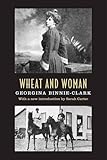
Georgina Binnie-Clark. Wheat and Woman. With a new introduction by Sarah A Carter. Toronto: University of Toronto Press, 2007. lxv + 313 pp. 95 (paper), ISBN 978-0-8020-3813-5.
Reviewed by Bonnie Huskins (Department of History, University of New Brunswick at Saint John)
Published on H-Canada (August, 2007)
Worth Another Look
Georgina Binnie-Clark (1872-1947), a young female journalist from England, purchased 320 acres near Fort Qu'Appelle in Saskatchewan in 1905, and established herself as a single woman farmer at a time when the Dominion Lands Act discouraged female homesteading. Wheat and Woman, "the only published book-length account of a single woman farmer" in Canada (p.xxiii), chronicles her trials and tribulations from the harvest of 1905 to that of 1908. Binnie-Clark bought the farm on an experimental basis, to prove that homesteading in Canada was a viable option for the redundant gentlewomen of Britain who could find neither husbands nor employment. She wished to convince these women that "what men had done for themselves in agricultural pursuits on the prairie, [they] could also do for themselves" (pp. 304-305). While Binnie-Clark was occasionally absent from the farm, it is clear that she worked the land from late 1909 until the onset of World War One, at which time she returned to England where she worked for the Department of Labour, organizing female agricultural laborers in the Yorkshire and Lincolnshire districts. Although Binnie-Clark maintained a residence in Chelsea and a small business in London's main shopping district, she did return to the prairies when her brother, Arthur, who also farmed in Saskatchewan, died in 1921. Thereafter Binnie-Clark shared the management of the farm with her sister Ethel, and by 1930, they had 275 acres in production (p. xl). By 1936, Binnie-Clark was again in England, where she died in 1947.
This is the third edition of Wheat and Woman, the first being issued in 1914 by William Heinemann of London, and by Bell and Cockburn of Toronto, and the second by University of Toronto Press in 1979. The question must invariably be asked: do we need a third reprint? The two introductions included in this edition suggest an affirmative response. The third edition begins with a new introduction by Sarah A. Carter, wherein she argues that it is "time to introduce this book and its author to a new generation and to reconsider both in the light of new approaches to the past and new research on women in Canada, in the British Empire, and on the Great Plains of North America" (p. vi). However, Carter is careful to articulate that this new introduction "builds on, and should be read in conjunction with" Susan Jackel's 1979 introduction, which is also included in this 2007 edition. Comparing and contrasting the two introductions provides the reader with an interesting exercise in how history has evolved since the late 1970s.
Before launching into an analysis of the content of Wheat and Woman, one must first consider its stylistic features. Wheat and Woman is a form of life-writing, a multifaceted autobiographical genre which is propelled by "a sincere, probing disregard" for "rules" and strict literary conventions.[1] Indeed, Wheat and Woman does not fit comfortably into any particular genre: Carter characterizes it as "a sort of early twentieth-century, western Canadian version of Susanna Moodie's 1852 Roughing It in the Bush" (p. vi), while Jackel views Binnie-Clark's publications as a form of Edwardian travel writing with the addition of fictional devices such as dialog, characterization, and plot to appeal to a glutted market (p. xxxvii). As a mutable genre, Wheat and Woman integrates alternative formats into its pseudo-fictional narrative, including excerpts from Binnie-Clark's diary and financial records. This literary analysis undoubtedly sends up red flags for the historian. As Jackel admits, it is "impossible to know with certainty whether the 'I' of this book is primarily self-revealing or self-creating: whether we are dealing with the confessional tones of the autobiographer, or the plausible but largely fictive revelations of an artfully-projected narrative persona" (p. xxxvii). Indeed, Binnie-Clark changed names and even personalities in this book to complement her narrative structure (p. ix). Thus, one must ask the question: how reliable is the information contained in Wheat and Woman? Jackel asserts that "even when all due allowance has been made for the hazards posed by her procedure, one can piece together enough fragments of the Binnie-Clark story to lay the groundwork for research elsewhere" (p. xxxvii). This reviewer concurs with Jackel that much of value can still be gleaned from this volume, despite its fictive elements. We must be cautious, but are we not supposed to treat all historical sources with a critical eye? Do not all sources contain conventions of various sorts?
What of content? Jackel, who approached the book as part of the University of Toronto Press's Social History Series in 1979, contended, not surprisingly, that Wheat and Woman has "much to offer the student of social history in Canada" (p. xxxv). Given the objective of women's historians in the 1970s-1980s to root out patriarchal oppression, Jackel maintained that Wheat and Woman's "strongest claim to reexamination ... lies in the light it sheds on sexual politics in this country during the century's early years" (p. xxxv). This is evident in Binnie-Clark's vigorous challenge to respectable middle-class gender norms in her assumption that marriage was not the ultimate destiny for all women: "there is another and increasing group of women who, if they cannot have marriage as an inspiration in their lives, refuse it as a mere resource" (p. 304).
Wheat and Woman attempts to prepare such independent single women for the challenges that they would confront on the prairie. For example, Binnie-Clark recorded the resistance that she experienced as she assumed the role of woman-farmer. After reprimanding one of her workers for his careless ploughing, he responded: "Boys Alive! I guess I know more about ploughing than any woman." And after a subsequent reprimand about his sulky attitude, he guffawed: "No offence...I was only having a laugh. Boys Alive! I guess a fellow's got to put up with a lot from a woman boss" (pp. 220-221). Binnie-Clark at times despaired over men's lack of appreciation for women's work: "none can make clear the labour and energy which women distribute, looking after the personal need of men who never give a thought to the work they are creating, but will spend hours meditating on the work they can evade" (pp. 227, 164). To avoid problems with male laborers, Binnie-Clark recommended that the most effective plan for an independent woman-farmer is to "train herself to do all her own chores" and hire workers only at "special seasons" (p. 227).
A major barrier to the success of the woman-farmer was, according to Binnie-Clark, the "male monopoly in the kingdom of politics." Indeed, in Wheat and Woman, Binnie-Clark recalled driving past a political meeting during an election campaign wherein the "benches seemed packed--with men only!" (p.77). Due to the patriarchal nature of "the kingdom of politics," laws were not favorable to female homesteaders. Binnie-Clark explains: "on every side my [male] neighbours had obtained their land as a gift from the Government, or at least one hundred and sixty acres of it, and a further hundred and sixty had been added on the condition of pre-emption, which is by payment of three dollars an acre in addition to the performance of the homestead duties; in this way a farm in every way equal to the one which had cost me five thousand dollars was to be obtained by any man for nine hundred and seventy dollars. So that even allowing that a woman farmer is at a slight disadvantage in working out a farm proposition, she has the killing weight of extra payment thrust on her at the very outset. She may be the best farmer in Canada, she may buy land, work it, takes prizes for seed and stock, but she is denied the right to claim from the Government the hundred and sixty acres of land held out as a bait to every man" (pp. 299-300). Moreover, Binnie-Clark despised men's lack of sympathy on this issue. When she laid out her complaints regarding the Dominion Lands Act, the most frequent response was "Too bad!" (p. 300). As a result of this fundamental inequality, Binnie-Clark joined the homesteads-for-women movement, which culminated in the presentation of a petition to Parliament in 1913, but it ultimately came to naught.
Carter, in her 2007 introduction, does not disagree with Jackel that gender inequality is central to Binnie-Clark's life and writing. Indeed, she laments the lack of attention Wheat and Woman received after the 1979 edition, as women's historians moved away from a focus on white Anglo-Saxon "woman worthies" in favor of "ordinary women," and as biographies became increasingly associated with the "old 'great men' approach to history." Carter contends, however, that we still need to study women like Binnie-Clark, "not because we need female additions to heroic tales of rugged individuals in the narrative of western Canada," but because Binnie-Clark's life and writing provides insight into "the privileges, limitations, and complexities" of "unstable categories" such as gender, class, race, and empire (p. vii). As an illustration, Carter questions the usual assumption that Binnie-Clark was an elite gentlewoman who wielded power and privilege on the prairie. Rather, Carter suggests that while Binnie-Clark may have been "genteel," she was not "well-to-do." She exhibited many of the trappings of gentility and respectability, such as education and a British heritage and culture, yet was born into a modest family and was always struggling financially (pp. vii-viii). Indeed, Binnie-Clark complained numerous times in Wheat and Woman about being "desperately short of money" (p. 190). Moreover, Binnie-Clark and her family were not viewed as elites in the Saskatchewan community in which they lived. Quite the contrary, they were often perceived as helpless green horns. Binnie-Clark implies in Wheat and Woman that this label was not unwarranted. She includes many humorous stories about her own incompetence: not being able to hitch up her own horses (p. 53), or to milk her own cows. On one Sunday morning she decided she would persevere with the milking: "I sat through two hours pulling and pressing, and squeezing and giving vent to my feelings. At the end of that time I had about a quart of Molly's milk in the pail, and I hadn't even looked at the hard cow. I got up for a moment to ease my cramped limbs, and Molly, thoroughly fed up from the prolonged ceremony, walked off gaily, kicking over the pail in her exit!" (p. 133). In another episode, after becoming disoriented on the way home from Qu'Appelle and ending in neighbor Guy Mazey's property, she discovered that he had no knowledge that he was supposed to be threshing out her crop, clearly an oversight on her part: "It is probable in the dazzling brightness of the kitchen my greenness, standing out from the background of the pathetic darkness in which I had lost my way, stood me in good stead, since among the entire threshing-gang only one tittered audibly at my amazed discomfiture, and he was promptly shut up" (pp. 41-42).
The sometimes contemptuous attitude shown toward English settlers often got under the skin of Binnie-Clark's brother, Lal. Lal exploded one day after an allusion to the poor quality of a fellow Englishman's fence: "Look here Adam...I never hit a chap beneath my own size, but if I ever hear that word 'green Englishman' from you again I'll give you a bath in the slough" (p. 225). This altercation not only provides insight into the negotiation of social status, but also the contestation of masculine identities. We have seen that many of the men in Binnie-Clark's world, whether Canadian, English, or Irish, resisted her usurpation of male work and male authority. In other words, they negotiated their masculinity in relation to assumptions about proper womanhood. However, Joy Parr asserts that "it is probably as important to leave open the possibility that some forms of masculinity have not been defined by their difference from femininities, but by their difference from other masculinities."[2] To be an English man in early twentieth-century Saskatchewan was to be at a disadvantage, despite British imperialists' claim to racial superiority: Canadians defined their masculinity as hegemonic, due to its practicality and physicality, two qualities clearly needed on the prairie. Binnie-Clark also provides a glimpse of homosocial male bonding between her brother and chore-boy Heriot Hylton, who was known to be a good storyteller. "One day I remember seeing my brother literally doubled up with laughter during the happy period after meal-time when men grow interesting to each other" (p. 83).
Binnie-Clark's "first allegiance," according to Carter, was not to her gender but to the British Empire. She was one of a generation of educated British women who saw it as their duty to promote the Empire "at home and in the colonies" (p. 10). Binnie-Clark's writings, including Wheat and Woman, and her submissions to periodicals like the Imperial Colonist (the official publication of the British Women's Emigration Association and the South African Colonization Society) were meant to entice British women to the colonies, particularly to Canada (pp. x-xi). She began to train "would be women-farmers" on her land beginning around 1910, although ironically most of them were eventually married off (pp. xiii, 308). Binnie-Clark eventually abandoned the idea of attracting solely female homesteaders, but she continued to promote British emigration to Canada through the Union Jack Farm Settlement program established in 1930. This program, however, received little support, as British imperialism started to wane, and free land began to dry up in Saskatchewan (pp. xx-xxii).
Binnie-Clark, like many of her generation, held eugenic ideas about the superiority of the British race: "the thoroughbred is as unmistakable in the human as in the equine order of beings" (p.171). Yet she was not above critiquing her fellow countrymen when the occasion warranted it. She was particularly critical of the Englishmen like Mr. Rossiter who arrived in the west with no actual knowledge of prairie farming, yet who assumed that "it would be simply a matter of watching another do it, and he would be quite all right" (p. 134). She also admitted that the English tend to be "fussy and hysterical over trifles" and that they are "not clever woodsmen" (pp. 258-59). She was not beyond self-contrition for her own tactless pontification. In a conversation with a Canadian and an Irish worker over a drunken man who had been defrauded of a valuable horse, Binnie-Clark exclaimed that such an act "would have been all right from your point of view, but out of the question for an English person." Upon informing their boss that it was an Englishman that bought the horse, "There was a tiny silence, followed by shrieks of Irish and Canadian laughter." Her Canadian worker then brought her down a peg: "I shouldn't have said, only you asked me straight out.... I guess there's good and bad in all alike. `Twill all come out in the wash!'" (pp. 139-140). Despite Binnie-Clark's great fondness and respect for Canadians, she still viewed them through the prism of empire: Canada embodied the "virgin side of the Great Mother" (pp. 312-313) and Canadians were "most valuable and desirable as general caretakers and overseers" (p. 271). Non-British races do not play a prominent role in Wheat and Woman; rather, they provide a contextual backdrop. Despite the proximity of Binnie-Clark's farm to Cree, Assiniboine, and Saulteaux reserves, Carter notes that there are few references to Aboriginals beyond her praise for the Le Bret Industrial School (pp. xi, 55-59). Moreover, "half-breeds," although "peculiarly alert and clever in any task which brings one into direct touch with nature and elementary conditions" such as fence-building (p. 130), were also quarrelsome drunks in Wheat and Woman, and Binney-Clark viewed drunkenness as an affront to the British Empire (pp. 242-243). There are references to the North West rebellion, but largely in the context of the experiences of "the patriarch of the village and the principal friend and adviser of the Indians," Archibald Macdonald. (p. 67).
Furthermore, Binnie-Clark's dealings with hired help, including chore-boys, agricultural labourers, carpenters, and caretakers, contributes much to the recent literature on labor-capitalist relations on the prairies. After releasing Mr. Rossiter for not carrying his load on the farm, Binnie-Clark lamented that he was the "only person with whom I had a stormy passage or with whom I agreed to differ in Canada and in whose conduct I failed to discover my share of the blame" (p. 149). It must have been somewhat comforting when another worker, Roddy McMahon, agreed that "You're best quit on him...I never see anyone yet to do so little and to want so much praise for it. 'Twas a fright!" (p. 149). Binnie-Clark's most stressful encounter was when laborer Patrick O'Hara left her at the onset of harvest. She railed against him: "You have played the meanest trick that a workman can possibly play, and--not that I consider it makes the matter better or worse--you have played it on a woman" (p. 247). As Cecilia Danysk has explained in her study of hired help on the prairies, "job- jumping" was a common practice of farm laborers who took advantage of the urgency for labor, especially during harvest. Nonetheless, she suggests that "despite instances of antagonism and even the effective use by farm workers of tactics of resistance, relations between labour and capital in prairie agriculture during the early years of the wheat boom were characterized not by conflict but by co-operation."[3]
There is evidence in Wheat and Woman of the persistence of "reciprocal work bees," which provided "individual farm families who lacked self-sufficiency in labour and skills," like Binnie-Clark, "a measure of insurance against hard times while they established and maintained a workable farm unit." Catharine Anne Wilson also contends that reciprocal work was "a key component in the structuring, operation, and definition of neighbourhood."[4] In Wheat and Woman, Binnie-Clark relied heavily on many of her workers and neighbors, especially Roddy McMahon: "I always found him a rock of defence in these very critical periods of the short farming season on the prairie" (p. 204). She also declared that "Roddy McMahon at his best is a good type of Canada's most valuable specimen of the man on the land, and as he is always in his best form through threshing[.] I knew I should get threshed out all right while such a friend remained at court" (p. 297). She exhibited gratitude for neighbors John and Danny McLeay, relations of Roddy: "No words can make clear how much I owed to John and Danny McLeay in my first seasons ... I can't say chivalry hasn't any real existence when I remember how often those three men [including Roddy] came across the prairie to do me service in time of need; when I think of their simple courtesy and kindness, their word of sympathy and advice when things went wrong" (pp. 170-171). Toward the end of the book, a dozen neighbors appeared at the farm in 1908 to offer a "helping hand" in battling a prairie fire "that menaced us all" (p. 282).
Despite the integral role of reciprocal assistance on the prairies, Wheat and Woman also corroborates the argument that rural society was not an egalitarian frontier, but rather a "hierarchy of the soil."[5] Binnie-Clark complained in her book that "the small farmer is not aided as he should be by the Government or the financial authorities in Canada," whereas the "rich farmer can command labour at the critical moment" and is treated more sympathetically by the banks (pp. 269-270).
It is clear that Wheat and Woman can be viewed through many different lenses, but one lens which neither Carter nor Jackel mentions is that of environmental history. In many ways the real focal point of Wheat and Woman is not gender, empire, or race, but the land. The book details the farming techniques involved in wheat farming in the early twentieth century, and as such is of great use to historians of agriculture. However, Wheat and Woman goes much deeper than that, revealing Binnie-Clark's ambivalent attitude toward the land, the climate, and the landscape. We see lyrical romantic odes to the beauty of nature: "No words can paint the beauty of the transfiguration of the fall in Canada. In the Qu'Appelle valley the trees are a maze of every tint of gold. Here and there is sometimes a touch of scarlet, and in Ontario the autumn carpet is clear vermilion, but in Saskatchewan the predominating tint of autumn is gold, and its effect against the rose and opal tint of sky and the grey-green of the landscape, and the sharp contrast of the water is beautiful beyond expression" (pp. 54-55). She also waxed eloquent about the Northern Lights: "One walked back to the cottage under a world of stars and the drawn words of the glorious legions known as the Northern Lights, a regiment which the archangels might have provided as a Royal Guard to guide all strangers through the new land, where Fear the gaoler cannot breathe" (p. 189). More ambivalent is her description of the view from the Maloney's house: "Whichever way one looks is Nature in her inspiringly beautiful mood" (p. 93). As she implies here, nature could also show its inhospitable side, as it did during the cold of winter, and in the heavy rain and windstorms of the prairies; Binnie-Clark found the latter "physically exhausting, and nerve racking" (p. 168). Wheat and Woman, in many ways, is a study of weather: the book is organized by season and shows the impact of extreme weather on resource extraction and general living conditions. Binnie-Clark contends that the failure of her 1907 crop was "not caused by early frost but through the belated spring and lack of sun in July and August" (p. 204). In this sense, for settlers like Binnie-Clark, who still "spent much of their time outdoors, the weather must be considered as an important part of the configuration of internal and external factors" shaping the development of the prairies.[6] Binnie-Clark also experienced the awesome destructive power of a prairie fire, which compared even to the "frozen harvest of 1907," had the potential to "wipe away everything" (p. 283). Moreover, there are references to another form of environmental history, notably wildlife management. Binnie-Clark mentions the government's "kill-'em-quick" management plan for gophers (p. 135) and the generous bounties offered for wolf skins; indeed, Binnie-Clark suggests that "wolf-hunting may be described as the commercial sport of the prairie" (p. 184). It is perhaps appropriate to end by noting that Binnie-Clark's ashes were scattered over the land that she both loved and feared (p. xlii).
Notes
[1]. Marlene Kadar, "Essays in Life-Writing," Robarts Centre for Canadian Studies, Working Paper Series, 89-W03, York University (March 1989), 5.
[2]. Joy Parr, "Gender History and Historical Practice," in Gender and History in Canada, ed. Joy Parr and Mark Rosenfeld (Toronto: Copp Clark Ltd., 1996), 20.
[3]. Cecilia Danysk, Hired Hands: Labour and the Development of Prairie Agriculture, 1880-1930 (Toronto: McClelland and Stewart, 1995), 100-101.
[4]. Catharine Anne Wilson, "Reciprocal Work Bees and the Meaning of Neighbourhood," Canadian Historical Review 82, no.3 (September 2001): 431.
[5]. Rusty Bitterman, "The Hierarchy of the Soil: Land and Labour in a Nineteenth-Century Cape Breton Community," Acadiensis, 18, no. 1 (Autumn 1988): 33-55.
[6]. Liza Piper, "Backward Seasons and Remarkable Cold: The Weather over Long Reach, New Brunswick, 1812-1821," Acadiensis, 34, no.1 (Autumn 2004): 55.
If there is additional discussion of this review, you may access it through the network, at: https://networks.h-net.org/h-canada.
Citation:
Bonnie Huskins. Review of Binnie-Clark, Georgina, Wheat and Woman.
H-Canada, H-Net Reviews.
August, 2007.
URL: http://www.h-net.org/reviews/showrev.php?id=13481
Copyright © 2007 by H-Net, all rights reserved. H-Net permits the redistribution and reprinting of this work for nonprofit, educational purposes, with full and accurate attribution to the author, web location, date of publication, originating list, and H-Net: Humanities & Social Sciences Online. For any other proposed use, contact the Reviews editorial staff at hbooks@mail.h-net.org.

