



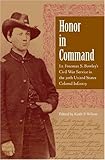
Keith Wilson, ed. Honor in Command: Lt. Freeman S. Bowley's Civil War Service in the 30th United States Colored Infantry. New Perspectives on the History of the American South Series. Gainesville: University Press of Florida, 2006. xxvii + 290 pp. $39.95 (cloth), ISBN 978-0-8130-2998-6.
Reviewed by Barbara Gannon (Independent Scholar)
Published on H-CivWar (August, 2007)
A Teenage Hero's Civil War
Keith Wilson edited the memoirs of a white teenager who received a commission in the 30th United States Colored Infantry (USCI). White officers of black regiments have been of keen interest to students of the Civil War. Joseph Glatthaar's Forged in Battle: The Civil War Alliance of Black Soldiers and White Officers (1990) set the standard for modern scholarly studies of these men. Like many Civil War soldiers, white officers in black regiments wrote memoirs chronicling their Civil War service in the postwar era. Thomas Wentworth Higginson's Army Life in a Black Regiment (1997) represents one of the better-known memoirs. Higginson's service with a black regiment was in keeping with his prewar anti-slavery activity; he held clandestine meetings with John Brown before the Harper's Ferry attack. In contrast, Bowley became an officer in a black regiment because he wanted to serve the Union and support his family; his father was sick and invalided out of the Army. He decided to apply for a commission in a black regiment because no political connections were needed; instead, applicants for these positions were tested on military subjects. Bowley passed his examination and received a First Lieutenant's commission at the age of eighteen in April 1864. Within a very short period of time he was thrown into the hell of the Wilderness Campaign. Ultimately, he was captured at the Battle of the Crater, a failed attempt by U.S. forces to exploit a hole in the Confederate lines around Petersburg created by an underground blast, an 1864 version of an improvised explosive device. He languished in Southern prisons until spring of 1865 and was paroled in time to rejoin his unit at the end of the war.
Decades after Appomattox, in 1899, Bowley published an account of service in the National Tribune, the national newspaper of the Grand Army of the Republic, the Union Army's largest veterans' organization. This brief summary of Bowley's service does no justice to the merit and value of his work. While Bowley may have become an officer in a black regiment as a way of supporting his family, he was as committed to his regiment as Higginson and provides a similarly valuable account of day-to-day life in a black regiment. In addition, Bowley's description of the Battle of the Crater, one of the most important battles involving African American soldiers, is riveting. He describes the butchery during the battle and the slaughter of black soldiers in its aftermath; many black soldiers were murdered after surrendering. While he managed to survive the battle, he spent months in Confederate prisons and his account of this experience is also invaluable.
Keith Wilson, who had previously written a study of the camp life of black soldiers, judiciously edited this memoir to improve its readability and provides the reader with an introduction which places this narrative in a broader historiographical context.[1] Wilson did an outstanding job researching the pension and service records of the 30th United States Colored Infantry to verify individuals or events discussed by Bowley. Unfortunately, some of his efforts may not be evident to the reader, because the text uses endnotes and not footnotes, a decision likely made by the publishers and not the author. Only a diligent reader will be willing to constantly flip back and forth to read Wilson's excellent commentary and supplemental research which accompanies Bowley's text.
In his introduction, Wilson rightly identifies two of the most important contributions of this memoir. First, while "the callous barbarism of war was seldom described in the great collections of Civil War memoirs that were being published towards the end of the century...the wanton cruelty of war, its vindictive, revengeful nature, was forgotten...this aspect of the war remained fresh in Bowley's memory, and it filled the pages of his memoir" (p. 37). Bowley does very little to sugarcoat the harsh reality of war. For example, when he was a prisoner he observed a visit by the citizens of Raleigh, North Carolina to starving U.S. prisoners who were being taken through this city northward on the way to parole. Bowley explains that many of these visitors "were accompanied by their dogs, and every dog that came in among these men was captured, killed, cut up, cooked, and eaten before the owner was aware of his loss. He particularly remembered one prisoner, a demented man, who had secured the head of a dog. This head he had thrust into the fire and singed off the hair, and smoked and blackened the flesh. The man was seated on the ground, tearing with his teeth the flesh from the dogs head. The blood trickled down and smeared the man's dirty face, and...he glanced around with a maniacal glare, fearful that someone would rob him of his horrible feast" (p. 206). Wilson also believed that Bowley's account was important because at a time Americans were trying to forget slavery and slave soldiers, this account made "a powerful claim for the black soldiers to be included on the nation's honor roll" (p. 2). I would suggest that part of the reason for the unvarnished nature of this account is that this memoir was published in the GAR's national newspaper and was not sanitized for a general, more squeamish, audience. I also found in my research that the National Tribune and other GAR sources include similar accounts of African American military service. Andre Fleche discusses other articles in the National Tribune that recalled black military service in a June 2005 article in Civil War History.[2]
While Wilson's introduction uses Bowley's memoir to illustrate nineteenth-century notions of masculinity, honor, duty, and patriotism, at forty-five pages it is too long and somewhat repetitive. Moreover, there are no surprises in this memoir if you read the introduction first; Wilson tells us Bowley's story, before Bowley gets a chance to do so. While Wilson's introduction includes a nuanced discussion of gender issues, he needed to perform a similar analysis of Bowley's racial attitudes. Instead, Wilson describes Bowley's racial attitudes as typical of this era without a closer examination of how these beliefs might differ from his contemporaries. For example, Wilson recognizes that the praise Bowley "gave to his men was quite genuine but his assessments were laced with notions of racism" (p. 10). Wilson argues that "Bowley was influenced by the racism of his day, believing that blacks were 'simple, timid,' and 'superstitious' he also believed that once they were subject to military training by competent officers they would become brave and patriotic soldiers" (p. 7). Bowley's attitudes were not typical of his day. Many American's believed that black men were completely incapable of becoming patriotic soldiers because they believed that African Americans were biologically inferior and only suited to slavery. A memoir detailing the experiences of a white officer in a black regiment demands a more rigorous examination of his racial attitudes.
Overall, this volume is an invaluable addition to Civil War studies. Keith Wilson should be applauded for finding this valuable memoir and making it available to modern readers. In addition, he provided a valuable service by analyzing it in light of our modern understanding of notions of masculinity, honor, and patriotism. This memoir would be of great value in an undergraduate or graduate level Civil War class. I would recommend, however, that undergraduates read Bowley's account first and then the introduction, since the introduction may be more valuable for advanced students. In addition, the work would be an excellent reading for an ROTC course on leadership. While Bowley does not set out to write a book entitled "Leadership Secrets of a Colored Troops Officer," he appears to have been successful overcoming a serious leadership challenge. How can a teenager from Massachusetts be accepted by his subordinates, most of whom were former slaves? He responded by demonstrating professional competence, a sincere interest in the welfare of his men, and a devotion to their shared cause, an effective formula in 1864 or 2007.
Notes
[1]. Keith Wilson, Campfires of Freedom: The Camp Life of Black Soldiers during the Civil War (Kent, OH: Kent State University Press, 2002).
[2]. Andre Fleche, "Shoulder to Shoulder as Comrades Tried: Black and White Union Veterans and Civil War Memory," Civil War History, 51 (June 2005), 175-201.
If there is additional discussion of this review, you may access it through the network, at: https://networks.h-net.org/h-civwar.
Citation:
Barbara Gannon. Review of Wilson, Keith, ed., Honor in Command: Lt. Freeman S. Bowley's Civil War Service in the 30th United States Colored Infantry.
H-CivWar, H-Net Reviews.
August, 2007.
URL: http://www.h-net.org/reviews/showrev.php?id=13474
Copyright © 2007 by H-Net, all rights reserved. H-Net permits the redistribution and reprinting of this work for nonprofit, educational purposes, with full and accurate attribution to the author, web location, date of publication, originating list, and H-Net: Humanities & Social Sciences Online. For any other proposed use, contact the Reviews editorial staff at hbooks@mail.h-net.org.

