



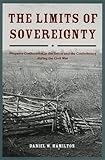
Daniel W. Hamilton. The Limits of Sovereignty: Property Confiscation in the Union and the Confederacy during the Civil War. Chicago: University of Chicago Press, 2007. i + 200 pp. $39.00 (cloth), ISBN 978-0-226-31482-2.
Reviewed by Louis Gerteis (Department of History, University of Missouri-St. Louis)
Published on H-CivWar (August, 2007)
On the topic of wartime confiscation Abraham Lincoln insisted that the Constitution governed the issue for Congress. The Constitution gave Congress full authority to determine the punishment for treason, but Article III, section 3 stipulated that "no Attainder of Treason shall work Corruption of Blood, or Forfeiture except during the Life of the Person attained." In this insightful and illuminating new study, Daniel Hamilton acknowledges that Lincoln succeeded in linking the issue of confiscation to treason and imposing the life estate limit on confiscation. But Hamilton locates his study within a wider analysis of the development of property rights theory. Hamilton begins with an examination of the widespread confiscation of Tory property carried out by states during the American Revolution. Here he identifies a republican view of property rights linked to loyalty to a sovereign power. This community based sense of property rights held that disloyalty to a sovereign power caused property rights to be extinguished.
As Hamilton demonstrates, some Republicans invoked this older view of property rights when they argued in favor of widespread confiscation and land redistribution during the Civil War. Former slaves similarly hoped that their loyalty to the Union might bring them "Forty Acres and a Mule" in freedom. It is the central thesis of Hamilton's work that widespread confiscation failed during the Civil War because a newer doctrine of individual property rights overcame the older association of property rights with loyalty to a sovereign. During the first half of the nineteenth century, writes Hamilton, "an individualized, rights-oriented conception of property gained increasing dominance in American law and in constitutional interpretation." In the postwar years, the Supreme Court, often led by Justice Stephen Field, reinforced the liberal theory of property rights and thoroughly rejected the older "conception of property ultimately held at the sufferance of the sovereign" (p. 9).
Military confiscation was a different matter altogether and Union commanders in the field made widespread use of confiscation (and assessments) to punish disloyalty and to strengthen their own military position. But, by definition, military confiscation took place in wartime and, while it could and did produce painful outcomes, its effects did not extend into peacetime.
Legislative confiscation is the central focus of Hamilton's work. The widespread use of confiscation by state legislatures during the American Revolution to seize the property of disloyal persons expressed a republican view of property rights that linked them to community stability and wellbeing. Federalists responded to what they viewed as an excess of republican zeal in this regard by drafting a Constitution that prohibited state and federal bills of attainder. Furthermore, the Fifth Amendment linked confiscation to judicial processes and significantly curtailed the Revolutionary era tradition. In the early decades of the nineteenth century, Chief Justice John Marshall built on these constitutional foundations to advance the doctrine of vested rights in property. "At the heart of the vested rights doctrine," writes Hamilton, "was the notion that the lines between legislative and judicial authority over property must be tightly drawn" (p. 46). Marshall's rigid interpretation of the Constitution's "obligations of contracts" clause drew precisely that distinction. The vested rights doctrine steadily gained authority in the first half of the nineteenth century and, during the Civil War debates over confiscation, most Republicans (with Lincoln at the forefront) embraced the "strict sanctity of private property" (p. 47). Nevertheless, a minority of Republicans held fast to elements of the older ideology.
A leading voice in this minority was Illinois Senator Lyman Trumbull. We are reminded by Michael Vorenberg's recent work on the Thirteenth Amendment and again in Hamilton's study that Trumbull deserves closer scholarly attention.[1] Trumbull led the effort to secure broad legislative confiscation during the Civil War and doggedly resisted Lincoln's efforts to restrict confiscation by tying it to individual treason trials and limit its reach to life estates. Treason trials were time consuming and they imposed an onerous burden of proof on the prosecution. By limiting confiscation to life estates, moreover, Lincoln and his supporters assured a very limited market for confiscated property. As Hamilton points out, few would want to buy property that could be claimed by heirs following the death of the disloyal, dispossessed owner. Lincoln's successes in these areas assured that widespread land redistribution would not become an outcome of the Civil War.
By contrast, Trumbull argued for a sweeping confiscation act. In the legislation he proposed, disloyal persons forfeited their property to the United States immediately, completely, and permanently. The physical act of confiscation would be carried out by commissioners appointed by the president who would move south with advancing federal armies. Court proceedings would take place only in Border States where loyal civil government existed. And, even in these proceedings, confiscation would occur not in punishment for the crime of treason, but through procedures familiar in admiralty law. As one of Trumbull's conservative opponents complained, "this bill proposes at a single stroke, to strip all this vast number of people of all their property, real, personal and mixed, of every kind whatsoever" (p. 49).
Trumbull's plan failed. Most Republicans embraced the vested rights doctrine and shrank from legislative confiscation. Historians have noted for many years that central government powers expanded significantly after the Civil War. But, in this area, as Hamilton notes, congress imposed new limits on its powers. What emerged as the Second Confiscation Act followed Lincoln's view that confiscation must be linked to treason trials and limited to life estates. The only sweeping passage of the Second Confiscation Act was its provision for the immediate liberation of slaves of disloyal masters.
The conservatism of the North regarding property rights is further highlighted by the enthusiasm with which the Confederacy embraced confiscation as a new sovereign power. The Confederate Sequestration Act of 1861 declared all property owned by persons not loyal to the Confederate government to be the property of that government. Officials seemed to hope that the value of northern property seized would largely pay the cost of their war for independence. As in other areas of governance, the Confederacy embraced a higher degree of central state authority than did the Union government. As it happened, debts owed to northerners constituted a large part of the confiscated property. Loyal Confederate citizens came forward voluntarily to pay their debts to the government. In the postwar years, the U.S. Supreme Court viewed all of these transactions as null and defeated Confederates found themselves paying their debts twice: first in obedience to the Sequestration Act and later to their northern creditors. The doctrine of vested property rights overwhelmed Trumbull's confiscation efforts and it continued to gain strength in the post war Supreme Court. Justice Stephen Field took the lead in this regard. The case of Miller v. U.S. (1870) involved the property of a Virginian (specifically his shares in a Michigan Railroad) that were seized in 1864 and sold at auction. The court upheld confiscation, but Field joined two other justices in dissent. Field accepted instrumentalist decisions when the effort to unravel ownership of confiscated property threatened the broader stability of economic relations. But, wherever possible (e.g. Bigelow v. Forrest [1869]) Field joined majority decisions that restored confiscated property to the descendants of disloyal persons. By the end of the nineteenth century, the doctrine of vested property rights had been so thoroughly established that the older doctrine of community rights seemed anachronistic, "a remnant of Revolutionary republican fervor," writes Hamilton, that had no place in modern America (p. 107).
Historians of Reconstruction have long noted that Radical Republicans forged a postwar consensus supporting equal rights and universal male suffrage at the same time that they debated but never embraced a plan for land confiscation and redistribution in the defeated South. Discussions of land reform died out as Republicans retreated from Reconstruction and as southern white Redeemers, emboldened by Andrew Johnson's leniency, seized control of southern states. Hamilton suggests that this familiar Reconstruction narrative is misleading. Republicans came to power in 1861 not simply to vanquish the Slave Power but to advance a liberal legal agenda that placed the uncompensated confiscation of private property beyond the reach of legislatures.
Note
[1]. Michael Vorenberg, Final Freedom: The Civil War, the Abolition of Slavery, and the Thirteenth Amendment (Cambridge: Cambridge University Press, 2001).
If there is additional discussion of this review, you may access it through the network, at: https://networks.h-net.org/h-civwar.
Citation:
Louis Gerteis. Review of Hamilton, Daniel W., The Limits of Sovereignty: Property Confiscation in the Union and the Confederacy during the Civil War.
H-CivWar, H-Net Reviews.
August, 2007.
URL: http://www.h-net.org/reviews/showrev.php?id=13473
Copyright © 2007 by H-Net, all rights reserved. H-Net permits the redistribution and reprinting of this work for nonprofit, educational purposes, with full and accurate attribution to the author, web location, date of publication, originating list, and H-Net: Humanities & Social Sciences Online. For any other proposed use, contact the Reviews editorial staff at hbooks@mail.h-net.org.

