



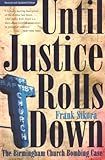
Frank Sikora. Until Justice Rolls Down: The Birmingham Church Bombing Case. Tuscaloosa: University of Alabama Press, 2005. xiii + 266 pp. $18.00 (paper), ISBN 978-0-8173-5268-4.
Reviewed by Mark J. Goodman (School of Social Sciences, York University)
Published on H-Genocide (August, 2007)
Bombingham Redux
The conviction of the Ku Klux Klan bombers who murdered Denise McNair, Cynthia Wesley, Addie Mae Collins, and Carol Robertson on September 15, 1963, at the Sixteenth Street Baptist Church, Birmingham, Alabama, was not erased by the machinations that delayed their legal commitment. But "justice delayed" was indeed, justice sorely tried. Eventually, Robert Chambliss, Thomas E. Blanton, and Bobby Frank Cherry were jailed for the killings. But as noted Civil Rights advocate Rev. Fred Shuttlesworth said (whose church in Birmingham was three times bombed in the 1950s), continuing delays might have made it possible for Cherry, for example, "to confront his maker" before he met his earthly judge.
Cherry barely got to the judge. First ruled incompetent to stand trial due to vascular dementia, he was only convicted in 2002 and taken by cancer in 2004. Like many of the police investigators profiled by Frank Sikora, Cherry had been trained in the military. He learned the art of demolition in the Marines. But Cherry, Blanton, and Chambliss continued to live full lives because J. Edgar Hoover, director of the Federal Bureau of Investigation, chose not to refer the case for prosecution. Sikora shows that the evidence that compelled their conviction (including the secret tapes that were not made available by the FBI in the first prosecutions) was already in FBI hands in 1963. Even after his death, Cherry's lawyer sought to vacate his conviction because the case was under appeal when he expired.[1]
In the meantime, Birmingham's fiery reputation suffered an unwelcome reprieve. In February 2006 working out of the Tuscaloosa Regional Airport, some two hundred officers from the Bureau of Alcohol, Tobacco, Firearms and Explosives, the FBI, the Alabama Bureau of Investigation, and volunteers from as far away as New York, sought arsonists responsible for damaging or destroying ten southern rural churches--some going as far as camping out at the churches to guard their front doors.[2] All of this was done in the wake of a 1998 bombing of a Birmingham abortion clinic.
These continuing episodes are emblematic of the South's more recent period of complex racial history and the extra-legal practice of terror, which must be distinguished from the legally sanctioned terror visited upon enslaved Africans and their children, or that imposed after slavery was abolished mostly in the form of convict laborers. Despite enormous changes in political climate, the violence lingers, its grip difficult to extinguish. At this late date, the FBI is contemplating the reopening of dozens of "cold cases" from the 1950s and 1960s where racial motives are suspected. The private nonprofit organization, the Southern Poverty Law Center, has submitted a list of at least seventy-four cases involving white-on-black violence.[3]
But we are now in a new period, and the bombing and the Sixteenth Street Baptist Church, staging ground for Martin Luther King Jr.'s daring Birmingham marches, are being turned into icons, allowing their significance to be stolen, diluted, or inverted. Thus, in February 2006, U.S. Attorney General Alberto R. Gonzalez, architect of George W. Bush's plan for arbitrary detentions in Guantanamo, spoke at the church pulpit, saying there was "still work to be done" in fighting discrimination; Bush's Secretary of the Interior declared the place a National Landmark. When she was National Security Aide, Condoleezza Rice explained to the National Association of Black Journalists that, brought up in Alabama, she had "grown up around the home-grown terrorism of the 1960s," and that the experience informed her view of what was needed in American foreign policy after September 11. Later, as Secretary of State, Rice reminisced about playing dolls with Denise McNair, one of the children blown to bits when a high-velocity explosive was planted under the church stairs. "We played together," said Condoleezza, "we sang together in little musicals. That picture of Denise with the dolls will always be near and dear to my heart."[4]
Frank Sikora's recently updated book is a lean, moving account of hard work done by lawyers and law enforcement personnel to "nail" the killers. A veteran reporter for the Birmingham News, he knows the scene intimately. So when he gives us detailed testimony of Elizabeth Hood, a niece of Flora Chambliss, explaining how she feared Chambliss would take revenge, even "plant a bomb in the middle of their house," or tells us how a defense lawyer told the district attorney after Cherry's conviction that his high-minded praise was "like peeing on my leg and telling me it's rain," we believe him--and we must, because the book, although detailed and precise, is not footnoted.
For younger readers, the graphic descriptions of the victims and of the wanton, pointless destruction of a fifth, unknown victim, Virgil Ware, a young boy shot on his bicycle on the same day as the Church bombing, will come as a revelation and a shock. This book's greatest contribution is to make vividly clear the close and sticky family relations among prosecutors and defense lawyers, politicians, police officers, the FBI, FBI informers, Klan members, Klan girlfriends, and Klan wives and children, who mainly populate the story, as the harassed black community, always respectfully and even tenderly, is seen more from the edge.
The cool, factual tone provides counterpoint to Diane McWhorter's Carry Me Home (2002) and will introduce the reader to wider accounts of the period and struggle, such as Taylor Branch's Parting of the Waters (1988). In places, Sikora's account reads like a tightly paced police procedural. It does not provide a theory for the kind of community cohesion and intimidation that ruled Birmingham and the South, but its contribution of testimony--along with dramatic views such as the PBS/Blackside documentary on 1961-63, "No Easy Walk" (Eyes on the Prize, Part 4) and Toni Cade Bambara's painfully secured reconstruction of the Atlanta serial murders in the 1980s (These Bones Are Not My Child [2000]) will help in the effort. Nor does the book solve the problem of the FBI delays, which belongs to the contested sociology of political power in the Kennedy, Johnson and Nixon eras.
Notes
[1]. Kevin Sack, "A Bitter Alabama Cry: Slow Justice is No Justice," New York Times, April 13, 2001; Michelle O'Donnell, "Bobby Frank Cherry, 74, Klansman in Bombing, Is Dead," New York Times, November 19, 2004; Ariel Hart, "Alabama: Klansman's Conviction Stands," New York Times, December 18, 2004; and Bill Baxley, "Why Did the F.B.I. Hold Back Evidence?" New York Times, May 3, 2001. On Blanton's conviction, Baxley, former Attorney General of Alabama, wrote: "What excuse can the F.B.I. have for allowing Mr. Blanton to go free for 24 years with this smoking gun evidence hidden in its files?" A FBI spokesman denied efforts to thwart the state's investigation. See Kevin Sack, "F.B.I. Denies an Effort to Hinder Alabama's Bombing Inquiry," New York Times, May 4, 2001.
[2]. Jim Noles, "U.S. Mounts a Vast Hunt for Church Arsonists," New York Times, February 15, 2006. The abortion clinic bomber is also accused of setting off an explosion at Centennial Olympic Park in Atlanta during the 1996 Olympics. Ariel Hart, "Alabama: Bombing Becomes a Capital Case," New York Times, March 4, 2005. Three Birmingham-area men were arrested for the first fires. See Grace Thornton, "Investigation Draws National Attention, Highlights Cooperative Effort," Alabama Baptist, February 1, 2007.
[3]. Associated Press, "FBI May Reopen Cold Cases," New York Times, February 23, 2007. From the Poverty Law Center list, thirty-two of the killings happened in Mississippi; the others occurred in Alabama, Arkansas, Georgia, Tennessee, Louisiana, North Carolina, South Carolina, Florida, Kentucky, and New York. This effort responds to the push to reopen the investigation of the 1955 killing of Emmett Till, a fourteen-year-old black youth in Mississippi, famously murdered for whistling at a white woman. See Eric Lichtblau and Andrew Jacobs, "U.S. Reopens '55 Murder Case, Flashpoint of Civil Rights Era," New York Times, May 11, 2004.
[4]. "Alabama: Church Now Landmark," New York Times, February 21, 2006; Jacques Steinberg, "National Security Aide Evokes Civil Rights Era," New York Times, August 6, 2003; and Steve Weisman, "At Memorial Ceremony in Alabama, Rice Pays Homage to Young Victims of Church Bombing," New York Times, October 23, 2005.
If there is additional discussion of this review, you may access it through the network, at: https://networks.h-net.org/h-genocide.
Citation:
Mark J. Goodman. Review of Sikora, Frank, Until Justice Rolls Down: The Birmingham Church Bombing Case.
H-Genocide, H-Net Reviews.
August, 2007.
URL: http://www.h-net.org/reviews/showrev.php?id=13470
Copyright © 2007 by H-Net, all rights reserved. H-Net permits the redistribution and reprinting of this work for nonprofit, educational purposes, with full and accurate attribution to the author, web location, date of publication, originating list, and H-Net: Humanities & Social Sciences Online. For any other proposed use, contact the Reviews editorial staff at hbooks@mail.h-net.org.

