

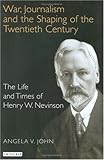
Angela V. John. War, Journalism and the Shaping of the Twentieth Century: The Life and Times of Henry V. Nevinson. London: I. B. Tauris, 2006. 246 pp. $45.00 (cloth), ISBN 978-1-84511-081-9.
Reviewed by Eugenia M. Palmegiano (Department of History, Saint Peter's College)
Published on Jhistory (July, 2007)
Henry Nevinson was, according to Angela John, a prolific writer, an ardent proponent of human rights, and a champion of national self-determination as well as an egoist, an adulterer, and an imperialist. John calls him the last Victorian war correspondent, a man his peers crowned their "king" (pp. 4, 3). Notwithstanding these labels and the book's title, the text devotes more space to his endeavors as a foreign correspondent than to his military reporting.
Nevinson, born in 1856, came to the press at the age of forty-one, armed with a second-class degree from Oxford and a background of scribbling biographies, short stories, and poetry; chairing the history department at Bedford College for women; and commanding a juvenile cadet corps for working-class Londoners. A chance meeting in 1897 with H. W. Massingham, Daily Chronicle editor, led to a commission to cover the Greco-Turkish War. Nevinson soon learned the ropes, principally how to secure transportation and translators, and how to deal with military censors. John characterizes him then and thereafter as a scrupulous observer, a good stylist, and a serendipitous columnist--always at the right place at a time when newspapers mattered. From this war until shortly before his death in 1941, he freelanced for British and American newspapers and magazines except for brief Edwardian stints as the Daily Chronicle literary editor and a Daily News leader-writer.
Nevinson's career as a war correspondent, told in four of ten chapters, took him to Spain during the Spanish-American War, Africa in 1899, the Balkans in 1912-13, and both fronts in World War I. In the contest between the British and Afrikaners, recognized by John and other historians as the "first media war," he was a minor figure among a host of correspondents (p. 28). While the book recognizes that journalists trapped in sieges and thwarted by disruptions in telegraphy and railroad lines could not satisfy editors' demands for instant news, it overlooks how mass readership catalyzed those demands.
Popular interest in the simmering Balkans was not very great prior to the outbreak of hostilities there in 1912. Nevinson first visited the region as a representative of private British organizations sympathetic to calls for independence and then traveled to Bulgaria and Albania to record the strife that precipitated the Great War. Once it commenced in 1914, clamor for news grew. The press had enough clout, John recognizes, to sidestep official guidelines. Nevinson, with his war-artist son Richard, was on the Western Front ahead of the credentialing of correspondents. John details Nevinson's descriptions of battlefield horrors and his complaints about British editors reluctant to print the brutalities of war and generals determined to suppress the publication of such reports. Although Nevinson's material surfaced in several British papers and American magazines, John sometimes gives short shrift to this work. For instance, discussing Gallipoli, she elaborates more on military strategy, albeit with a provocative aside on Nevinson's encounter with Keith Murdock, novice Australian correspondent and father of Rupert.
Five of the six remaining chapters narrate Nevinson's activities as "our own correspondent," the nineteenth-century nomenclature for anyone willing to go anywhere. In 1904, he investigated slavery in Angola and islands in the Gulf of Guinea. Harper's Monthly Magazine paid him one thousand pounds for the series, which he followed with a book (1906), an undertaking he repeated after most assignments. Ironically, as John points out, he penned editorials for the Daily News in 1908 when George Cadbury, whose chocolate empire depended on Angolan slavery, owned it.
From 1905 Nevinson intermittently examined the Russian Empire. His Daily Chronicle letters on the St. Petersburg riots arrived out of sequence and suffered from editing, though he polished them into another volume in 1906. In 1908 his essays on the Caucasus appeared in Harper's; in 1910 he produced his Nation articles on Finland after a junket there; and in 1919 he interviewed Soviet Commissar Maxim Litvinov (when Litvinov would see no other journalist) for the Daily Herald.
Nevinson's early commentaries on Russia ran about the same time as those on India. In 1907 he went to the subcontinent for the Manchester Guardian, Glasgow Herald, and Daily Chronicle in order to study "unrest" (p. 105). His "Letters" to the Nation were fodder for another book, published in 1908. To prepare for this trip, John notes, Nevinson interviewed John Morley, secretary of state for India, but she fails to link Morley's journalistic background with his understanding of the symbiotic relationship between Raj governance and press influence. Likewise, the chapter on India cites rather than analyzes, in terms of character and audience, the Indian and Anglo-Indian gazettes of Nevinson's acquaintance and frequently does not indicate his connection to them. For example, the reader discovers only from endnotes that he wrote for the Indian Review. Additionally, John has little to say about Indian editors except for Surendranath Banerjeawith (Bengalee), whose skill impressed Nevinson. Instead, she delineates his perceptions of the Indian National Congress. One explanation for this imbalance, as in the chapter on Gallipoli, is John's dependence on Nevinson's diaries. While his reactions justify her emphases, his responses reveal more about the man than the reporter.
Unlike Eastern Europe and India, Ireland had long fascinated Nevinson. Returning from an 1897 excursion, he began a series on the "Celtic Revival" for the Daily Chronicle. The series ended in 1903, but from 1912 through 1922 he tracked the debate about Home Rule and the resistance to it for the Nation, Daily News, Manchester Guardian, Daily Herald, and New Weekly, at home, and the Baltimore Sun and Atlantic Monthly. He consistently associated the struggle in Ireland with other national movements in the British and the Ottoman empires.
In the decade after World War I, Nevinson journeyed to Germany, Palestine, and the United States. In the United States, he lectured and covered national political conventions and international meetings for the Baltimore Sun, Manchester Guardian, New Leader, and the Nation. In Britain after, he wrote more books and poetry and did a few BBC broadcasts.
Nevinson dedicated much of his journalism to the advocacy of civil rights, whether of ethnic groups without their own country, of British women without the franchise, of Africans without liberty, of Scottsboro defendants without a fair trial, or of anyone falling to Nazi dominion. Still, as John acknowledges, he was no candidate for sainthood. She characterizes him as paternalistic, bordering on racist, in his interpretation of the Indian National Congress. And, in a candid chapter, she spells out his stunning disregard for the women with whom he had relationships.
The book has numerous illustrations and content endnotes, which are invaluable because there is no bibliography except of books which Nevinson authored or to which he contributed. There is neither a chronological list of his journalistic contributions nor a topical one, so that it is hard to ascertain the number he wrote. Because the text does not always date or place some of his journalism, the reader has to peruse the endnotes closely, a tedious process made worse by situating abbreviations of newspapers and magazines in the front matter. Equally troubling, text references to Nevinson's press colleagues frequently give only their surnames, and the index omits many of them.
The result is that this volume is good biography but not good journalism history. As F. M. Leventhal demonstrated in his book, The Last Dissenter (1985), on H. N. Brailsford (Nevinson's erstwhile confrere), it is possible to do both well.
If there is additional discussion of this review, you may access it through the network, at: https://networks.h-net.org/jhistory.
Citation:
Eugenia M. Palmegiano. Review of John, Angela V., War, Journalism and the Shaping of the Twentieth Century: The Life and Times of Henry V. Nevinson.
Jhistory, H-Net Reviews.
July, 2007.
URL: http://www.h-net.org/reviews/showrev.php?id=13450
Copyright © 2007 by H-Net, all rights reserved. H-Net permits the redistribution and reprinting of this work for nonprofit, educational purposes, with full and accurate attribution to the author, web location, date of publication, originating list, and H-Net: Humanities & Social Sciences Online. For any other proposed use, contact the Reviews editorial staff at hbooks@mail.h-net.org.

