



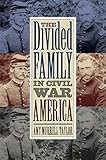
Amy Murrell Taylor. The Divided Family in Civil War America. Chapel Hill: University of North Carolina Press, 2005. xiv + 319 pp. $39.95 (cloth), ISBN 978-0-8078-2969-1.
Reviewed by Meg Galante-DeAngelis (Department of Family Studies, University of Connecticut)
Published on H-Minerva (July, 2007)
Families, Public Interests, and Private Welfare
In 1863, Warner Alexander Thomson wrote, "My natural affection for my sons and love for my country cause a struggle in my mind--it is a painful one" (p. 27). Thomson held Union sentiments, while his sons served in the Confederate army. Thomson and his sons exemplify the conflict of hearts and politics, proving that the divided family, the bread and butter of historical fiction, is no less dramatic and much more complex in the real world of families who lived through the Civil War. In Amy Murrell Taylor's The Divided Family in Civil War America, the complexity is revealed.
While the country struggled with succession, states' rights, and slavery, the basic structure of society was also struggling. The family unit, organized to sustain and support, fought the fracture of the political times in various ways. Focusing on families most vulnerable to opposing national loyalties, Taylor uses diaries, letters, and a variety of private and public documents from and about white middle- and upper-class families in Missouri, Kentucky, Tennessee, Virginia (and the area that would later become West Virginia), Maryland, Delaware, and Washington, D.C. In each chapter, Taylor helps us to view several of the ways that family division could reveal itself.
Chapter 1 focuses on the relationships between divided sons and fathers, chronicling how normal individuation struggles revolved around the defining issue of the generation and the politics of the time. Recognizing rebellion as a normal stage in a young man's life, families measured personal freedom against deep ideological commitment, filial defiance against political conscience, national loyalty against familial loyalty. In the end both fathers and sons thought that their different strategies would help to preserve their family position and livelihood, sometimes with a tragic end. Taylor engages us to think about how fathers and sons attempted to convince each other of the rightness of their beliefs and to delicately balance paternal, filial, and political loyalties.
Chapter 2 focuses on women and men with divided loyalties during their courtships and marriages. Although daughters were often influenced by their father's political beliefs, during courtship and after marriage they sometimes straddled the fence to keep the family peace. Passive political loyalties were distinct from political activity. Some unions left a place for political expressions, but the activity of the wife reflected on the husband's place in the community. Taylor examines how the contextual issues of nineteenth-century marriage and courtship limited and expanded the lives of those involved and how this context was changed by the war.
Chapter 3 focuses on the relationships of brothers and sisters. The power of the sister relationship comes through, allowing sisters to nurture each other and confront each other's beliefs while feeling every emotion one can feel in this primary relationship. Brothers and sisters engage in a relationship like no other. Women had less to lose with their brothers than in any other male/female relationship structure. The sibling relationship has an emotional and intellectual freedom that was not enjoyed in other relationships--so the debates, disagreements, and outright fights over loyalties as well as the true expressions of affection highlight the importance of the permanence of these relationships. These interactions are the most interesting Taylor describes because we look deeper into the sibling relationship as it measures, survives, and fractures with the sectional conflict. The most compelling of the chapters is chapter 4. The epicenter of the families most affected were those who were divided not only by loyalty but also by location. Little focus has been given to mail and travel restrictions and how families clung to the smallest contact as hope of future reconciliation. Families interacted with the military and with spies and smugglers, used private freight carriers, published letters and placed cryptic "advertisements" in newspapers, sent "invisible" messages written in milk or onion juice--anything to get a message to a family member on the other side of the border. Taylor's evidence here is fascinating and this chapter expanded would make a tremendous contribution about the lives and ingenuity of families on the borders.
Chapter 5 examines the border family through the eyes of the popular fiction writers of the 1860s. The themes of conflict and unbreakable bonds, and subjects which included moralistic and cautionary tales of deception for survival, seduction for a patriotic purpose, slaves, faithful servants, agents of espionage, and romantic triangles, mirrored Northern and Southern views of the sectional conflict.
Chapters 6 and 7 focus on the war's powerful hand in forever altering the relationships in the affected families. Emotional scars, burned by the almost constant process of conciliation, worry, anger, grief, and reframing of relationships, left the survivors weary and changed. But this did not mean that they did not hold hope for reconciliation or being reunited with family members relocated by war, through sale in slavery, or because of emancipation. Taylor highlights the continuing call of familial duty as the crux of forgiving the divide of sectional politics or the scar that had difficulty healing.
Taylor engages us in thinking about the divided family in a more complete way through the sheer variety of her perspectives. It tantalizes us to think more about these families and leaves several areas worthy of further investigation, such as the lost kin ads of ex-slaves, the newspaper notices to families across the borders, reunions of black families after the war, and litigation of mixed-race relatives against white relatives. The choice of cover art is incongruous--while the book uses many real brothers and other family relationships, the cover highlights West Point classmates, "brothers" George A. Custer and James Washington. This photograph seems an odd and inappropriate choice, and the few pages about West Point "brothers" seem forced and out of place. This does not take much away from this interesting and well-written work that may lead others to engage in more work on this subject.
If there is additional discussion of this review, you may access it through the network, at: https://networks.h-net.org/h-minerva.
Citation:
Meg Galante-DeAngelis. Review of Taylor, Amy Murrell, The Divided Family in Civil War America.
H-Minerva, H-Net Reviews.
July, 2007.
URL: http://www.h-net.org/reviews/showrev.php?id=13398
Copyright © 2007 by H-Net, all rights reserved. H-Net permits the redistribution and reprinting of this work for nonprofit, educational purposes, with full and accurate attribution to the author, web location, date of publication, originating list, and H-Net: Humanities & Social Sciences Online. For any other proposed use, contact the Reviews editorial staff at hbooks@mail.h-net.org.

