



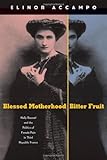
Elinor Accampo. Blessed Motherhood, Bitter Fruit: Nelly Roussel and the Politics of Female Pain in Third Republic France. Baltimore: Johns Hopkins University Press, 2006. x + 312 pp. $50.00 (cloth), ISBN 978-0-8018-8404-7.
Reviewed by Jessica Davidson (Department of History, James Madison University)
Published on H-Women (June, 2007)
Feminism and Family in Third Republic France
An historian of women and French history, Elinor Accampo offers Blessed Motherhood, Bitter Fruit: Nelly Roussel and the Politics of Female Pain in Third Republic France in line with her prior publications on gender and social reform in late nineteenth-century France. In her 2006 book, she contends that her goal is "to analyze reactions to Roussel and to her doctrine as a means of elucidating the gender system in France and its relationship to political culture" (p. 2). The work also is clearly, and perhaps more effectively, a biography of Nelly Roussel. The French feminist lived from 1878 to 1922 and her history therefore fits into the key fin de siecle period of European history. Accampo astutely establishes Roussel's life and experience during turn of the century France as full of contradictions. From a Catholic bourgeois background, in 1898 she married a French artist and sculptor, Henri Godet. On the one hand, Roussel as a mother and a wife embodied the "eternal feminine" idealized both through Catholicism and through French Republican values, yet she distinguished herself as a controversial and outspoken proponent of birth control through her participation in the Neo-Malthusian movement of the day. Accampo's work contributes to the field of European women's history, in particular adding to the literature on the history of birth control and nineteenth-century feminisms.
Accampo organizes her study within seven chapters and an epilogue. The chapters are primarily chronological beginning with Roussel's childhood and ending with her death. In between, Accampo explores Roussel's life as "Mother and Missionary," as a rising "Spectacular Apostle," "The Public and Private Politics of Female Self-Sacrifice," Roussel's illnesses in "Pathologies and Persecutions," and "The Great War: Pacifism, Censorship, and the Disease of a 'Weary, Wounded Heart.'" The epilogue presents the legacy of Roussel in large part through her daughter, Mireille. It also discusses the national trajectory of birth control in France, not officially legalized after the 1920 law to ban its use and propaganda, until 1967. Of particular interest in the book are the illustrations that come after page 107. Along with maps of the country marking the regions visited by Roussel on her speaking tours, there are many reprints of photos of Roussel and her family. Through the black and white photos, the reader can appreciate the allure of Nelly Roussel, at once feminine and passive, and yet unabashedly posing for the camera either as an actress (she was involved in drama from an early age) or as a public lecturer. The reader also familiarizes herself with the story of Roussel's life. She began her political interest at an early age and formed her philosophy from her identity as "a freethinker, freemason, and a feminist" (p. 15). She wrote extensively in freethinker and feminist journals and especially in those of the French Neo-Malthusians, called the League for Human Regeneration. She published on the topic of women and childbirth establishing her view that sex could and should offer pleasure to women instead of pain solely for the purpose of procreation. Her opinions proved controversial and garnered criticism particularly from the growing French right-wing pronatalist movement. They attested that Roussel and other Neo-Malthusians were responsible for the declining birth rate in France. Increasingly the right-wing politicians accused the Neo-Malthusians of representing and exacerbating "fears about German aggression, national degeneration, and unstable gender roles" (p. 137). As protests grew and world war emerged, Roussel, along with the Neo-Malthusian movement, suffered defeat as the right wing reaffirmed traditional ideas about sexuality and womanhood in the early twentieth century culminating in the 1920 legislation that illegalized birth control (except for condoms) and all related propaganda. At the same time, Roussel's already fragile health failed even more. Doctors diagnosed her with illnesses including severe menstrual problems, depression, anxiety, and ultimately and fatally tuberculosis. Shortly after her campaign to redefine female sexuality and reproduction came to a close post war, she died of pulmonary tuberculosis in a sanatorium.
Roussel's story coincides with the birth of modern feminism in the European context. Although primarily remembered for her pro birth control activity, including countless published articles and speeches with the Neo-Malthusian movement, Roussel, according to Accampo, was also a feminist. Most French feminists of the nineteenth century, attests Accampo, did not also support the use of birth control neither for increased female pleasure in sexual activity nor for population management. Roussel, therefore, was unique. Accampo convincingly establishes Roussel's special identity within French feminism. She also attempts to classify Roussel's type of feminism using twentieth-century theory. The author refers to Roussel throughout the book as "radical" for her advocacy of birth control and female pleasure, or prevention of female pain through childbirth. She also labels Roussel as radical through the unconventional merging of her Neo-Malthusian campaign and her feminist agenda. She points out that unlike Margaret Sanger, Roussel's American equivalent, the French activist meshed her support of birth control to a feminist purpose (p. 246). The larger question, however, remains how to interpret Roussel's lifetime of advocacy within modern feminist theory. In addition to calling Roussel radical, Accampo also places her within the second-wave of feminism (p. 1). Coming to fruition in the 1970s, second-wave feminism embraced the use of birth control and women's sexual freedom and pleasure. In this sense, Roussel was clearly ahead of her times and in the more radical individualist feminism camp, as opposed to traditional relational feminism (These are Karen Offen's definitions utilized by Accampo.) There is some confusion then when Accampo claims that Roussel "evo[ked] both equality and difference" classifying her clearly as a relational feminist (p. 9). The fact that she bore three children and gained public legitimacy through her traditional "eternal feminine" roles as wife and mother would normally place Roussel in the more typical nineteenth-century category relational feminism. However, Accampo paints Roussel as a feminist full of contradictions. She writes "Though Roussel nuanced her rhetoric, her end goal was subversive and radical" (p. 47). She further argues that "defying categorization, Roussel always evoked opposites" (p. 100). Accampo's last summation of Roussel's feminist identity as conflicting is the most compelling. It is not in placing, or misplacing, Roussel's legacy as second-wave or radical that a women's historian or student of women's history can best appreciate her significance. Instead it is through Roussel's thoroughly ambiguous and paradoxical identity that she is most emblematic of nineteenth-century European feminists. This interpretation of Roussel is also the true strength of the book. Roussel, as presented by Accampo, exemplified the contradictions of the majority of forward thinking, feminist women at the turn of the century. Therefore in a college class on the history of European women, this book would serve an important and essential purpose. I believe undergraduate or graduate students would benefit from the use of an in-depth biography of a representative member of first-wave European feminism.
If there is additional discussion of this review, you may access it through the network, at: https://networks.h-net.org/h-women.
Citation:
Jessica Davidson. Review of Accampo, Elinor, Blessed Motherhood, Bitter Fruit: Nelly Roussel and the Politics of Female Pain in Third Republic France.
H-Women, H-Net Reviews.
June, 2007.
URL: http://www.h-net.org/reviews/showrev.php?id=13336
Copyright © 2007 by H-Net, all rights reserved. H-Net permits the redistribution and reprinting of this work for nonprofit, educational purposes, with full and accurate attribution to the author, web location, date of publication, originating list, and H-Net: Humanities & Social Sciences Online. For any other proposed use, contact the Reviews editorial staff at hbooks@mail.h-net.org.

