



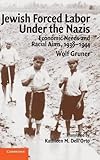
Wolf Gruner. Jewish Forced Labor under the Nazis: Economic Needs and Racial Aims, 1938-1944. Dell'Orto. Published in association with the United States Holocaust Memorial Museum. New York: Cambridge University Press, 2006. xxiv + 322 pp. $75.00 (cloth), ISBN 978-0-521-83875-7.
Reviewed by Frank Buscher (Department of History, Rhodes College)
Published on H-German (June, 2007)
An Overlooked Program of Exploitation and Persecution
Anyone familiar with Wolf Gruner's work knows that the Berlin historian and Nazi forced labor specialist does not shy away from controversy. He challenges widely accepted notions and identifies what he considers misinterpretations of the historical record.[1] He maintains this approach in this monograph, contesting several standard views of Jewish forced labor under the Nazis. These matters include the belief that Jews performed forced labor principally in the SS-run camp empire. Instead, Gruner exposes the civilian labor administration as the main abuser and exploiter, arguing that its Arbeitsämter in the Reich and the occupied territories compelled vast numbers of Jews to work to advance German economic interests. Officials labeled the program "segregated labor deployment." Gruner places the program's establishment in 1938. He criticizes scholars who have proposed a later starting date for "inexcusably" underestimating the entire phenomenon (p. xi). Perhaps most importantly and problematically, Gruner challenges historians who argue that in the final analysis National Socialists preferred systematic and complete annihilation to economic exploitation. By doing so, he portrays forced labor as something of a lifesaver, a position that is bound to provoke debate. He insists that "[t]ens of thousands of Jews survived the Holocaust because they were exempted from genocide due to economic interests and labor shortages" (p. 294). Critics may counter that, in light of nearly six million dead European Jews, Gruner's estimate amounts to little more than a statistical drop in the bucket. They may also suggest that surviving forced laborers were already marked for death and would have been killed in short order had the war lasted a few more months.
At the same time, the book certainly brings home the vastness and complexity of the effort to extract labor from the regime's Jewish victims in various regions. Conceived in Austria and first implemented in Germany after the November 1938 pogrom, the program involved a certain progression soon exported to the Protectorate of Bohemia and Moravia as well as occupied Poland. Official measures that deprived Jews of their means to make a living quickly led to high unemployment, misery, and increased public expenditures. Keen to complete the isolation of the Jews from the remaining population and to compensate for serious labor shortages, the labor administration decided on segregated deployment. Labor offices assigned Jewish forced laborers to work for private industry, the Wehrmacht, local and regional governments, Organisation Todt, and other entities. Their work ranged from demeaning (waste disposal sites) to extremely physically demanding (road and hydraulic construction; agriculture; forestry) to skilled labor at private companies. They toiled and suffered in an estimated 1,300 camps independent of the SS camp system, although in upper Silesia and the Government General the SS also ran several labor camps. As might be expected, treatment and "compensation" of forced laborers were worse in occupied Poland than in the Reich.
While the exact number of camps will probably never be known due to the short operating durations of many sites, the number of prisoners is even more difficult to determine. Gruner argues that, if one includes western Europe and the occupied Soviet Union, "more than a million" Jews were engaged in forced labor in the late summer of 1941 (p. 290). For the Reich and occupied Poland, he estimates a total of "hundreds of thousands" (p. 293). In Germany the program reached its peak with 51,000-53,000 workers in late July 1941, shortly before deportations began to decimate the Jewish population, including forced laborers. During 1942-45 an additional 10,000-20,000 Mischlinge and persons in mixed marriages were forced to work in construction or clear debris in German cities after aerial bombings. In Austria the labor administration's segregated labor deployment peaked at 8,000 in early 1941 before deportations made deep cuts. In the Protectorate of Bohemia and Moravia the largest number was over 16,000 in spring 1942. In occupied Poland numbers were far higher; here, labor offices also developed a new system to rent out workers to employers. Forced laborers, already severely undercompensated, saw wages decline even more. In the Warthegau, the program's peak actually coincided with the height of the deportations, as 95,000 Jews worked as forced laborers in January 1943.This number pales in comparison to developments in the Government General, where "Jewish forced-labor programs organized by labor offices ... clearly overshadowed the SS-controlled labor programs, both in size and in significance for the war economy" (p. 273). Gruner estimates that 700,000 Polish Jews performed compulsory labor in late 1940, although he points out that, in some areas, forced labor did not peak until 1942.
The situation in Poland was particularly complex and brutal. Here, SS officials routinely ran their own camps, and the SS indeed put itself in charge of forced labor in 1942. Despite this move, labor offices did not disappear. In fact, their employees not only recruited and rented out Polish Jews, but also selected workers for deportation and hence certain death. Hunger, malnutrition, and disease claimed large numbers of Jewish forced laborers in Poland. Those too weak to work were either deported or shot by the occupiers. But even in this particularly lethal climate, economic common sense trumped the ideological drive to murder every last Jew, according to Gruner. The SS exempted, at least temporarily, many forced laborers from the systematic destruction of Poland's vast Jewish community. Workers' suffering by no means ended here. They continued to toil in SS-run concentration camps and were later taken to Germany as laborers, where many survived the end of the war.
The book holds other surprises. One is the great mobility of forced laborers. For example, Austrian Jews were compelled to work in hydraulic construction in northern Germany, while Polish Jews found themselves in Germany helping to build a stretch of one of the Führer's pet projects, the Reichsautobahn. That this work was done against Adolf Hitler's express wishes provides further evidence that economic pragmatism tended to outweigh ideology. Moreover, the labor administration deducted welfare and unemployment contributions from the forced laborers, even though the latter were already impoverished and ineligible to collect benefits. The impressive variety of camps is also noteworthy. Germany alone was home to six different types of work camps, which were not part of the concentration camp system.
In terms of historiographical debates the book would seem to support the position of the moderate structuralists. Hitler does enter the picture, of course, frequently handing down decisions after his quarreling underlings had been unable to agree. Readers will find, however, that the concept of requiring work from Jews in exchange for public support originated at the local level in the mid-1930s. The welfare offices of several German big cities certainly did not need a nudge to start working towards the Führer. Starting in 1938, though, the Berlin leadership coordinated persecution of the Jews in the Reich. Several agencies were involved and assigned different tasks. In contrast to the administrative chaos, bureaucratic infighting, and duplication of function historians have come to associate with Nazi governance, more cooperation than competition occurred regarding the persecution of the Jews. Thus, the seemingly pedestrian labor administration became an integral part of a system designed to isolate, humiliate, exploit, and plunder the Jewish minority completely. It did so with remarkable efficiency, as the numbers of camps and forced laborers indicate.
Much of the material in this book appeared elsewhere in the 1990s, especially chapters 1-4 and 7-8, which, Gruner stresses, have been updated and rewritten. Each chapter concludes with a convenient summary. The conclusion further summarizes the author's findings and arguments. The translation is solid, although on occasion it follows the original German manuscript too literally. Gruner delights in citing statistics--too much so, in my opinion--which may explain why he relies on two layers of summaries to drive home his point. One also wonders whether it would have been more effective to arrange chapters topically rather than geographically. But this approach might not have been possible owing to the previous publication of several chapters. Gruner's monograph will appeal primarily to experts on the Third Reich and the persecution of the Jews. Non-specialists, amateur historians, and undergraduate students, on the other hand, will find it a difficult read.
Note
[1]. Wolf Gruner, "The Factory Action and the Events at the Rosenstrasse in Berlin: Facts and Fiction about 27 Febuary 1943--Sixty Years Later," Central European History 36 (2003): 179-208.
If there is additional discussion of this review, you may access it through the network, at: https://networks.h-net.org/h-german.
Citation:
Frank Buscher. Review of Gruner, Wolf, Jewish Forced Labor under the Nazis: Economic Needs and Racial Aims, 1938-1944.
H-German, H-Net Reviews.
June, 2007.
URL: http://www.h-net.org/reviews/showrev.php?id=13321
Copyright © 2007 by H-Net, all rights reserved. H-Net permits the redistribution and reprinting of this work for nonprofit, educational purposes, with full and accurate attribution to the author, web location, date of publication, originating list, and H-Net: Humanities & Social Sciences Online. For any other proposed use, contact the Reviews editorial staff at hbooks@mail.h-net.org.

