

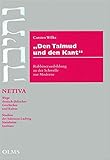
Carsten Wilke. "Den Talmud und den Kant": Rabbinerausbildung an der Schwelle zur Moderne. Hildesheim: Georg Olms Verlag - Weidmannsche Verlagsbuchhandlung, 2003. 726 S. EUR 69.00 (cloth), ISBN 978-3-487-11950-2.
Reviewed by Hillel Kieval (Department of History, Washington University in St. Louis)
Published on H-German (June, 2007)
Transforming Rabbinic Culture in Germany
During the first decades of the twentieth century, the figure of the "Doktor Rabbiner," the university-educated rabbi who was also a graduate of a theological seminary, was ubiquitous in German and Austro-Hungarian Jewish communities, so much so as to be caricatured in fiction and cultural criticism. A century or so earlier, however, rabbis in the German lands had been largely indistinguishable from their colleagues in other parts of Europe, including partitioned Poland. They were simply products of decades of Talmud study, legal adjudicators, and teachers in tune with the cultural assumptions and religious values of their communities. Over the next century, the German rabbi came to exemplify in his own personal development and professional persona the realization of the cultural ideals of Bildung (formation) and religiosity, but to what degree he continued to exemplify the values of the community that he served remains an open question. What transpired between these points in time, or, at least, from the last quarter of the eighteenth century through the first half of the nineteenth century, is the subject of this massive work by Carsten Wilke.
This volume is a wide-ranging, learned, and critical account of a revolutionary transformation in rabbinic culture "on the threshold of modernity," to use the author's words. It chronicles the transition from the Enlightenment debates and reforms of the 1780s to the establishment of the first rabbinical seminaries in the 1850s and 1870s. Wilke is determined that his not be a Whig history of the German rabbinate, nor even an institutional history per se. The author fairly bristles at the teleological simplicity of the claim, put forward by historians of the modern rabbinical seminaries, that such institutions "took the place of" the traditional talmudic academies (yeshivot) in the education and production of Jewish religious elites in Germany and the Habsburg monarchy. His reasons for rejecting this formulation, while acknowledging its superficial correctness, are manifold. First, for much of the nineteenth century, Jewish communities showed very little enthusiasm for proposals to establish publicly funded seminaries. It is telling, in this regard, that the first such institution to be created in Germany, the Jewish Theological Seminary in Breslau, which opened in 1854--in some respects the most successful of the German seminaries--was fully supported by a private foundation, formed out of the estate of a single individual, Jonas Fraenckel. Despite the rapid acculturation of German-speaking Jews in the late eighteenth and nineteenth centuries and the not-so-subtle pressures brought to bear by the German states on Jewish communities to adopt cultural and educational reforms, there was no great groundswell in the German-Jewish world to "replace" the premodern yeshivah with a modern seminary.
Second, if one were to insist on viewing the transformation in rabbinic culture in Germany as a linear process of institutional replacement, Wilke would at least want one to acknowledge that the decline of the traditional yeshivah and the emergence of the modern seminary were not chronologically contiguous phenomena. They were separated, rather, by several decades and perhaps as much as half a century. Third, what transpired in the interim--between the shattering of the framework for traditional Jewish education under the weight of Enlightenment-era reforms and the professionalized training of rabbis who were graduates of classical gymnasia and/or students in the philosophical faculties of German universities--did not consist of a single trajectory or an obvious outcome, though such was the triumphalist argument composed in hindsight by the chroniclers of the new institutions of Jewish higher learning. Wilke insists, to the contrary, that the first half of the nineteenth century is better understood as a kind of blank slate on which German Jewry mapped an uncertain, hesitant, and internally contradictory vision of what it wanted its own religious leadership to become. But the major reason why the linear path from yeshivah to seminary does not suffice for Wilke is that it incorrectly identifies the object of his study. In the author's estimation, educational institutions and their curricula are not the real subject of analysis, but instead rabbinic culture, broadly conceived. His goal in the end is to trace multiple evolutions: in the conception of what made a proper education for rabbis; in the often contradictory demands placed upon rabbinical candidates by their own communities and the larger political culture of emancipation and reform; and in the self-consciousness of the emerging rabbinate itself.
This ambitious research agenda is matched by a wide geographical sweep, an exhaustive reading of archival and primary source material, and--for the reader, at least--an exhausting attention to detail. The volume is a work of over 700 pages comprising three main divisions, sixteen chapters, and some eighty-two sub-chapters, with accompanying numerical headings, including decimal points. This book is simply too long and tries to cover too many points. One finds chapters on yeshivot in central Europe from 1780 to 1830, their students, faculty, geographic distribution, curriculum, methods of instruction, and financial support; state-initiated cultural and educational reforms and their effects on Jewish culture and identity; new forms of rabbinic leadership in the early nineteenth century (including a sub-chapter on French rabbis as consistorial officials); new models of rabbinic learning and erudition; state-mandated schools and examinations; academic Jewish studies (Wissenschaft des Judentums) and its effects on rabbinic formation; and much more besides. This is a work of complicated syntax and subtle argumentation, which, when combined with its great length, challenges the reader (in the end, unreasonably) to keep its main theses in focus. The absence of a topical index (there is only an index of place names!) only adds to the unwieldiness of the enterprise.
It is unfortunate that the author has precluded a broad readership, because he has uncovered a wealth of information and offers a nuanced and original interpretation of Jewish culture under the impact of modernizing reform. He may not be the first scholar to demonstrate that, far from being rendered immediately obsolete by the reforms of the absolutist state, the traditional yeshivot survived, and even flourished, in the German lands well into the nineteenth century. But, to my knowledge, he is the first to disrupt our sense of the inevitability of the replacement of the yeshivah with the modern seminary, the first to demonstrate just how indeterminate the future of rabbinic culture and training was at the "threshold of modernity." He correctly points out that even after the political reforms and social aspirations of the Enlightenment had rendered the older forms of universal Jewish education obsolete, what Jewish communities in the German lands needed from their religious leaders were individuals who could function as "translators of the talmudic world." In one of his more apt formulations, Wilke writes that what was needed was "a university-educated patriarch who, for the sake of his philologically-dissected literary sources, would still be prepared to sacrifice his only son" (p. 684). Exactly how one was to combine German idealism (den Kant) and Talmud was an open question. It seems that Wilke's personal preference for the informal model, in which the prospective rabbi pursued a doctorate in the humanities while simultaneously receiving private ordination from a traditional Talmud scholar--hence, den Talmud and den Kant, but not in the same curriculum and without one critical method impinging on the other, leads him to be overly skeptical of the many projects that emerged for the establishment of Jewish theological seminaries and to overestimate the real potential over the long term for pursuing two parallel educational tracks. Wilke appears to regret the confessionalization of Judaism along ideological lines, the professionalization of the rabbinate in movement-oriented seminaries, and the subordination of rabbinic learning to the strictures of Wissenschaft. Here, I suspect, he is guilty of wishing against historical experience.
If there is additional discussion of this review, you may access it through the network, at: https://networks.h-net.org/h-german.
Citation:
Hillel Kieval. Review of Wilke, Carsten, "Den Talmud und den Kant": Rabbinerausbildung an der Schwelle zur Moderne.
H-German, H-Net Reviews.
June, 2007.
URL: http://www.h-net.org/reviews/showrev.php?id=13249
Copyright © 2007 by H-Net, all rights reserved. H-Net permits the redistribution and reprinting of this work for nonprofit, educational purposes, with full and accurate attribution to the author, web location, date of publication, originating list, and H-Net: Humanities & Social Sciences Online. For any other proposed use, contact the Reviews editorial staff at hbooks@mail.h-net.org.

