

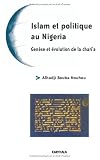
Alhadji Bouba Nouhou. Islam et Politique au Nigeria: Genese et Evolution de la Chari'a. Paris: Karthala, 2005. 280 pp. No price listed (paper), ISBN 978-2-84586-648-5.
Reviewed by H. B. Lovejoy (Department of History, University of California Los Angeles)
Published on H-Africa (May, 2007)
The Evolution of Shari'a Law in Northern Nigeria
American foreign policy on Nigeria in the post-September 11 world has been shaped by the rise of Islamic fundamentalism, the support for democratic reform, and the need to secure foreign supplies of oil. Nigeria is Africa's most populated country and the fifth largest oil supplier of the U.S. In Islam et Politique au Nigeria: Genese et Evolution de la Chari'a, Alhadji Bouba Nouhou, anthropologist at the Universite de Bordeaux, sheds light on the resurgence of Shari'a law (Islamic law) in parts of Northern Nigeria and the impact of this development on U.S.-Nigeria relations. He argues that the re-adoption of a legal system based on Muslim principles of Shari'a is directly linked to post-September 11 U.S. policies. Nouhou explains how the adoption of Shari'a in twelve states of Northern Nigeria has influenced Nigeria's role in the international political arena. By tracing the evolution of Islam in Northern Nigeria since its arrival in the seventh century, he argues that the emergence of modern-day Islamic fundamentalism in the region has coincided with the country's attempt to implement an American-modeled democracy. In his exploration of the roots of Islamic fundamentalism, Nouhou focuses on three phases: genesis and consolidation, Islam's interface with British colonialism, and the political-economic crisis of the 1980s.
Nouhou shows how Islamic law was introduced in the region in the seventh century with the arrival of Ibadi Muslims and outlines the consolidation of Islam through the nineteenth century. The author also discusses the evolution of Islam with the adoption of Maliki law and the impact of the Fulani-led jihad of Uthman dan Fodio, the introduction of Wahhabism and eventually the advent of European imperialism and its influence on the Islamic North, as opposed to a non-Islamic South.
In considering the interaction of Islam with British colonialism, Nouhou begins with the Berlin Conference of 1884-85 and the subsequent "partition of Africa." Northern Nigeria, largely comprised of Hausaland, was and still is predominately Muslim. This radicalization of Islam in the first half of the twentieth century eventually led, as Nouhou argues, to the formation of new Islamic universities, colleges and schools in the North. Nouhou argues that British-style "indirect rule" made use of Islamic legal courts to alter political agendas and thereby challenge the autonomy of the legal system. After political independence from Britain in 1960, Nigeria, as a country, had difficulty in creating a strong and unified national identity due to the ongoing tensions between the Islamic and non-Islamic regions.
Nouhou's treatment of the history of Islam relies on rather outdated secondary sources in his discussion. Unfortunately, he provides little critique of these sources and where they fit into the current historiography. There has been extensive work on the history of Islam in Nigeria since the pioneering work of Mervyn Hiskett, Norbert Tapiero, John Paden and J. N. D. Anderson. Failure to explore more recent scholarship, especially by Nigerian historians is a serious weakness of the book.
Nouhou's use of primary sources raises similar concerns. In his account of the first phase of Islamic development in Nigeria, Nouhou uses translations of Arabic documentation, especially that of colonial official H.R. Palmer, without discussion of the limitations of such early translation. This critique applies to Nouhou's use of works by Uthman dan Fodio, Muhammad Bello, and Abdullahi dan Fodio. Nouhou also uses colonial sources, most notably Frederick Lugard's memoirs. Lugard was High Commissioner of Northern Nigeria from 1900 until 1906 and also Governor between 1912 through 1918. But again, he neglects to engage in historical analysis and critical discussion of those texts, and seems to treat what was printed as historical fact.
In his examination of political and economic crisis of the 1980s, Nouhou presents an analysis of the political-economic crisis of the 1980s, in which the return to civilian power occurred at a time of growing interest by the United States in Nigerian oil production. Nouhou is more comfortable in this contemporary setting, as it allows him to employ his expertise in anthropological and political analysis. Here Nouhou analyzes the memoirs and autobiographies of key political and religious authorities, including Shehu Shagari, ex-president of Nigeria (1979-83), and Abubakar Gumi and Adamu Abdallah Illori, former grand Qadis in the North. He studies these men in order to demonstrate the sociopolitical role Islam has played since the economic crisis in the 1980s.
According to Nouhou, the economic crisis stemmed from conflict between the Muslim North and the non-Islamic South in relation to control of oil. Nouhou establishes how Islam has historically, from its North African origins until the present, served as a focal point in attempting to find solutions to socio-economic and political problems in the country. Nigeria is, however, composed of approximately three hundred different ethnicities, and while the author acknowledges this ethnic complexity, he fails to integrate an analysis of this diversity adequately into his discussion. For example, he establishes a timeline of the Fulani-led jihad of the early-nineteenth century, but he omits the impact of the jihad on the collapse of the Oyo Empire, especially after 1817. As the jihad demonstrates, the involvement of Yoruba in Islam predated European colonialism. Nouhou's attempt to cover such a large period, like so many other books of this kind, has led to sweeping historical generalizations that provide only superficial comparisons between the distant past and the present.
Nouhou makes the re-introduction of Shari'a law sound as if such a policy is the logical consequence of the long history of Islam in the interior of Nigeria. He argues that the North tried to sustain control of the economy and political power, although from the 1960s onward, power shifted to the oil-rich South, which pushed to align foreign policy with the United States. Shortly after President Olusegun Obasanjo's re-election in 1999, many of the Northern states reinstated Shari'a law, and by the September 11, 2001 attacks on the United States, twelve of the thirty-six federal states had imposed the Shari'a, according to Nouhou, as a solution to "all of socio-economic and political problems, while at the same time the country opened itself to democracy aligned with U.S. strategies" (p. 11). Nouhou explains how the return to Shari'a law has conflicted with Washington's attempts to preserve its economic interests in the country by promoting its own style of democracy to achieve political stability. Nouhou's methodological failings in using old scholarship do not do justice to the complexities of reform Islam within the Nigeria state, although he does establish an interconnection between oil politics, September 11, and the spread of the Shari'a.
If there is additional discussion of this review, you may access it through the network, at: https://networks.h-net.org/h-africa.
Citation:
H. B. Lovejoy. Review of Nouhou, Alhadji Bouba, Islam et Politique au Nigeria: Genese et Evolution de la Chari'a.
H-Africa, H-Net Reviews.
May, 2007.
URL: http://www.h-net.org/reviews/showrev.php?id=13201
Copyright © 2007 by H-Net, all rights reserved. H-Net permits the redistribution and reprinting of this work for nonprofit, educational purposes, with full and accurate attribution to the author, web location, date of publication, originating list, and H-Net: Humanities & Social Sciences Online. For any other proposed use, contact the Reviews editorial staff at hbooks@mail.h-net.org.

