

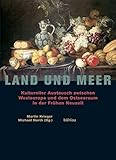
Martin Krieger, Michael North. Land und Meer: Kultureller Austausch zwischen Westeuropa und dem Ostseeraum in der Frühen Neuzeit. Köln: Böhlau Verlag, 2004. 269 S. EUR 34.90 (paper), ISBN 978-3-412-17703-4.
Reviewed by Kevin Goldberg (Department of History, University of California-Los Angeles)
Published on H-German (May, 2007)
Tastefully Exchanged
This richly detailed study deals with cultural exchange between western Europe and the Baltic Sea region during the early modern period. The volume represents the first published results of the research spurred on by a collaborative project on communication and integration in the Baltic region begun at the University of Greifswald in 2001. Most of the twelve essays, all by German, Polish, or American scholars, center on one of two main themes; first, the transfer and reception of western European cultural goods and ideas in the areas surrounding the Baltic Sea, and second, the intellectual networks that facilitated communication as well as the transfer of goods between regions. Although the contributing scholars are drawn only from the disciplines of history and art history, readers with broader interests including cultural anthropology, geography, and consumer culture will also be rewarded. While the approaches of the essays are diverse, the geographic focus is somewhat more limited. The Netherlands in the West and the important Baltic port city of Danzig emerged as key locations of cultural exchange in the early modern period, and thus are given heavy treatment throughout the volume. Other important centers of exchange, including Hamburg and Reval, are given less but still sufficient treatment, while some locations, namely all of the Nordic Baltic, are treated in far less detail. In addition, although not necessarily the aim of the volume, the reader should not expect to find much in the way of French or Iberian influence from the western European side. The narrowness of geographic scope represents the volume's most significant, and perhaps only, limitation.
The volume's two editors, Martin Krieger and Michael North, begin by introducing the idea of cultural exchange between western Europe and the Baltic region. The current work is meant to build upon the previous scholarship of, among others, Peter Burke. A key point of argument arises over whether the value, symbolic and otherwise, of an exchanged object is determined by its culture of origin or culture of destination. Krieger and North develop this issue further by addressing the differences between cultural exchange among the main port cities of western and Baltic Europe and among the major cities of Baltic Europe and its hinterland.
By far the largest section of the book is dedicated to the transfer of architectural ideas and artistic products, including paintings, furniture, and other decorative objects, between western Europe and the Baltic. Thomas DaCosta Kaufmann's essay delivers an extremely useful historiographic guide for the uninitiated, or an informative and concise review for the well traveled, which explains how the relationship between East and West has been discussed in relation to art and architecture. Among the avenues of future research suggested by Kaufmann is the elevation of regional over more specifically localized studies and the further examination of Russian art and architecture in the broader Baltic Sea region. For Michal Wardzyñski, Danzig stood at the center of exchange between the Netherlands and Poland-Lithuania. In an examination of the trade of art and pattern books (Musterbücher), Wardzyñski ultimately demonstrates how Dutch, Flemish, and German artistic taste was transferred to rather remote regions beyond the urban world of Danzig, largely driven by the demands of geographically diverse Polish nobles. The fifteen-page essay, supplemented by photographs and maps, is very effective in demonstrating how standards of taste are determined politically and through the effects of migration. Edmund Kizik's well-contextualized essay reveals the sources of Dutch influence on Danzig and the Polish-Lithuanian hinterlands. Kizik uses death inventories (Nachlassinventäre), as do many of the other contributors, to get at the kinds of artistic goods and paintings exchanged. Similarly, Anna Oleñska tracks international trends in artistic taste emanating from Danzig. In particular, she looks at the significant role of the Danzig art market for the outfitting of noble homes in Poland. For Ewa Manikowska, the Warsaw estate of Stanis³aw August Poniatowski provides a glimpse at the factors affecting buying patterns in art and luxury goods. An appendix to Manikowska's essay includes portions of Poniatowski's correspondence regarding the purchase and sale of art, furniture, and decorative objects. In a shift of geographic location, Michael North examines the rise in size and importance of Hamburg as a center for art auctions. Among other factors, Hamburg's location, liberal auction laws, and its position as the home of many influential dealers with connections to the Netherlands, all helped Hamburg become a significant center of exchange and influence. North also tracks the "secularization of taste" in art auctions throughout the seventeenth and eighteenth centuries. The entire first section demonstrates that the idea of taste, secularized or otherwise, was a fundamental principle in cultural exchange.
The second section of the book focuses on furniture and home décor within the exchange networks. Corina Heß reconstructs the use of decorative and luxury goods in Danzig homes during the seventeenth and eighteenth centuries. Her resourceful use of diagrams helps the reader comprehend the changes in number and quality of lighted objects, mirrors, lockers, and other goods. Heß manages to successfully draw comparative conclusions between the use of such goods in Danzig and other cities in the region. In one of the volume's shorter essays, Maciej Maksymowicz uses excerpts from the Wöchentliche Danziger Anzeigen from the eighteenth century to discuss the Danzig market for art and handicrafts. The source reveals the extent of the secondhand market for artistic goods in Danzig during this time period. In an interesting study of German merchants in eighteenth-century Reval (now Tallinn), Jörg Driesner, and Robert Riemer once again demonstrate the possibilities of using death inventories to recreate past societies. Here, the authors show, among other things, how objects such as mirrors served as markers of prestige and high taste.
The final section deals with intellectual correspondence insofar as it contributed to cultural exchange between East and West. Martin Krieger adeptly positions Hamburg as a center of intellectual crossings during times of crises, not simply because of its useful geographic position. This is largely done through an extensive analysis of Joachim Jungius's correspondence during the violent first half of the seventeenth century. Krieger leaves no stones unturned in his thorough breakdown of Jungius's letters and their role in Hamburg's function as an important center of communication. Following up this essay, and concluding the book, is Klara Deecke and Ingrid Gabel's extended excerpt on the "Hartlib-Kreis" intellectual network. Again, correspondence is analyzed here, on a comparatively large scale, to demonstrate how ideas were transferred across the continent. From his residence in England, Samuel Hartlib stood at the vortex of an entire network of intellectuals throughout Europe; Deecke and Gabel show the complexity of such correspondence.
This volume fits neatly within the growing interest in transnational histories. Its strength lies in demonstrating how certain kinds of ideas were exchanged across cultures. Conceptions of taste in the Baltic region, only partially a product of local origins, were built around the importation and reassessment of foreign ideas. In the early modern period, both urban and rural gentry were largely responsible for the acceptance and distribution of aesthetic ideals. In this case, the book shows how artistic and architectural initiatives were imported to the urban centers of the Baltic and then spread throughout its hinterland.
While the contributors to the volume do an impressive job recreating the intellectual networks that carried these ideas, some readers may legitimately be left wondering about the possible roles of kinship and perhaps even religious belief in these intricate processes. Depending on their interests and research background, readers may find the plethora of names, some familiar and some less so, daunting. Those interested in cultural exchange but not necessarily well versed in the early modern Baltic region may find themselves confused at some points, which could potentially detract from its suitability for the American graduate seminar. Some essays are better than others in their historical contextualization. The contributors and publisher should be commended for their liberal use of maps, diagrams, charts, and graphs in many of the essays. The inclusion of separate indexes for place names and personal names is also quite helpful.
An implicit concept that cuts across the majority of the essays is that taste, as an aesthetic ideal, travels freely across geographic boundaries but not without the assistance of some sort of carrying agent. In this regard, the idea of taste plays a critical role in the narrative. However, it is the idea of taste that deserves further attention, not because it is treated inadequately in the volume, but precisely because the volume reveals the significance of taste as a scholarly concept. What and where are the boundaries of taste both as a factor in historical processes and as an analytical device for historical research? Is aesthetic discrimination simply a sieve for artistic ideas or is it related to mental processes or culturally constructed ideas combined with other forms of selection? Can we unpack and dissect early modern and modern forms of taste and tie them into a society's historical consciousness? Bringing taste into the canon of universally accepted historical concepts opens avenues yet unexplored, which remain in wait. This volume begins to work in that direction.
If there is additional discussion of this review, you may access it through the network, at: https://networks.h-net.org/h-german.
Citation:
Kevin Goldberg. Review of Krieger, Martin; North, Michael, Land und Meer: Kultureller Austausch zwischen Westeuropa und dem Ostseeraum in der Frühen Neuzeit.
H-German, H-Net Reviews.
May, 2007.
URL: http://www.h-net.org/reviews/showrev.php?id=13189
Copyright © 2007 by H-Net, all rights reserved. H-Net permits the redistribution and reprinting of this work for nonprofit, educational purposes, with full and accurate attribution to the author, web location, date of publication, originating list, and H-Net: Humanities & Social Sciences Online. For any other proposed use, contact the Reviews editorial staff at hbooks@mail.h-net.org.

