



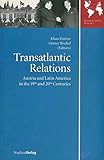
Klaus Eisterer, Günther Bischof, eds. Transatlantic Relations: Austria and Latin America in the 19th and 20th Centuries. Innsbruck: StudienVerlag, 2006. 332 pp. EUR 34.90 (paper), ISBN 978-3-7065-4213-5.
Reviewed by Jonathan Kwan (School of History, University of Nottingham)
Published on H-German (May, 2007)
Atlantic Studies Arrives in Austria
The first volume in the "Transatlantic" series, edited by the historian Günther Bischof and published by the landlocked Innsbruck publisher StudienVerlag, looks at the under-researched field of Austrian-Latin American relations. The connection of Atlantic Studies with a firmly continental power such as Austria may at first sight appear strange, and indeed, Austria's geographic position away from the lucrative Atlantic trade routes greatly contributed to its relative "economic backwardness" in the nineteenth century. Despite this apparent incongruity, the book hints at the wide range of subjects within this nascent field. As the introduction states: "the interactions between Habsburg 'Austria'/republican Austria and the Latin American countries over the course of some 200 years of history are rich and take place on many different levels from the personal to the official" (p. 14). Published just in advance of the fourth European Union-Latin American/Caribbean summit held in May 2006 during the Austrian European Union presidency, this book will hopefully provide impetus in exploring Austria's connection to the non-European world, an oft-neglected field of study. Overall, despite an early apology for "a hodgepodge of interactions, all valuable on their own terms, but in no way pretending to present a complete picture" (p. 9), a number of general themes do emerge.
Unsurprisingly, official diplomatic contact provides a constant thread throughout the three chronological sections of the book, which deal in turn with the nineteenth century, the interwar and wartime period, and "After 1945." Rudolf Agstner, in a thorough survey, investigates the network of consulates south of the Rio Grande up to the end of World War I. While the essay provides insights into the development of the consulate system, more discussion of actual everyday consulate work would have facilitated more wide-ranging conclusions. His reliance on materials in the Viennese archives rather than any South American sources may have contributed to the institutional emphasis of the essay. Klaus Eisterer's essay, "The Committee for the Protection of Austrian Interests in Brazil (1943-1945)," focuses on the figure of Anton Retschek, a career diplomat who was fired without a pension shortly after the Anschluß. Retschek stayed in Brazil and formed the committee during the war, the main issue being the registration of distinctly Austrian identity papers. During the war Austrians were automatically regarded as German citizens and therefore, after 1942, enemy aliens, unless they could prove Austrian patriotism and anti-Nazi conviction. Stefan Müller's essay on Austrian-Mexican relations from 1901 to 1956 merely skates over the surface of events, though he includes some good background detail of Mexico's protest against the Anschluß. It is the only essay that does not read smoothly in English, while the book is, in general, well translated. In the "After 1945" section, Margit Franz discusses the SPÖ's solidarity with the Nicaraguan Sandinista government between 1979 and 1990. She highlights the configuration of Austrian foreign policy after World War II and the clear ideological distinction between the ÖVP and the SPÖ within the context of the Cold War. Bruno Kreisky (SPÖ) professed support for the Sandinista government, which was understood as a clear anti-Reagan signal, and provided funds for development, whereas Alois Mock (ÖVP), who became foreign minister in 1987, followed the American line, calling for democratic elections.
Most of the essays in the nineteenth-century section are about individual figures and their adventures in South America. Claudia Reichl-Hann provides an excellent biographical essay on Leopoldine Habsburg, Empress of Brazil from 1822 to 1826. While providing no real new insights or findings, the essay sums up existing scholarship and provides a good introduction to a lesser-known member of the Habsburg family. By delving into both private and public, Reichl-Hann outlines Leopoldine's upbringing, marriage, and political role in a turbulent time for Brazil, Portugal, and Austria. Leopoldine's sense of duty and sacrifice in the face of her husband's flagrant infidelity followed in the long tradition of Europe's foremost royal family. Erwin Schmidl's short piece on Maximilian's motley and unsuccessful Austrian troops in Mexico confirms their inglorious reputation. Christa Riedl-Dorn's essay on explorers to South America is more substantial and draws attention to numerous forgotten adventurers who filled the museums and warehouses of central Europe with exotic plants, wildlife, and minerals. We are introduced to the "Austrian Humboldt," Thaddeus Peregrinus Haenke, the members of the 1817 expedition to Brazil (who were part of the preparation for Leopoldine's move there) and various other adventurers and collectors of the nineteenth century.
The emphasis in the interwar section falls on larger groupings, in particular the wave of emigration from Austria to Latin America after World War I. This is no surprise given the grim situation in Republican Austria, where unemployment was a constant problem. Ursula Putsch's short overview is complemented by Katrin Achrainer's in-depth study of Andreas Thaler's Dreizehnlinden project. Achrainer's essay is a detailed and fascinating look at the former minister of agriculture's attempt to found a Tyrolean community in the forests of Brazil. While Thaler's Tyroleans made up only a small portion of the 30,000 Austrian interwar emigrants to South America, the project's trajectory is instructive. In time-honored Austrian tradition, his government connections were essential for the plans to get off the ground. His desire to head up the community and to emigrate with his family led to considerable publicity at the beginning of the project. Subsequent difficulties, which included legal issues, criticism of Thaler's leadership, and the onset of war, marked the rapid shift from heady idealism to the stark reality of transplanting and constructing a community far from home.
The "After 1945" section begins with a lengthy essay on the flight of Nazi war criminals through the "Nazi escape hatch" of South Tyrol. Gerald Steinacher superbly reconstructs the chaotic end of World War II and the fluid situation in its immediate aftermath. The reader is immediately plunged into the murky world of people smugglers, safe houses in the countryside, and false identities. With the help of pro-Nazi bishop Alois Hudal and lax control in the issuance of Red Cross papers, many former Nazis, including high-ranking SS officers, escaped to Argentina where, because of their skills and education, they were met with open arms. The section is filled out with Margit Franz's aforementioned essay on Austrian-Nicaraguan relations and with Herbert Berger's essay on Austro-Chilean solidarity from 1973 to 1990. Berger mixes autobiography and history to illuminate this minor episode in the history of Austrian organizations and foreign policy.
The final section of the book is devoted to cultural links and appears a little incongruous amongst papers of a mostly historical nature. This is especially the case for Franz Grafl's essay on Austrian reception of Latin American films from 1960 to 2005, since he adopts a cultural studies approach with little empirical backing. Eva Maria Stehlik's essay on the Latin American literature boom is more substantial and provides a good introduction to the phenomenon. She traces the gradual growth of interest throughout the 1960s and early 1970s, which culminated in the 1976 Frankfurt Book Fair's adoption of a Latin American theme. At the end of the essay she discusses the particular challenges facing the new generation of Latin American writers in the shadow of their illustrious predecessors.
Unfortunately no concluding essay postulates future lines of research in Austrian-Latin American relations. Some possible avenues would be the increased use of Latin American archives and the incorporation of Spanish-language scholarship. Of the authors of historical essays, only Riedl-Dorn, Eisterer, Müller, and Berger use Latin-American works and sources, and then only minimally. Nevertheless, the diversity of subjects covered in this volume raises important questions about Austria's foreign relations with other neglected regions, such as Africa, Asia, and Australia. In an ever more connected world, the growth in such fields as Atlantic Studies, world history, emigration studies, and others is to be encouraged. Austria should not miss the boat.
If there is additional discussion of this review, you may access it through the network, at: https://networks.h-net.org/h-german.
Citation:
Jonathan Kwan. Review of Eisterer, Klaus; Bischof, Günther, eds., Transatlantic Relations: Austria and Latin America in the 19th and 20th Centuries.
H-German, H-Net Reviews.
May, 2007.
URL: http://www.h-net.org/reviews/showrev.php?id=13188
Copyright © 2007 by H-Net, all rights reserved. H-Net permits the redistribution and reprinting of this work for nonprofit, educational purposes, with full and accurate attribution to the author, web location, date of publication, originating list, and H-Net: Humanities & Social Sciences Online. For any other proposed use, contact the Reviews editorial staff at hbooks@mail.h-net.org.

