



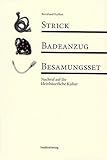
Bernd Kathan. Strick, Badeanzug, Besamungsset: Nachruf auf die kleinbäuerliche Kultur. Innsbruck: StudienVerlag, 2006. 111 pp. EUR 19.90 (paper), ISBN 978-3-7065-4197-8.
Reviewed by Ray Canoy (Department of History, University of Oklahoma)
Published on H-German (May, 2007)
The Hills Are Alive
Bernard Kathan offers his short book as an "obituary" for the vanished world of the traditional small farmer in the German-speaking Alpine regions of Europe. This obituary takes shape in a series of short essays, about sixty in all, evoking the texture of this milieu by examining found objects from everyday material culture. At first, this seems a straightforward enough project, if one with an author seemingly overmatched by the problems of integrating two approaches, the documentary/analytical versus the aesthetic/elegiac. The more the reader engages with the book, however, the more this awkwardness stands revealed as something of a deliberate stylistic conceit and perhaps a clue to Kathan's further intentions. Not quite a parody, the book is nevertheless written by a conceptual artist as well as a commentator familiar with the subject, one very adept at sending up the clichés that have grown up in post-industrial urban consumer culture around the whole project of commemorating vanished traditional worlds.
Kathan is an installation artist from the Austrian state of Vorarlberg. He is known for outdoor work, such as the 1992 erection in an Alpine valley of an empty tent containing audio equipment out of which recorded industrial sounds that emerged to be captured by a voice-over reporter, Kathan himself, recording coverage of the "art event." Until the reader realizes the numerous levels on which the artist/author is possibly working in the present book, it is difficult to pigeonhole this work. Is it a breezy anthropological inventory? A badly documented and referenced social history? A stream-of-consciousness ethnographic analysis? An extended set of literary metaphors and meditations? Even a coffee-table book of "found" art with unusually mannered captions? Although the book partakes of all these genres, in the end the author/artist cannot avoid revealing his hand by showing a preference for the serendipitous and the impressionistic over the analytical and the empirical.
The book is largely bereft of scholarly apparatus. The small handful of notes refers us to fictional or autobiographical accounts of rural experience, catalogues of rural-themed art or photography, collections of traditional rural songs, and the like. No reference is made to any of the secondary literature on recent structural transformations in rural central Europe, or to larger issues of "deprovincialization" or socioeconomic modernization in this part of the world, discussed in the work of Antonia Maria Humm, Peter Lintner, Axel Schildt, Paul Erker, or Arnold Sywottek. The work has the feel of a whimsically curated catalogue for a very personal museum of rural life in someone's dream world--perhaps Rene Magritte's. No introduction, foreword, or preface lays out Kathan's arguments and the book launches directly into an examination of its first object, a simple length of cord. In an afterword, the author does move from his individual objects to more general thematic considerations. Here, as in the rest of the work, the stated goal of elegy coexists somewhat uneasily with often quietly funny critiques of the reification and idealization in tourism, art, and literature of the rural Alpine milieu by observers from the thoroughly urbanized societies of present-day central Europe. Kathan overlays this with his own Möbius strip of reflections on the reflexivity of his documentary/aesthetic social commentary.
A very individual and idiosyncratic sensibility governs Kathan's choice of objects. Although a good number consist of the kinds of things predictable for a theme like this, such as agricultural tools, traditional religious devotional items, handmade furniture, household and kitchen equipment, farm account books, and the like, others seem unlikely choices with which to document a "traditional" milieu, for example, plastic artificial insemination devices for livestock, bathing suits, a pair of binoculars sitting on a kitchen windowsill. Still others (discarded washing machine glass doors, mouse and rabbit droppings, a numbered stub from a community raffle drawing, a dented aluminum bowl from a hardware store, a stuffed owl) seem at first inspection positively bizarre. Creating three classes of objects within the volume is my own attempt to resist the conclusion that the willfully random aesthetic of confrontation and juxtaposition often found in the non sequiturs of installation or conceptual art is the sole guide to Kathan's choices.
Apart from dutiful observations about past habits of work and community solidarity evoked by traditional tools, Kathan deploys some of the accompanying essays as an anecdotal foundation for his more eclectic and often apparently arbitrarily chosen conclusions. The bathing suits, it turns out, have become since the 1960s the preferred outfits for female field hands who, unable to enjoy beach vacations because of the pressing harvest, have apparently decided to at least adopt the accoutrements of the leisure society and along the way, Kathan believes, eroticize the rural summer. The binoculars on the windowsill, he argues, helped perpetuate the goldfish-bowl atmosphere of small town life into a present era of consolidated acreage and dispersed farmhouses and suburbia by allowing the nosy the same access to close-up views of what their now more distant "neighbors" were up to, as in the vanished landscape of intimate residential main streets in clustered settlements. The glass washing machine door, rescued from a junked unit, is pressed into service, both as a weather-proof outhouse or workshop window, in a long rural tradition of never throwing away anything that might still be useful in an unexpected way, and in the equally long tradition of artists exploiting the potential for accidental effects in the juxtaposition of unrelated subjects in a narrative. The mouse droppings provide an occasion to meditate on the close physical proximity of all sorts of animal life to humans in rural areas and eventually lead to Kathan's own boyhood flashbacks of sleeping in a farmhouse with the oddly comforting sound of burping, cud-chewing, and farting cattle in the next room.
In his concluding essay, Kathan addresses various issues revolving loosely around the extent to which rural life has shed much of its traditional character and feel, as well as how questionable our remaining sources of access to this fading world have become. For him, farmers' diaries prove too laconic and living history museums and similar interpretive centers overemphasize the picturesque while at the same time sanitizing the displayed spaces, removing the daily clutter, the ever-present vermin (something of an obsession for the author), and the other detritus of actual living. With some noteworthy exceptions, Kathan complains, photographers specializing in this subject similarly stress the anthropological, the stylized, yet also the humorlessly "authentic," reflecting back what the author calls the "bourgeois-urban gaze" back onto the viewer.
These closing considerations are not really those of an empirical investigator. It is as if Kathan the artist is having fun taking on the voices and personae of a succession of rather ponderous community activists, social geographers, anthropologists, and literary critics anxious to stem the tide of comfortable urban misappropriations and kitschifications of rural heritage. He does not really pursue any of these critiques in systematic ways, but does succeed through them in with the goal of elegy--with all the roundabout trains of thought, sudden emotional leaps, repetitions, and deeply cryptic personal associations of that genre. Some resolution emerges when Kathan begins to ruminate on his own methodology. He freely admits the arbitrariness of his choices, the interchangeability of most of the objects, and the importance of his own autobiographical memories as evoked by these things, many of which were apparently sent to him by friends or artistic collaborators, or acquired on impulse in flea markets. In the end, the book is a work of art, not scholarship or reportage. Kathan is particularly creative in appropriating various registers of analytical and scholarly writing to help create the mood of distance and inaccessibility. He has written a book that not only accomplishes a subtle aesthetic aim, but can help evoke a much-needed visceral sense of place and time for scholars working analytically on the subject in the very disciplines from with Kathan poaches his styles.
If there is additional discussion of this review, you may access it through the network, at: https://networks.h-net.org/h-german.
Citation:
Ray Canoy. Review of Kathan, Bernd, Strick, Badeanzug, Besamungsset: Nachruf auf die kleinbäuerliche Kultur.
H-German, H-Net Reviews.
May, 2007.
URL: http://www.h-net.org/reviews/showrev.php?id=13170
Copyright © 2007 by H-Net, all rights reserved. H-Net permits the redistribution and reprinting of this work for nonprofit, educational purposes, with full and accurate attribution to the author, web location, date of publication, originating list, and H-Net: Humanities & Social Sciences Online. For any other proposed use, contact the Reviews editorial staff at hbooks@mail.h-net.org.

