



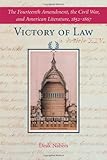
Deak Nabers. Victory of Law: The Fourteenth Amendment, the Civil War, and American Literature, 1852-1867. Baltimore: Johns Hopkins University Press, 2006. xii + 239 pp. $49.95 (cloth), ISBN 978-0-8018-8350-7.
Reviewed by Evan Carton (Department of English, University of Texas at Austin)
Published on H-Law (May, 2007)
Victory over Context
At regular intervals throughout Victory of Law, historical actors and analysts suggest that political facts (institutions and relations of power--and laws as instruments of power) may be more important than words and ideas in defining the terms and trajectory of African slavery and African American citizenship in the United States. Thus, abolitionist William Lloyd Garrison is quoted dismissing a tortured and ineffectual linguistic "proof" of the Constitution's opposition to slavery with the remark: "the important thing is not the words of the bargain, but the bargain itself" (p. 141). Historian David Potter is quoted as characterizing the Freeport Doctrine--an insupportable position on territorial sovereignty and constitutional law that Stephen Douglas was maneuvered into taking in the 1858 Lincoln-Douglas debates--as "one of the great nonevents of American history" (p. 105). Supreme Court Justice Robert Grier is cited as insisting that the unconstitutionality of the Southern states' secession was decided not by legal argument but by the Civil War (pp. 24-25). And "many of the principal figures in the debates over Reconstruction" are admitted to have cared "pretty little how the conflict was described," so long as their practical objectives were met in its resolution (p. 37).
Deak Nabers rejects such materialist and instrumentalist understandings of slavery and emancipation, as well as the Constitution's role in both. In their place, he offers an account of this history in which epistemology rules, hermeneutics liberate, and literary abolitionists help bring about a new legal imaginary without which the "Poetic Constitution" (p. 173) disclosed (or produced) by the Fourteenth Amendment--a Constitution that resolves the founders' apparent equivocation or hypocrisy on the question of slavery and squares "the seemingly contradictory Northern war aims" of union and emancipation (p. xi)--"would literally have been inconceivable" (p. 9). Nabers's project originated, he tells us, in a graduate school mentor's "off-the-cuff remarks about the relations between lyric and the law" (p. xi). True to its inspiration, Victory of Law offers a number of suggestive textual juxtapositions and insights. But Nabers's textual orientation is too hermetic to support his historical argument about the emergence of an emancipationist Constitution, and his commitment to advancing that argument by means of rhetorical analysis and to consolidating his local insights "into something like a regular book" (p. xii) produce readings that are too selective, eccentric, and strained to persuade.
The book's central argument is as follows: In 1861, the North went to war against the seceding states on the grounds that secession was an act of lawlessness and bellicosity--an act that not only materially damaged the Union but violated its Constitution and, as Lincoln put it, imperiled the right of any "constitutional republic" to "maintain its territorial integrity, against its domestic foes" (p. 28). In victory, however, the North faced a problem: how to reconcile its "two chief aims in the Civil War--union and emancipation" (p. ix)--both with one another and with its claim to have joined the battle only to vindicate the law. (The first and strongest chapter of Victory of Law reads Herman Melville's 1866 poetry collection Battle Pieces and Aspects of the War--from which Nabers draws his title phrase--as a meditation on the political, ethical, and epistemological dimensions of this problem.) As "a legal enactment" (p. 9), after all, the same Constitution that had established the union the North fought to defend had, for upwards of seventy years, protected (or seemed to protect) slavery, though it never spoke the word. Moreover, for much of the quarter century that preceded the war, Garrison and other abolitionists had attacked the Constitution and the entire regime of man-made, positive law as slavery's very basis, while invoking the ostensibly opposing (and, in their view, properly prevailing) dictates of natural or higher law as the authority for emancipation. On this view of what the Constitution was and did, the Reconstruction amendments that abolished slavery and provided for African American citizenship could only count as radical transformations of the union and the law, and imperial impositions on the defeated South; they could not plausibly be advanced and understood as restorative. Yet they were advanced and understood as such. "Emancipation was realized in the United States," Nabers asserts, "as an expression of constitutional necessity rather than a form of constitutional repudiation" (p. 3)--a feat whose cognitive ground and very "conditions of intelligibility" (p. 9) substantially derived from the "legal thematics in the major literary works of the 1850s" (p. 10). As the decade progressed, works by such writers as Henry David Thoreau, Harrriet Beecher Stowe, Nathaniel Hawthorne, and William Wells Brown--several of whom had formerly embraced the idea that "slavery and the law were not only inextricable but also identical" (p. 57)--repudiated or destabilized this "broad Garrisonian paradigm" (p. 114) and forged instead "a constitutionalist basis for emancipation" (p. 10). Representing the law as "an essentially hermeneutical activity ... tethered to the world of discourse" (pp. 166-167), these writers helped Americans begin "to think of a constitution as a set of statements in need of enforcement rather than a legal enactment on its own" (p. 9), and thus to view "the 'compromises' that allowed slavery to flourish in the United States" as "compromises of the Constitution, not compromises by the Constitution" (p. 5). With the Reconstruction amendments, accordingly, the Constitution emerged uncompromised at last and in its true aspect as "a form of written higher law" (p. 8), rather than as higher law's opponent.
This story rests, I think, on several dubious or overstated claims. For starters, emancipation--unlike the explicit and original motive of preserving the union--was neither a Northern war aim at the outset of the conflict nor an inevitable consequence of a Northern victory. Even after the Emancipation Proclamation laid the foundation for slavery's complete abolition at war's end, full citizenship and voting rights for blacks were not assured. Any number of historical contingencies--including the war's unexpected length and toll, and Lincoln's assassination--cleared the path to the substantive achievements of the thirteenth and fourteenth amendments, a path that postwar lawmakers took for a complex of ideological, affective, and practical political reasons, rather than by virtue of their late epistemological conversion to its constitutional necessity. To the extent that they sought to ground these amendments in an overarching constitutional theory, these lawmakers were impelled not by a desire for formal ideational consistency, but by legal interpretive convention and by the strategic demands of sectional reconciliation. (Though unreconstructed white Southerners remained unpersuaded that it was the Constitution--rather than superior Northern troop strength, capital, and arms supplies--that had provided the basis for emancipation.) In any case, the argument for an antislavery Constitution required no new "conditions of intelligibility" in the Civil War's immediate prelude or aftermath, since this position had been long available and often articulated in debates over slavery's consistency or inconsistency with founding American principles and texts.
Nabers's story of epistemic crisis and transformation, however, requires as its starting point a "broad Garrisonian paradigm" within which Americans perceive--with outrage, resignation, or satisfaction, depending on their politics--that the Constitution authorizes slavery. This is indeed the platform from which the argument of Victory of Law is launched, in spite of Nabers's admission that the Garrisonian paradigm was not generally paradigmatic and, indeed, might not even have governed Garrison's own thought and speech: "Garrison's most radical assaults [on American law as slavery's source, parent, and embodiment] never exactly represented mainstream American antislavery thought. There is some question, indeed, as to whether they actually represented Garrison's own thoughts about slavery. Not only did his positions on the matters I will be addressing fluctuate from the 1830s to the 1860s, but it is often difficult to determine whether Garrison was more committed to the constative matter of the arguments he prosecuted or the performative matter of the social and political effects those arguments might have had in the immediate contexts in which he delivered them" (p. 49). His own caveats notwithstanding, Nabers strains to make his historical case by reading such texts as Thoreau's early antislavery essays and Stowe's antislavery novels as shaped and bound by Garrisonian antinomianism in its most thoroughgoing and literalistic form. And, throughout Victory of Law, Nabers strains to sustain the privilege of epistemology and hermeneutics over more instrumental social and political contestation by (bizarrely) assuming virtually every utterance by literary and political rhetors alike to be constative--a proposition of fact or belief--rather than performative and contextual.
Nabers reads Thoreau's antislavery writings--from "Resistance to Civil Government" (1849) through "Slavery in Massachusetts" (1854) to the John Brown essays of 1859--as charting "a steady progression in Thoreau's thinking" (p. 94), from the Garrisonian position that altogether renounces the law and the state as parties to an "almost metaphysical alliance ... with slavery" (p. 56) to a position that finds in American law the law of nature and the foundation and recourse of freedom. If this trajectory "has gone almost entirely unrecognized in Thoreau studies" (p. 94), as Nabers asserts, it is because it is unpersuasive. The selective, not categorical, disobedience to the law and resistance to the state that Thoreau reports and theorizes in the first and most celebrated of these essays is an act of critical citizenship. Predicated on the taxpaying citizen's personal implication in the unprincipled state actions that he finances, Thoreau's action from principle is explicitly calculated, as he puts it, to separate the diabolical from the divine--in himself, in others, and in the American state and its morally amalgamated political heritage. Radical as this project is, its character is ultimately reformist, as implied by Thoreau's insistence that if one thousand, one hundred, ten, or even one honest man were to withdraw from his copartnership with oppression and be locked up in the county jail, it would be the end of slavery in America. Ignoring counter-evidence to his claim that "Resistance to Civil Government" imagines an utterly illegitimate and unregenerate state, Nabers goes on to make a weak case for Thoreau's "intense desire for government" and embrace of the law as "the foundation for freedom" in the later essays (p. 110). This case includes such arguments for Thoreau's reconciliation to the law as his use of the word "plea" in the title of his address, "A Plea for Captain John Brown," and his rebuke of the governor in "Slavery in Massachusetts" for failing "to see that the laws of the State were executed" (p. 110). Five years after professing his "eagerness for a state that 'governs not at all,'" Thoreau now mounts "a critique of the state for not governing enough" (p. 110), Nabers points out, as if the same state were at issue in each instance and Thoreau's cognitive conversion on the question of the state's character and function were the likeliest explanation of his 1854 rhetoric. Conveniently absent is the intervening fact of the 1850 Fugitive Slave Law, which put state law as well as local sensibilities in Massachusetts into direct conflict with an enforced federal provision, and which provided the obvious context and strategy for Thoreau's challenge to Massachusetts officials to administer justice in accordance with their state's laws and putatively cherished traditions.
When he turns to Stowe, Nabers's case for "her systematic aversion to normative legal authority" (p. 59) hinges on an absent article: Stowe's statement near the outset of Uncle Tom's Cabin (1852) that the evil shadow that hangs over plantation slavery's careful display of a benign paternalistic order is "the shadow of law" (p. 61). The fact that no "the" precedes the word "law" suggests to Nabers that Stowe's "problem is not with a particular legal order [but] with legal orders as such" (p. 61), indeed, that "the problem of slavery merely serves as an example of the more general problems of law" (p. 59). Nabers also cites, but does not comment on, the very next sentence in Stowe's "shadow of law" passage, which begins with a phase ("So long as the law considers") whose temporal conditionality and provision of the definite article might have given him pause. Instead, he presses on, again attributing to Stowe's antinomian first principle--rather than to her gender politics or to the limits of her racial progressivism or to her novel's Christological design--the absence of "a legal alternative to slavery" in Uncle Tom's Cabin (p. 63). In 1852, by Nabers's account, a radical aversion to the law informs Stowe's novelistic imagination; in 1856, that imagination is in the throes of conversion to legalism. If Uncle Tom's Cabin--for all its sympathy to black suffering--cannot authorize black citizenship because Stowe imagines law and slavery to be inextricable, Dred_--for all its sympathy to the same--cannot authorize slave revolution "because Stowe had begun, however ambivalently, to cast the law as a necessary instrument of freedom" (p. 98).
In theme and, to a large degree, in method, the project of Victory of Law finds its nineteenth-century precedent in a work that it discusses in some detail, Lysander Spooner's 1845 The Unconstitutionality of Slavery. One of "a spate of constitutional antislavery arguments developed from the mid-1830s through 1861" (pp. 135-136), Spooner's tract compensates for its lack of "an unproblematic ground for thinking that the Constitution proscribes slavery," Nabers writes, by adopting "Rules of Interpretation" designed "to make what little evidence he [presents] count as definitive" (pp. 139-140). Among these rules is one that "prioritizes the actual words in a constitution over a general knowledge of its provisions" (p. 140). The ultra-formalist hermeneutics of The Unconstitutionality of Slavery leads legal historian Robert Cover, whom Nabers quotes, to pronounce, "Spooner's constitution is amputated from any societal context" (p. 141). I often felt much the same way about the arguments of Victory of Law.
If there is additional discussion of this review, you may access it through the network, at: https://networks.h-net.org/h-law.
Citation:
Evan Carton. Review of Nabers, Deak, Victory of Law: The Fourteenth Amendment, the Civil War, and American Literature, 1852-1867.
H-Law, H-Net Reviews.
May, 2007.
URL: http://www.h-net.org/reviews/showrev.php?id=13119
Copyright © 2007 by H-Net, all rights reserved. H-Net permits the redistribution and reprinting of this work for nonprofit, educational purposes, with full and accurate attribution to the author, web location, date of publication, originating list, and H-Net: Humanities & Social Sciences Online. For any other proposed use, contact the Reviews editorial staff at hbooks@mail.h-net.org.

