



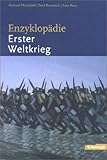
Gerhard Hirschfeld, Gerd Krumeich, Irina Renz. Enzyklopädie Erster Weltkrieg. Paderborn: Ferdinand Schöningh Verlag, 2004. 1002 S. EUR 58.00 (cloth), ISBN 978-3-506-73913-1.
Reviewed by Michael B. Barrett (Department of History, The Citadel)
Published on H-War (April, 2007)
An Excellent One Volume Reference
The value of an encyclopedia is usually directly proportional to its length and the quality of its contributions. Although the Enzyklopaedie Erster Weltkrieg is a single volume, it is a thousand pages long and the names of the contributors will be very familiar to scholars of the Great War. The international cast has many who are tops in the field. Given the limitations imposed by a single volume, this is an excellent compendium of material about the First World War. The organization is unusual. Most reference works are organized alphabetically, but in the Enzyklopaedie, several lengthy thematic sections precede the usual A-to-Z entries.
The first part of the Enzyklopaedie, called "Interpretation," has separate sections devoted to the major belligerents, society at war, the course of the war, and the historiography of the war. The section on the warring powers contains essays of about fifteen pages each on the major Entente and Central Powers. The authors generally examine entry into the war; war aims; politics on the home front; leadership; the economy; morale; forming or being forced to accept armistice terms; and so forth. The section on France is a bit more restrictive, focusing on wartime politics. The Belgian piece provides some rather interesting facts for an oft-overlooked power. For example, the Belgian Army steadfastly refused to participate in Allied offensives until the final one. Nevertheless, during the war the government-in-exile called 60,000 men to the colors, plus another 32,000 volunteered. Most came from overseas colonies. The army's insistence on giving orders solely in French provoked a protest movement, we discover.
These summaries are followed by thematic essays under the broad heading of "Society during the War." Under this rubric are pieces placing into the context of the war topics such as women, children and adolescents, workers, soldiers, and academics, followed by war literature, religion, propaganda, medicine and the war economies. Another section handles the course of the war, with succinct essays dealing with the road to war; the transition from European to world war; the direction of the war by the Entente and by the Central Powers; the law of war and war crimes; and the ending of the war. The final section concerns the historiography of the war. Of course the brush strokes are necessarily broad here (as in all the interpretive essays), but a lengthy work summarizes the official histories as well as the military, diplomatic, and later academic interpretations. For some reason East German historiography of the war merits its own separate piece, while no other state does. No mention is made of Russian historiography. Nonetheless, within the constraints of a single volume, all these essays provide excellent, up-to-date summaries of interpretations in each field.
The A-to-Z entries cover some six-hundred-plus pages and are the most fascinating part of the work. Entries are well-written, and the illustrations are excellent. Unfortunately, the editors must take length into consideration, so not everything or everybody merits an entry. Nonetheless, the scope is impressive, ranging from superstitions to vermin in addition to the usual military topics and figures. Only a few can be mentioned, which are noted here on the basis of random selection, and just to provide a glimpse of the wide-ranging interests the editors displayed in collecting these pieces. An entry on film has a great listing of movies, conveniently divided into those made during the war and those from the inter-war period. There are fascinating pieces on the cultivation of heroes and their use in propaganda.
Many readers will be familiar with the semi-apotheosis of the Hindenburg-Ludendorff team in Germany, but nations needed more than the traditional figures in this faceless war of millions and materiel, so usually young officers associated with the newest technology, (e.g., aircraft and submarines) were pushed to the fore. When these proved insufficient, writes G. Schneider, the anonymous "Front Soldier" came to the fore. Another fascinating Schneider piece illustrates the ubiquitous practice in Germany and Austria of raising war loans by paying to drive nails into wooden symbols (made famous by the title of John Wheeler-Bennett's biography of Field Marshal Paul von Hindenburg: Hindenburg: The Wooden Titan, (1936)). The most frequent was an iron cross, but state and city coats of arms were popular, as were wooden U-boats or planes, followed by mythical symbols like Henry the Lion or Siegfried. An essay on sexuality presents a quick comparison of venereal disease statistics. In the era of mass war, sexually transmitted diseases could no longer be viewed as a personal problem once large numbers of soldiers became hors de combat, and governments and military authorities took steps to limit transmission. An essay on internment practices reveals that internees across the board were not treated appreciably different than prisoners, often kept in concentration camps, and sometimes used as forced labor. War loans, credits and exhibitions designed to arouse patriotism and to raise funds find excellent coverage. Major campaigns, battles and leaders are all here as well. There are excellent maps.
The majority of the contributors appear to be German, and to no surprise, German personalities and subjects are probably in the majority. In addition, the coverage is a little uneven. There is an entry on Erwin Rommel, for instance, whose role in the war is rather limited, yet only two of the five commanders of the various numbered British armies in the British Expeditionary Force merit separate essays: Douglas Haig and Henry Rawlinson. Most readers would agree that General Herbert Plumer is a more important figure in the Great War than Rommel. Another discrepancy would be an article on Admiral Count Maximillian von Spee, yet none on Spee's English counterpart who defeated him at the Falkland Islands, Vice Admiral Frederick Sturdee. But this is minor carping at an otherwise impressive piece of scholarship, one that offers a broad scope of entries, especially on topics and issues often deemed tangential. Every college library should add this volume to its Great War collection, and the publisher should consider having it translated so a wider audience can enjoy and benefit from the erudition of the contributors and editors.
If there is additional discussion of this review, you may access it through the network, at: https://networks.h-net.org/h-war.
Citation:
Michael B. Barrett. Review of Hirschfeld, Gerhard; Krumeich, Gerd; Renz, Irina, Enzyklopädie Erster Weltkrieg.
H-War, H-Net Reviews.
April, 2007.
URL: http://www.h-net.org/reviews/showrev.php?id=13114
Copyright © 2007 by H-Net, all rights reserved. H-Net permits the redistribution and reprinting of this work for nonprofit, educational purposes, with full and accurate attribution to the author, web location, date of publication, originating list, and H-Net: Humanities & Social Sciences Online. For any other proposed use, contact the Reviews editorial staff at hbooks@mail.h-net.org.

