



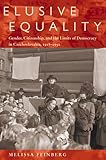
Melissa Feinberg. Elusive Equality: Gender, Citizenship, and the Limits of Democracy in Czechoslovakia, 1918-1950. Pittsburgh: University of Pittsburgh Press, 2006. 288 pp. $35.00 (cloth), ISBN 978-0-8229-4281-8.
Reviewed by Tara Zahra (University of Chicago, Department of History)
Published on HABSBURG (April, 2007)
Gender and the Fragility of Democracy in Czechoslovakia
In a recent issue of The New Yorker, Milan Kundera repeated one of the most well-worn tropes of the Czech nationalist movement in the twentieth century. "For the small nations, existence is not always self-evident, but always a question, a wager, a risk; they are on the defensive against History, that force which is bigger than they, which does not take them into account, which does not even notice them," he asserted.[1] Following the fall of the Iron Curtain in Eastern Europe, historical writing on democracy in Czechoslovakia typically followed this convenient line. Czechoslovakia, an oasis of liberal, democratic values in Eastern Europe, was easily overwhelmed by the forces of History at Munich, when the Western allies sold the Czechs out to Hitler in the name of "peace in our time." Following the Second World War, History swallowed Czechoslovak democracy once again, only this time the Russians were driving the tanks. In the words of Czech historian Vaclav Kural, "To tell the truth, the negation of Masaryk's conception of the Czechoslovak Republic was forced by the defeat in Munich and the merciless pressure of the Nazis. Only under these conditions was the democracy which was defended and protected by the Czechoslovak Republic alone in all of Central and Southeastern Europe ultimately discredited and buried!"[2]
To be sure, a revisionist camp soon emerged. Historians have since highlighted structural weaknesses in Czechoslovakia's interwar democracy, as well as the destabilizing effects of nationalist pressure groups on interwar political culture. But whether Czechoslovak democracy is praised or condemned, too often it has been measured against an ideal type. Instead of asking what democracy meant to Czechoslovak citizens, historians have largely debated about the extent to which Czechoslovakia looked like America or Great Britain in the 1990s. Melissa Feinberg's Elusive Equality takes a refreshingly different approach to the history of Czechoslovak democracy. Through the lens of gender, she tells the story of a fierce internal contest among Czechoslovak citizens over the meaning and content of democracy between 1918 and 1950. In these struggles over women's equality, proponents of a rights-based, individualist conception of democracy gradually lost out to those who upheld two collectives--the nation and the family--as the basic units of a democratic society. Democracy, in their view, entailed protecting these collectives, and the greater social good, even at the expense of individual rights, such as the rights of women to economic or legal equality within the family, to abortion, or to equal pay for equal work.
This book achieves several important goals. By tracing the conflicts which raged among Czechs over the meaning of democracy, Feinberg decisively discredits the view that Czechs were always the objects, and never the subjects or agents, of their state's own history. The principles of "authoritarian democracy" promoted by the short-lived Second Republic after Munich, she argues, were not a foreign stain or imposition on Czech society. Rather, they "came from a growing consensus among Czechs about what they wanted from democracy: not individual freedom or equality, but national security and a form of social justice which did not threaten the gendered nature of the family" (p. 227). She takes a similar view of the post-1945 "people's democracy," which enjoyed widespread support from women. In 1947, the Communist Party boasted 446, 148 female members, compared to 600,000 men and women registered as members of the Czech National Socialist party in the same year, and the Communist regime quickly achieved many of the policy goals that interwar feminists had long fought for in vain. Second, Feinberg avoids measuring Czechoslovakia against an anachronistic, static, model of democracy. She analyzes democracy and citizenship as contested ideals which proved to be remarkably (perhaps tragically) elastic, and she reminds us in her conclusion that democracy is always "only a process, always becoming, always changing, and never stable" (p. 229).
Finally, she makes a substantial contribution to the political and cultural history of East Central Europe through the lens of gender. While a long line of historians and political theorists have analyzed the ways in which democracy and nationalism were locked together in Europe's interwar nation-states, Feinberg's book is one of the first to systematically analyze the central place of another collective--the family--in emerging East European conceptions of democracy and citizenship after World War I. I probably do not have to state the obvious: the history of gender and women in East Central Europe is still far too thin in comparison to British, French, or German history. Women historians are often embarrassingly underrepresented at many of the important conferences in our field, and on most of the syllabi we use to teach it. Feinberg's book provides a solid foundation and model upon which future historians of women, gender, and sexuality in East Central Europe will hopefully build.[3]
Five of the book's seven chapters are devoted to the First Czechoslovak Republic, and focus on the activism of the organized Czechoslovak feminist movement. In particular, Feinberg follows the Women's National Council, an umbrella organization for Czechoslovak women's groups founded in 1923 by Frantiska Plaminkova, a former leader of the women's suffrage campaign. Plaminkova was a Czech National Socialist party member, and a delegate in the Czechoslovak senate from 1925-39. After a brief discussion of Czech nationalist and feminist movements in the Habsburg Monarchy, Feinberg begins her story with the revolutionary ideals of 1918, a moment of seemingly unlimited promise for Czechoslovak feminism. "Women's equality emerged early in 1918 as a symbol for the victory of democracy; it was hailed as the means by which the Czech nation would fling off its 'backward' past as part of the Habsburg Empire," she argues (p. 225). In particular, Czechoslovak president Tomas Garrigue Masaryk upheld the equality of women as a basic tenet of democracy, and the introduction of women's suffrage in the First Republic enjoyed widespread popularity across the political spectrum.
This happy consensus around women's equality--and the meaning of democracy in Czechoslovakia--was, however, short-lived. The new Czechoslovak constitution was itself riddled by ambiguity. On the one hand, Article 106 of the constitution declared that "privileges of sex, birth, and occupation will not be recognized by the law," and seemed to pave the way for a radical recognition of women's individual rights. But Article 126 stated that "marriage, motherhood, and the family are under the protection of the law," a clause which required upholding traditional gender roles in the eyes of most Czechs, Feinberg argues. These competing constitutional guarantees set the stage for ongoing and frequently bitter contests over women's legal equality in several realms. While feminists in the Women's National Council typically sought to abolish all vestiges of women's legal inequality, inside and outside of the family, others insisted that women's legal equality extend only to the marriage altar. Within the family, in this view, women's rights were to be circumscribed by the higher interests of the family and the nation, dictated by the laws of God or nature rather than the principles of lawmakers.
Subsequent chapters trace debates over reform of the Czechoslovak civil code, married women's citizenship, women in the civil service, and abortion. While Czechoslovakia's 1919 civil code legalized divorce and established civil marriage, more radical proposals to eliminate the legal, economic, and decision-making authority of husbands over wives in the family were defeated. Lawmakers insisted that such equality would threaten domestic tranquility and the state itself, as estranged spouses would constantly appeal to the courts to arbitrate petty household disputes. Proposals to protect a married woman's right to control her citizenship met a similar fate. While lawmakers enacted new provisions to prevent women from becoming stateless, and to allow women who married non-Czechoslovak citizens to petition to keep their citizenship (with time limits), proposals to permit women to retain their Czechoslovak citizenship automatically (and to pass that citizenship onto their children) were defeated in the name of family harmony and unity.
Feinberg's chapters on the rights of married women employed in the civil service and on debates over abortion legislation underscore the gradual triumph of collectivist visions of democracy over individualist, rights-based ideals. As the social crisis of the Depression deepened in the 1930s, so too did public disapproval of married women in the civil service. These women were portrayed in the press as selfishly depriving unemployed men and their families of their right to a livelihood. Democracy itself, in this view, required that the perceived collective interests of the family and society override the rights of individual married women to work for equal pay. The Czechoslovak government ultimately responded to these demands, enacting discriminatory legislation which reduced or eliminated married women's bonuses, merit pay, and salaries, in spite of vehement protest from feminists in the Women's National Council. Finally, Feinberg analyzes how the debate about abortion in interwar Czechoslovakia was framed almost exclusively in terms of collective interests, rather than individual rights. While opponents of abortion invoked the collective morality of the family and the nation, Social Democratic proponents of legalizing abortion spoke in the name of social justice. They demanded safe and legal abortion as a means of safeguarding the social conditions of living children, sparing working-class families from deeper poverty, and allowing working-class women the same access to safe abortions that middle-class women already enjoyed. Once again, Feinberg's analysis suggests the ways in which the perceived needs of the collective and a collectivist understanding of democracy won out over competing discourses of individual rights.
It was therefore no great leap to the "authoritarian democracy" of the Second Republic after Munich, in which protecting and purifying the Czech nation was the utmost priority. Feinberg's sixth chapter discusses the fate of the feminist movement under the Second Republic, and the rising fortunes of conservative women (especially Agrarian party members and Catholics), who formed a women's auxiliary called the Women's Center of the Czech National Council. The Women's Center promoted a conservative strain of maternalist, difference feminism--one which retained a space for women in public life and the economy, but based on their allegedly distinct qualities, talents, and virtues as women. Feinberg's final chapter takes us into the Communist era. Following the liberation of Czechoslovakia, Czech National Socialist Milada Horakova established a new Council of Czechoslovak Women as a successor to the Women's National Council. In the revolutionary fervor of the postwar "national cleansing," however, consensus among feminists quickly dissolved, as polarizing party politics divided supporters of the Communist party from National Socialists such as Horakova. In 1950 Horakova herself was tried and executed in one of Czechoslovakia's first show trials. The Communist press and the scripted trial depicted her not only as a traitor to the nation and party, but as a cold-blooded, unmaternal, warmonger who betrayed feminine values.
Feinberg's promising study is compromised to some extent by the surprising absence of Czechsoslovak Germans from her story. In her introduction, Feinberg refers to the "curious tie that Czechs made between democracy and their nation" and argues that this tie justifies her decision to limit her analysis to Czechs (p. 14). But it is precisely the centrality of nationalism to both Czechoslovak conceptions of democracy and debates about gender which makes the absence of German-speakers so astonishing. This is not simply a matter of telling the story "from both sides," as many people mistakenly assume. It is rather a matter of understanding how those sides were first constituted. The tie made by Czech nationalists between democracy and their nation would seem less curious to Feinberg and to her readers, if it was analyzed in its full context, as the product of an intense dialogue with the German nationalist movement. From the nineteenth century onward, Czech nationalists claimed to represent the antithesis of an elitist and undemocratic German nationalist movement--but these were highly polemical claims. Particularly in the realms of social politics, gender, and the family, Czech and German nationalist movements were constituted in conversation and competition with one another. This did not, however, reflect a nationally polarized social world, in which "Czechs" and "Germans" were constantly at odds in all walks of life. Competition between Czech and German nationalist movements on social issues often reflected the frequent uncertainty of their own clients' national loyalties, as both movements focused precisely on the family as a means to secure the loyalties of individuals who were not firmly tied to one national community or the other.
Since Feinberg did not analyze the activism of German nationalists or feminists around women's equality, we ultimately have too little context for evaluating or fully understanding two fundamental Czech nationalist claims that structure this important story: 1) the claim that the Czech nation had a particular affection for democracy; and 2) the claim that Czechs had a particular enthusiasm for women's equality, at least in 1918. Feinberg admirably compares Czech debates about gender roles, the family, and democracy to parallel debates in Germany, Austria, France, and the United States, but there is a curious silence throughout the book about what German-speakers in the Bohemian Lands thought and wrote about the same issues. An analysis of Czechoslovak Germans' debates about gender and women's equality might well have confounded some Czech nationalist claims to possess an exclusive monopoly on both democratic values and feminism in the Bohemian Lands. Heidrun Zettelbauer's recent work on German nationalist women in the Austrian Empire, for example, seems to suggest just this.[4] Attention to the interaction between Czech and German nationalists on issues of women's rights would have strengthened and deepened Feinberg's critical argument about the gradual abandonment of a rights-based conception of democracy in favor of more collectivist visions.
The story of women's activism in interwar Czechoslovakia could also be used to challenge the singular emphasis on nationality as the organizing principle of social, cultural, and political life in Eastern Europe. Feinberg implies that she is leaving the field of nationalism studies to others. After all, it is a topic about which we have all heard plenty in the past ten years. While it is admirable to seek out new fields of research--and gender is one of the most important--it is hardly possible to transcend nationalist categories and narratives by treating a multinational state as a homogenous nation-state. By maintaining an exclusive focus on Czechs in analyzing issues that were far from nationally exclusive, Feinberg does not simply leave the field of nationalism studies to others. She implicitly reinforces the dearly held nationalist principle that nationality was the ultimate source of political loyalties in East Central Europe. Readers are left to wonder to what extent German-speaking and Czech-speaking Catholics or Socialists rallied together on issues such as abortion rights or married women's employment. Does it make sense that the subjects and agents of Feinberg's story are always "the Czechs," even on issues which surely involved alliances and interests--such as class, religion, or even gender itself--that may have (even temporarily) superceded, cut across, or undermined national interests and politics? This, it seems, was a missed opportunity, but future gender historians in East European history will still have much to thank Feinberg for, in setting out a solid foundation for future research, and in integrating Czechoslovak history into a broader European history of gender, citizenship, and democracy.
Notes
[1]. Milan Kundera, "Die Weltliteratur," The New Yorker, January 8, 2007, 28.
[2]. Vaclav Kural, Statt Gemeinschaft--ein Auseinandergehen! Tschechen und Deutschen in Grossdeutschen Reich und der Weg zum Abschub, 1938-45 (Prague: Ustav mezinarodnych vztahu, 2002), 101.
[3]. Other recent and welcome additions to the history of women and gender in East Central Europe include the essays in the collected volume edited by Maria Bucur and Nancy Wingfield, Gender and War in Twentieth-Century Eastern Europe (Bloomington: Indiana University Press, 2006); and Maureen Healy, Vienna and the Fall of the Habsburg Monarchy (Cambridge: Cambridge University Press, 2005).
[4]. "Die Liebe sei Eurer Heldentum". Geschlecht und Nation in volkischen Vereinen der Habsburgermonarchie (Frankfurt: Campus, 2005).
If there is additional discussion of this review, you may access it through the network, at: https://networks.h-net.org/habsburg.
Citation:
Tara Zahra. Review of Feinberg, Melissa, Elusive Equality: Gender, Citizenship, and the Limits of Democracy in Czechoslovakia, 1918-1950.
HABSBURG, H-Net Reviews.
April, 2007.
URL: http://www.h-net.org/reviews/showrev.php?id=13088
Copyright © 2007 by H-Net, all rights reserved. H-Net permits the redistribution and reprinting of this work for nonprofit, educational purposes, with full and accurate attribution to the author, web location, date of publication, originating list, and H-Net: Humanities & Social Sciences Online. For any other proposed use, contact the Reviews editorial staff at hbooks@mail.h-net.org.

