



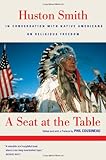
Huston Smith. A Seat at the Table: Huston Smith in Conversation with Native Americans on Religious Freedom. Berkeley: University of California Press, 2005. xxi + 266 pp. $24.95 (cloth), ISBN 978-0-520-24439-9.
Reviewed by Christopher Vecsey (Department of Religion, Colgate University)
Published on H-AmIndian (March, 2007)
They Talk, We Listen
I once was asked to deliver a convocation speech at my university. Rather than hold forth myself, I invited Chief Irving Powless Jr. of nearby Onondaga Nation to address the audience--students and faculty--and he was well worth hearing. A colleague later complained that I had cheated the students out of a chance to learn about my academic discipline (Religious Studies and Native American Studies combined). I replied that one of the greatest disciplines is the ability to listen to others.
So, I am sympathetic to Huston Smith's impetus to hear out American Indians about the difficulties they have achieving religious freedom in the United States. I am also sympathetic to Smith, whose book, The World's Religions (1991), I have assigned annually for most of my teaching career. I like his appreciative approach, as one way among others to study religions. In a method others would call romantic, but he might call spiritual, he treats them as pathways to humanistic wisdom, a means by which people can transcend their petty ego.
Furthermore, I am sympathetic to the Indians with whom Smith has chosen to converse. At least two of them I would call friends, and several others colleagues. I have met many of them and I look forward to meeting others. Every one of them--Lakotas (the late Vine Deloria, Jr., Charlotte Black Elk, Anthony Guy Lopez), Iroquois (Oren Lyons, Tonya Gonnella Frichner, Douglas George-Kanentiio), Navajos (Frank Dayish, Jr., Lenny Foster), Ojibwe (Winona LaDuke), and Pawnee (Walter Echo-Hawk)--have something of worth to say about Native religiousness and its travails. I have produced books on most of the topics they discuss--tribal belief and worship, traditional narratives, ecological values, territorial rights, involvement with Christianity, and legal issues concerning contemporary religious practice. Indeed, Oren Lyons and Walter Echo-Hawk--two of the interlocutors--have contributed to my works and I respect their knowledge.
Why, then, am I so disappointed in this book? It is not the small errors, which can slip into any volume. Joseph Bruchac is mistakenly identified as Lakota. Luther Standing Bear is called both Oglala and Brule. The United States is said to have broken over eight hundred of its Indian treaties. (It conducted only about four hundred.) The explanation of the 1990 Employment Division of Oregon v. Smith Supreme Court decision and the consequent Religious Freedom Restoration Act of 1993 (subsequently struck down by the same court) is hardly recognizable to anyone familiar with American Church-State jurisprudence.
Perhaps it is the general tone of exaggeration pervading the book. It derives from filmed encounters at the World Parliament of Religion in Cape Town, South Africa in 1999. And like the movie version of the same name, A Seat at the Table , it tends to flatter the Indian conversants. They are all said to be "leaders" (p. xiii), giving the impression of religious expertise or governmental status. These are intellectuals, activists, academics, lawyers, and journalists. Lyons holds the title of "faithkeeper" and Echo-Hawk is a tribal judge, but what of the others? Smith fawns over Deloria, telling him that he may be American history's "one great philosopher, one great theologian" (p. 13). He says to LaDuke, "There is so much wisdom in what you put so simply and powerfully" (p. 52). To their credit, they demur at his compliments.
"Winona, you give me great reinforcement" (p. 48), Smith comments to LaDuke. "Oh, you're stirring up all kinds of opinions in me!" (p. 11), he avows to Deloria. Perhaps that is the problem, as I see it. That Smith already has his notions--about American Indian religion, about the human condition in the modern world--and these conversations serve to reify them.
The worst passages have Smith and Deloria sounding like two old cracker-barrel reactionaries, kvetching that Western science, materialism, and Christianity are sending the cosmos to hell in a hand basket. "Science and the Vatican" (p. 150) are the double bogeymen of the book, along with newspapers like the New York Times. "They're all propaganda sheets" (p. 187), Deloria opines to Smith's concurrence. Deloria calls science "speculation" (p. 10). He says that evolutionary theory is all wrong. To Smith, "science is good" (p. 149), but not its methods nor its materialism, and its findings are mere "opinions" (p. 149). When Deloria says something to that effect, Smith retorts, "Absolutely right" (p. 187), or "Right, so right" (p. 188).
The text refers to the "centuries-long battle between science and religion, a kind of territorial dispute over the sacred itself" (p. 148), and this serves as the book's leitmotif. Indian religion is repeatedly pitted against what Smith calls "the elite scientists" (p. 191). His discussion with Frichner refers to the Human Genome Diversity Project as a "vampire project" (p. 135), and "a raping of our spirituality" (p. 136). To which Smith replies, "I have another theory about the far-reaching implications of science that I would like to share with you" (p. 139), which seems to be that scientists are in "danger of playing God" (p. 139). There is a kind of paranoia on Smith's part about scientific projects, as he asks about "the hidden motivations lurking behind" them (p. 154).
In general, there is too much diatribe in the book, and not enough tribe. American Indian religions are profoundly interesting, not only in their overall devotion to relatedness among all living beings, but in their tribal specificities. When Smith was teaching at Syracuse Universities, decades ago, several Iroquois took him to Onondaga, and he says he learned about their religion, from a distance. But his lack of knowledge shows, as he asks if the Peacemaker differs from Handsome Lake, or if the Midwinter Ceremonial rehearses Handsome Lake's story. Perhaps he listened for wisdom without hearing the details.
If there is additional discussion of this review, you may access it through the network, at: https://networks.h-net.org/h-amindian.
Citation:
Christopher Vecsey. Review of Smith, Huston, A Seat at the Table: Huston Smith in Conversation with Native Americans on Religious Freedom.
H-AmIndian, H-Net Reviews.
March, 2007.
URL: http://www.h-net.org/reviews/showrev.php?id=13016
Copyright © 2007 by H-Net, all rights reserved. H-Net permits the redistribution and reprinting of this work for nonprofit, educational purposes, with full and accurate attribution to the author, web location, date of publication, originating list, and H-Net: Humanities & Social Sciences Online. For any other proposed use, contact the Reviews editorial staff at hbooks@mail.h-net.org.

