



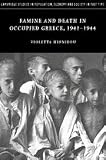
Violetta Hionidou. Famine and Death in Occupied Greece, 1941-1944. Cambridge: Cambridge University Press, 2006. 261 pp. $30.00 (cloth), ISBN 978-0-521-82932-8.
Reviewed by Maria Dimitriadou (Historical Archives Department of the Benaki Museum, Athens)
Published on H-German (March, 2007)
The Last European Famine Occurred in Greece
In the last decade, research in Greece about the German occupation and the subsequent civil war has produced a significant number of publications. Most of these studies refer to the political or the economic situation of the country and also to the role of the allies in the formation of Greek policy. The human factor has not been adequately investigated, although Greeks suffered enormously and in many ways. Famine was one of them.
In this volume, Violetta Hionidou tries to unravel the truth about the great famine in Greece during the occupation years; she provides readers with a global view of the facts but allows us to form our own opinions about the events. Hionidou makes use of unpublished sources from the Archives of the International Committee of the Red Cross in Geneva, opened for researchers only in 1996, and the testimonies of those who lived through this turbulent period. These personal stories are extremely interesting, as they illuminate the larger dimensions of the dry facts.
In order to clarify doubts about the extent of the problems, the author tries to place her study in historical context; her desire is to answer readers' questions about the tragic period of the occupation and its effects on the Greek population. Most of the information that reached people in Greece at that time was rumor, which created great anxiety in the population and resulted, among other things, in the reduction of available foodstuffs. For example, the news about the delay of liberation resulted in a price inflation that did not reflect the actual size of the food supply.
This study focuses primarily on clarifying our picture of the situation in Greece during the occupation with regard to the general population. The imposition of the blockade by the British, along with the unexpected help from the Americans and the Vatican, is one of the subjects discussed at length. Of course, within the limits of a book, it is quite difficult to provide a thorough presentation of the situation in Greece overall. The author selected the wartime experiences of three groups as case studies. These populations, even if they come from the same area, the Aegean islands, are very different; their differences were reflected in their administration, products, communication, access to transportation, and so on. Based on this differentiation, Hionidou problematizes the claim that the famine occurred only during the winter of 1941-42; instead, she argues that the population suffered throughout the occupation. Only the extent of shortages and their duration differed, due to some of the factors mentioned above. For example, life in Chios during the famine was easier, because the island produced fruits sufficient to cover inhabitants' needs and provide a surplus that could be exchanged for other commodities. One of the most impressive sections of the book examines the differences between the German and Italian administrations. While the Germans intervened as little as possible, Italian political aims, which included the annexation of the Cyclades, demanded a much more strict administration.
The requisition of foodstuffs by the occupation forces, the results of this practice, and the role of agricultural productivity are adequately analyzed in other chapters of this book. This analysis should put an end to discussions of the consequences of requisitions and the impact of low productivity. Hionidou convincingly argues that requisitions and productivity have been misunderstood in previous research. Productivity of foodstuffs was not always low; moreover, it did not necessarily affect the entire country. In fact, production levels actually increased in some areas at certain points. But although a substantial number of products were produced, very few of them reached consumers due to poor administration of the country by occupiers and the poor operation of markets in occupied Greece.
The first signs of recovery appeared the moment that relief operations arrived. Most of them reached the country after the blockade was lifted and food was supposedly distributed to the most vulnerable groups. For this purpose a substantial number of committees were created in which local authorities and people from the upper classes oversaw the fair distribution of the food. Sometimes, however, relief efforts did not run smoothly or according to plan.
Many Greeks relocated during the occupation in order to find better living conditions, both within the country and to other countries. Although transportation was not safe or easy at the time, many traveled illegally to the Turkish coasts. During such crises, one expects the greatest population losses to occur among children, the elderly, or women. In Greece, however, a rather high mortality rate predominated among adult males. This has a scientific explanation, which includes the larger body size of men and exhaustion after participation in war. The result was the reduction of the male population, which negatively impacted the Greek economy. Children were well protected from starvation; many soup kitchens were created especially for them. Individual families also protected those among their number who were considered particularly good providers. In consequence, the most vulnerable segment of the Greek population was the elderly. Although in normal times, they were protected their children, with whom they lived, during wartime, Greek families often favored their children at the expense of the elderly. The majority of deaths during the occupation in Greece were caused by famine and not by disease.
The food situation was used as a propaganda weapon by almost everybody involved. It generated differences or deepened existing antipathies between social bodies, such as those that separated the Orthodox and Catholic Christians of the islands, or the political Left and Right. Hionidou has provided another view of this specific period and draws on new information to reveal another layer of the reality of the famine in her discussion of hyperinflation, poor organization, and the identification of enemies and friends. Thanks to Hionidou's study, readers will have the opportunity to form a new opinion of the terrible famine years in Greece.
If there is additional discussion of this review, you may access it through the network, at: https://networks.h-net.org/h-german.
Citation:
Maria Dimitriadou. Review of Hionidou, Violetta, Famine and Death in Occupied Greece, 1941-1944.
H-German, H-Net Reviews.
March, 2007.
URL: http://www.h-net.org/reviews/showrev.php?id=12986
Copyright © 2007 by H-Net, all rights reserved. H-Net permits the redistribution and reprinting of this work for nonprofit, educational purposes, with full and accurate attribution to the author, web location, date of publication, originating list, and H-Net: Humanities & Social Sciences Online. For any other proposed use, contact the Reviews editorial staff at hbooks@mail.h-net.org.

