



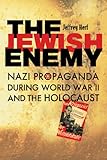
Jeffrey Herf. The Jewish Enemy: Nazi Propaganda during World War II and the Holocaust. Cambridge: Harvard University Press, 2006. 416 pp. $29.95 (cloth), ISBN 978-0-674-02175-4.
Reviewed by Aristotle Kallis (Department of European Languages and Cultures, Lancaster University)
Published on H-German (March, 2007)
A Distinctive Contribution
Jeffrey Herf's latest book charts a new path in his distinguished career as scholar of National Socialism and, more broadly, of modern German history. Ever since the publication of Reactionary Modernism (1984), Herf has amply manifested his ability both to bring exciting new topics into research focus and to revisit more traditional themes from a fresh perspective. A quick glance at the titles of his other two major monographs (War By Other Means: Soviet Power, West German Resistance and the Battle of the Euromissiles [1991], and Divided Memory: The Nazi Past in the Two Germanys [1997]) attests to his constantly changing concentration on topics within twentieth-century German history but also his willingness to engage with very different topics, periods or indeed countries.
The Jewish Enemy marks a return to the period of National Socialism, but the book's primary focus on Nazi wartime anti-Semitic propaganda places it in a different body of historiography in comparison to his earlier works. Nazi propaganda has always received scholarly attention, whether on the basis of "totalitarianism" in the context of "generic fascism" or from the viewpoint of the Holocaust.[1] The topic has received fresh consideration in the last two decades, particularly through the works of David Welch and Ian Kershaw, thus contributing to a growing tendency to take (National Socialist) propaganda seriously.[2] Interdisciplinary approaches, new conceptual frameworks and methodologies--as well as a wider spectrum of new research aspects (such as cinema and visual propaganda, broadcasting, television and so on)--have created a fascinating and constantly updated field of study that offers invaluable insight into National Socialism as a whole.[3]
The Jewish Enemy is both a welcome contribution to this body of literature and a sui generis book. In comparison to that of other recent works on Nazi propaganda, Herf's scope is more restricted, both in terms of subject (anti-Jewish propaganda) and time frame (World War II). It builds on his fascinating chapter on the techniques Joseph Goebbels used during World War II to implicate German public opinion in the regime's genocidal policies.[4] Although it provides an excellent overview of Nazi wartime propaganda, its architecture rests on the proposition that the belief in a worldwide "Jewish conspiracy" constituted the glue that held the various Nazi discourses together (p. 106). According to Herf, this particular narrative underpinned the entire worldview of the Nazi leadership (particularly Adolf Hitler and Goebbels) and became a self-referential basis for interpreting both the past and the present. The author urges us to abandon the prevalent "rationalist bias" that tends to view ideology as an "instrument used for other purposes" (p. 269) and thus appreciate that "the war against the Jews was in [Nazi leaders'] minds synonymous with World War II" (p. 265).
Through a chronological structure that moves seamlessly from an introductory section on pre-1939 Nazi propaganda themes and structures to the shifting narratives of the wartime period, Herf shows convincingly that the attacks on the regime's wartime "enemies" (Britain; after 1941 the Soviet Union and the United States) were underpinned by the same Überbegriff of an alleged "international Jewish conspiracy." This notion, far from being a simple propaganda trick, had been meticulously articulated in the 1920s and 1930s by Hitler and his clique (chapters 1-2), becoming a prism through which the Nazi leadership continued to interpret history until the very end. With the outbreak of World War II, this narrative acquired fresh relevance, this time by being associated with the Jews' alleged culpability for the war itself (chapter 3), in what Herf calls a blatant "reversal of cause and effect" (p. 270). Chapter 4 charts the revision of Nazi propaganda in the wake of Operation Barbarossa, after two years of an awkward alliance with the Soviet Union and the 1941 U.S. entry into the war. Chapter 5 examines the period during which the Nazi regime's genocidal machine embarked on the process of mass extermination of the European Jewish population and suggests an analogy between the lethal radicalization of policy and the increasingly aggressive tone of propaganda itself. Herf contends that both private references (like Goebbels's diary entries) and public pronouncements (like Hitler's speeches) about "extermination" and "annihilation" should be taken at face value rather than dismissed as euphemisms (pp. 168-169, 267-268). Finally, the last two chapters chronicle the leap of Nazi propaganda into discourses of "fear" after the defeat at Stalingrad--a tendency that became much more pronounced in 1944 and 1945. Once again, however, the idea of the "Jewish conspiracy" was omnipresent, paradoxically as both a justification for the Nazi regime's continuing war effort and as an excuse for the impending defeat.
Herf's argument is lucidly put forward from the first pages and consistently echoed throughout the subsequent analysis. A multi-layered argument, it rests on some fundamental ideas. For Herf, "Hitler was the central, decisive historical actor driving events toward the war and the Holocaust" (pp. 5, 143, 190). He is portrayed as bent on a "total war" since 1938-39 (p. 51) and determined to "solve" the Judenfrage in the most uncompromising and brutal (genocidal) fashion (pp. 64-65). In this respect Herf embraces fully an intentionalist approach that sees Hitler as ideologically fixed on a policy of exterminating Germany's "Jewish enemy" and consistently advancing this idea in speeches and policy initiatives alike. Herf attaches central significance to Hitler's January 30, 1939, "prophesy" before the Reichstag (pp. 50-53, 77, 115) but takes all of his public pronouncements extremely seriously. In fact, Herf interprets Hitler's September 30, 1942, dictum that "[the Jews] will stop laughing everywhere" as coterminous to announcing genocide to his audience (p. 168). He summarily dismisses the discussion about the so-called "Madagascar Plan" as "lies for posterity's sake" (p. 147). When it comes to the German public opinion, Herf is careful not to make facile, oversimplified judgments (as Daniel Goldhagen did a decade ago) (p. 277). But he does emphasize that the writing was on the wall, both figuratively and literally--the phrase "[t]hey will stop laughing" became one of the most widely circulated and read mottos through a November 1942 "Word of the Week" poster (a source Herf considers crucial and largely under-explored by previous works on Nazi propaganda). In a brilliant example of serious historical writing, the author wonders whether Germans confronted with this poster would have had "the intellectual curiosity, political acumen and moral courage" to realize that it amounted to a virtual announcement of genocide. But he never questions the regime's political intentions to that particular effect (p. 168).
Given Herf's intentionalist approach, The Jewish Enemy focuses heavily on the personalities of Hitler and Goebbels. References occur to other figures such as Otto Dietrich, Julius Streicher and Robert Ley, as well as to some other important propagandists (such as Wolfgang Diewerge) but for Herf, Nazi anti-Jewish propaganda reveals both full ideological-political agreement and "cooperation among different and at times antagonistic institutions" (p. 272). Dietrich and Goebbels are portrayed as locked in personal and jurisdictional battles but otherwise each contributing to the lethal radicalization of anti-Jewish propaganda (pp. 154, 187-190). Herf also provides a welcome focus on propaganda directed to audiences in the Arab countries.
Yet, above all, Herf's understanding of the motives behind the Nazi regime's anti-Jewish propaganda stands out. Although Herf pays attention to both the historical basis of anti-Semitism and the lethal contribution made by "modern" racialist arguments, he interprets the Nazi genocide as "a paranoid political rather than biological conviction and narrative" (p. 151; compare pp. 6, 265-267; emphasis added). This idea appears to downgrade the importance of discourses of race and eugenics in Nazi ideology in favor of an over-blown, all-pervasive belief in the alleged political omnipotence of the "international Jew." Herf invites us to pay particular attention to the twisted web of Nazi causalities--how the Jews were held responsible for the 1918 "stab-in-the back," for the outbreak of World War II, for Winston Churchill's stubborn refusal to negotiate, for Franklin Roosevelt's support for Britain and eventual decision to join the war, for Joseph Stalin's alliance with the West, for the destruction of Germany after 1943 and the alleged Allied punitive plans to reduce a defeated Reich to rubble. In this twisted political universe, the annihilation of millions of European Jews was, according to Herf, "an ordinary consequence of the [Nazi] logic of war" (p. 267).
Perhaps the author's distinction between the "racial" and the "political" basis of Nazi anti-Semitism is somewhat exaggerated. Genocide--especially "total genocide"--presupposes the denigration of the particular "other." Herf distinguishes Nazi genocidal anti-Semitism from earlier non-genocidal (though by no means benign) equivalents (pp. 265-266). A large part of Nazi anti-Jewish propaganda focused on the "speciation" of the Jews as a racially inferior and detrimental "alien growth" within Germany, Europe and the entire world. The shocking moral indifference to the fate of entirely defenseless Jews in the early 1940s, the language of the "industrial processing" of human life as a wasteful commodity, of senseless cruelty and obsessive disregard for end-means rationality (the latter theme dealt with brilliantly in Herf's own Reactionary Modernism), all point to a perception of "the Jew" as both lethal international conspirator and crucially "inferior" form of human life. Racial arguments facilitated the disparagement of "the Jew"--not only as a political being but also as a biological entity. It is otherwise difficult to even begin to comprehend the Nazi's contempt for Jewish life that led to the mass executions of the Einsatzgruppen in 1941 and eventually to the chimneys of the death camps in Poland.
This conviction, along with the decidedly intentionalist focus of the book, might appear somewhat troubling to scholars who subscribe to structuralist understandings of Nazi policy-making and of the Final Solution or those who are willing to take Nazi racial concerns all too seriously. They should not distract, however, from the sheer brilliance of The Jewish Enemy in terms of re-focusing attention on the centrality of anti-Semitism in both Nazi propaganda and policy. Herf's book adds much-needed intellectual ammunition to the argument that propaganda should be taken very seriously, that it divulges intentions as much as it conceals them, that it may often come to dominate our political and moral landscape and that it may lead otherwise rational human beings into losing any contact whatsoever with reality, causing them to cast aside a modicum of respect for human life. Although the book focuses on a particular regime, country and period, this "most lethal of all ideological poisons" (anti-Semitism) is still present in the twenty-first century--and it is by no means the only one. Herf's analysis captures the paradox of Nazi propaganda in the most convincing and eloquent manner--that Jews perished in their millions under the Nazi "new order" precisely because of the all-powerful distorting prism of radical anti-Semitism, which a totalitarian regime chose consciously to make the central, irreducible tenet of its entire worldview.
Notes
[1]. See, among others, Z. A. B. Zeman, Nazi Propaganda, 2nd ed. (London: Oxford University Press, 1964); Ernst K. Bramsted, Goebbels and National Socialist Propaganda 1925-1945 (East Lansing: Michigan State University Press, 1965); Marlis G. Steinert, Hitler's War and the Germans: Public Mood and Attitude During the Second World War (Athens: Ohio University Press, 1977); Jay W. Baird, The Mythical World of Nazi War Propaganda, 1939-1945 (Minneapolis: University of Minnesota Press, 1974); Robert Edwin Herzstein, The War that Hitler Won: The Most Infamous Propaganda Campaign in History (New York: G.P. Putnam's Sons, 1978); David Bankier, The Germans and the Final Solution: Public Opinion under Nazism (Oxford: Blackwell, 1992).
[2]. David Welch, The Third Reich. Politics and Propaganda, 2nd ed. (London: Routledge, 2002) and Propaganda and the German Cinema, 1933-1945 (London: Tauris, 2001); Ian Kershaw, The "Hitler Myth": Image and Reality in the Third Reich (Oxford: Oxford University Press, 1987).
[3]. Among the most recent works, see Randall Bytwerk, Bending Spines: The Propaganda of Nazi Germany and the German Democratic Republic (East Lansing: Michigan State University Press, 2004); Richard Taylor, Film Propaganda: Soviet Russia and Nazi Germany (London: Tauris, 1998); Eric Rentschler, The Ministry of Illusion: Nazi Cinema and Its Afterlife (Cambridge: Harvard University Press, 1996); Aristotle Kallis, Nazi Propaganda in the Second World War (London: Palgrave, 2006).
[4]. In Jörg Echternkamp, ed., Das Deutsche Reich und der Zweite Weltkrieg, vol 9/2: Die Deutsche Kriegsgesellschaft 1939 bis 1945 (Stuttgart: Deutsche Verlagsanstalt, 2005).
If there is additional discussion of this review, you may access it through the network, at: https://networks.h-net.org/h-german.
Citation:
Aristotle Kallis. Review of Herf, Jeffrey, The Jewish Enemy: Nazi Propaganda during World War II and the Holocaust.
H-German, H-Net Reviews.
March, 2007.
URL: http://www.h-net.org/reviews/showrev.php?id=12977
Copyright © 2007 by H-Net, all rights reserved. H-Net permits the redistribution and reprinting of this work for nonprofit, educational purposes, with full and accurate attribution to the author, web location, date of publication, originating list, and H-Net: Humanities & Social Sciences Online. For any other proposed use, contact the Reviews editorial staff at hbooks@mail.h-net.org.

