



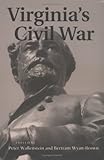
Peter Wallenstein, Bertram Wyatt-Brown, eds. Virginia's Civil War. Charlottesville: University Press of Virginia, 2005. xiii + 303 pp. $35.00 (cloth), ISBN 978-0-8139-2315-4.
Reviewed by Michael Chesson (University of Massachusetts-Boston)
Published on H-CivWar (March, 2007)
Race, Religion, Gender, and Marse Robert Deconstructed
This handsome volume contains twenty essays based on papers from a 2002 conference hosted by the University of Richmond, with some sessions at the Virginia Historical Society and the Tredegar iron works (now the acclaimed American Civil War Center), plus an introduction and afterword. It is aimed at specialists, not general readers. According to the distinguished co-editors, Peter Wallenstein of Virginia Tech, and Bertram Wyatt-Brown, Richard J. Milbauer Emeritus Professor of History at Florida, there were 126 participants (of whom this reviewer was one, serving as a commentator), in 29 panels and 3 plenary sessions. The editors' criteria for selections are not given. Whether they picked the best is uncertain, but those included are uneven in quality, typical of most such collections. The pieces are tightly edited, with the average length under thirteen pages, including notes conveniently placed after each. A few are so brief that they offer more questions than answers, while others try to cover subjects much too broad. The topical rationale for selection is clear. The editors know that battles and generals continue to get more attention from the authors of monographs and the public than the wartime state's social and cultural experience, so their choices explore "some areas seldom treated" (p. xii): women, African Americans, and religious leaders. Although true at the time of the Civil War centennial, it is hardly the case for blacks and women now, as evidenced by the scores of secondary works cited by the contributors. A number of important works have appeared recently on religious aspects of the broader conflict, but faith has long been a concern for students of the Lost Cause, the martyred Lincoln, and belief in the Union as a kind of civic religion.[1] The editors note that gender is a dominant theme of the wartime and postwar essays, which they find "striking" (p. 2), yet gender studies across a number of disciplines has become a huge industry, spreading even into this blood-encrusted field, especially among practitioners of the so-called new Civil War history, which at times looks suspiciously like the old "new social history" micro-waved in a plastic tray. What is truly remarkable is that of the twenty-one contributors only six are women.
The editors' claim that there was not one Civil War in Virginia but many is a truism characteristic of most large historical events. Of course each person's experience was unique, but the challenge for historians other than biographers is to consider many individuals' experiences and what they mean collectively. Of the twenty-one contributors, at least two are now emeritus; five are full professors (including two in English at Richmond in a polite nod to a once closely related discipline); three associate professors, four assistant professors, including one in a visiting position; four doctoral candidates (one on a postdoc); and three unidentified. Of those whose careers would have been most helped by inclusion, eleven were untenured when it went to press. Four still lack tenure-track jobs, the long gestation period of this volume perhaps resulting in a boost too little, too late.[2]
Virginia's Civil War is an example of the gulf noted by Gary W. Gallagher between military and social historians.[3] Professors dominate the latter group, and non-academics the former. Guess who has the most readers? Scanning a few essays shows why neither the general public, nor most Civil War buffs, will read this volume. Potential buyers should check the table of contents and index on Amazon first for a complete list of authors and their subjects, which is beyond the word limit of this review, though the full text of the original version will be available at a link on my campus website.[4] Buyers expecting military history, perhaps misled by the title (a bit of Woodwardian irony?) will likely be disappointed, and that is unfortunate. A number of the authors have significant insights. The Civil War series edited by Jack Davis and Bud Robertson, covering Virginia year by year, might be better for many, though judging by the first volume, it also has its problems.[5]
The essays are grouped in three sections, the first, oddly enough, on Robert E. Lee. Four papers by Emory M. Thomas, Michael Fellman, Charles Joyner, and Wyatt-Brown were originally presented in a plenary session, but Lee is at the heart of a fifth, Ian Binnington's on Confederate nationalism, and a sixth by John M. McClure on postwar Lexington's race relations. Thomas's nuanced essay is balanced, but he is too much the gentleman to point out the many faults of Lee's critics. Fellman and Joyner have some valuable insights, but slip into myth-making of their own while trying to demolish Lee's edifice. Wyatt-Brown's "Robert E. Lee and the Concept of Honor" is by far the longest piece, and the most heavily documented, typical of his illuminating work. Including appendix 4, an alleged postwar incident at St. Paul's Episcopal church in Richmond discussed by several authors, seventy-eight pages address the Marble Man, 27 percent of the entire book.[6] So much space devoted to one person is curious, particularly for a volume that promises a focus on new topics. Since we are now observing the bicentennial of Lee's birth, all six essays are timely. Unfortunately, while some of the discussion of Lee is substantial and useful, there is far too much that is present-minded if not simple-minded. Of course Lee was a racist, like most white Americans in the nineteenth century including William L. Garrison and Wendell Phillips. It might be more useful to examine why his moderate racism was so muted. Unfortunately for politically correct historians, the answer can probably be found in his social class, breeding, and faith. No doubt Lee also had strange views about women. He sounds almost antebellum.
Four essays focusing on religion are the freshest and most original in the volume. Charles Irons explores "Reluctant Protestant Confederates: The Religious Roots of Conditional Unionism," adding to the work of Daniel W. Crofts and William W. Freehling.[7] Wayne Wei-Siang Hsieh analyzes "Christian Love and Martial Violence: Baptists and War--Danger and Opportunity." Rather than a tired discussion of what they fought for, Jason Phillips investigates why they fought on against hopeless odds in "Religious Belief and Troop Motivation: 'For the Smiles of My Blessed Savior'," a question treated in more detail by Tracy Powers.[8] Monte Hampton's "Navigating Modernity: The Bible, the New South, and Robert Lewis Dabney" is a searching examination of Stonewall Jackson's chaplain and staff officer after the war. It is impossible in a short review to convey the richness of interpretation and detail in these four pieces. Some of those on race and gender are not of equal quality, and several have significant flaws.
Among the remaining essays, the most valuable are in the postwar section, including Susanna Michele Lee's "Contested Unionism: William Pattie and the Southern Claims Commission," on the question of loyalty, and its often shifting definition between 1860 and the 1870s. Pattie, a Warrenton merchant, said he had opposed secession, and claimed to have supported Republican candidates after the war, but his neighbors, including John S. Mosby, a Republican himself, challenged his veracity. Amy Feely Morsman's 2004 dissertation abstract, "Gender Relations in Planter Families: A Postwar Experiment and Its Lost Legacy," is promising. By the 1880s a new generation had come of age, many of them children of Virginia's last plantation elite. These couples abandoned rural life for the professions and urban jobs. Drawing on the work of Jane Turner Censer, Morsman argues that they did not follow their parents, who survived the immediate postwar era in mutual partnerships, but returned to gender roles closer to those of their grandparents, despite living in Washington, Norfolk, Richmond, and Lynchburg. She has an important subject and asks significant questions, but from this sketch it is hard to tell how well Morsman will integrate various aspects of white society in the New South, or reconcile contradictory aspects of the New Dominion.
Some of these aspects are covered by the final essay, which is one of the best, Caroline E. Janney's "To Honor Her Noble Sons: The Ladies' Memorial Association of Petersburg, 1866-1912." She begins with the 1904 dedication of the former Blandford Episcopal Church as a Confederate chapel, despite competition between rival Lost Cause groups, in this case the Ladies' Monument Association (LMA) and the younger United Daughters of the Confederacy, allied with the United Confederate Veterans. Her women had occasional help from the city and state. Their membership and activity rose and fell, reflecting economic booms and the Panics of 1873 and 1893. Janney summarizes the consensus view of the growth of Lost Cause events. They appeared with the hardcore unreconstructed in the 1860s, bloomed in the 1880s, and reached their peak early in the twentieth century. Since national organizations are usually emphasized, Janney thinks historians have missed local efforts to keep the faith. Her point is well taken. General studies often slight the local and specific, but local history, however valuable, can lack context. How did Petersburg, so small in the last third of the nineteenth century that many urban historians would not even rank it as a true city, compare with more successful places such as Norfolk and Richmond? Did Petersburg become a backwater like Vicksburg, which never recovered from the war? Perhaps Alexandria, Lynchburg, Roanoke, and Fredericksburg would offer better comparisons. Janney is a cultural, social, and intellectual historian, and a very good one, but at times seems to underestimate the importance of political factors. Sharpening the focus of her new and original thesis, and marshaling her evidence, she must decide what it all means. Do her findings support David Blight's sweeping indictment of white Southerners, and the war generation generally, for mis-remembering what the veterans fought for? Or can she fashion a more sophisticated interpretation? Her essay is an appropriate and poignant conclusion to Virginia's Civil War, a volume that reveals more about the current state of the historical profession than its contributors may realize.
Notes
[1]. See Gardiner H. Shattuck Jr., A Shield and Hiding Place: The Religious Life of the Civil War Armies (Macon: Mercer University Press, 1987); Steven E. Woodworth, While God Is Marching On: The Religious World of Civil War Soldiers (Lawrence: University Press of Kansas, 2001); Kent T. Dollar, Soldiers of the Cross: Confederate Soldier-Christians and the Impact of War on Their Faith (Macon: Mercer University Press, 2005); and Harry S. Stout, Upon the Altar of the Nation: A Moral History of the Civil War (New York: Viking, 2006).
[2]. I checked the contributors in the Directory of History Departments, Historical Organizations, and Historians, 32nd Edition, 2006-2007 (Washington: American Historical Association, 2006), including one with a job at an historical society among the tenure-track.
[3]. Gary W. Gallagher, "'The Progress of Our Arms': Whither Civil War Military History?" 44th Annual Robert Fortenbaugh Memorial Lecture (Gettysburg: Civil War Institute, Gettysburg College, 2005). Though not the first to note this split, his essay is perhaps the most felicitous treatment, wise, witty, and even-handed. It should be read after Maris A. Vinovskis's "Have Social Historians Lost the Civil War? Some Preliminary Demographic Speculations," Journal of American History 76 (June 1989), 34-58. The short answer to the latter's question is yes.
[4]. http://www.faculty.umb.edu/michael_chesson/publications/reviews/vcw/vcw.html.
[5]. William C. Davis and James I. Robertson, eds., Virginia at War, 1861 (Lexington: University Press of Kentucky, 2005). A fine study with a biographical approach is John G. Selby, Virginians at War: The Civil War Experiences of Seven Young Confederates (Wilmington, DE: SR Books, 2002).
[6]. The best and most critical treatment of whether Lee joined a black man at the communion rail, and if so, why, is Nelson Lankford, Richmond Burning: The Last Days of the Confederate Capital (New York: Viking, 2002), 243-44, 275 n. 8. This dubious incident is suspicious. It lacks primary source documentation, relying entirely on a Confederate veteran's supposed recollection published in 1905, but it is a convenient backdrop on which scholars can project their own views of Lee, white Southerners, and Gilded Age race relations.
[7]. Daniel W. Crofts, Reluctant Confederates: Upper South Unionists in the Secession Crisis (Chapel Hill: University of North Carolina Press, 1989); and William W. Freehling, The South vs. The North: How Anti-Confederate Southerners Shaped the Course of the Civil War (New York: Oxford University Press, 2001). [8]. Tracy Powers, Lee's Miserables: Life in the Army of Northern Virginia from the Wilderness to Appomattox (Chapel Hill: University of North Carolina Press, 1998), especially 301-21.
If there is additional discussion of this review, you may access it through the network, at: https://networks.h-net.org/h-civwar.
Citation:
Michael Chesson. Review of Wallenstein, Peter; Wyatt-Brown, Bertram, eds., Virginia's Civil War.
H-CivWar, H-Net Reviews.
March, 2007.
URL: http://www.h-net.org/reviews/showrev.php?id=12928
Copyright © 2007 by H-Net, all rights reserved. H-Net permits the redistribution and reprinting of this work for nonprofit, educational purposes, with full and accurate attribution to the author, web location, date of publication, originating list, and H-Net: Humanities & Social Sciences Online. For any other proposed use, contact the Reviews editorial staff at hbooks@mail.h-net.org.

