



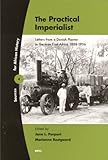
Jane L. Parpart, Marianne Rostgaard, eds. The Practical Imperialist: Letters from a Danish Planter in German East Africa 1888-1906. Leiden: Brill, 2006. xvi + 235 pp. $59.00 (paper), ISBN 978-90-04-14742-3.
Reviewed by Michelle Moyd (Department of History, Cornell University)
Published on H-German (February, 2007)
Practicing Imperialism: An Insider/Outsider Perspective on German East Africa
This volume makes available for the first time in English print a selection of the correspondence from Christian Lautherborn, a Danish planter who lived and worked in Germany's East Africa colony during its early years. The letters, found amongst a collection of artifacts from East Africa in the Vendyssel Historical Museum in Hjørring, Denmark, provide substantial insights into daily life in the colonial setting. Translated into English with minimal commentary by the editors, the documents are presented in an untrammeled, readable format that makes the text an effective teaching and research tool. The editors, in rescuing these documents from obscurity and making them available to the English-reading, if scholarly, public, have done colonial and African historiography a great favor.
Lautherborn's letters, some of which were written for publication in a local Danish newspaper, reveal a man who was a keen observer of African life and early German colonial practice. His position as a non-German European gave him both insider and outsider vantage points on colonial life. His letters provide useful information on African life in the territory and also "reveal some of the tensions around class, national identity and culture [among Europeans] that permeated the colonial enterprise" (p. xi). The editors cast him as a "practical imperialist, bent on introducing modern agricultural methods and producing goods for a profit" (p. xi). Coming from a socioeconomic and religious context in Denmark that he found stifling, Lautherborn set out to "become something" (p. 9) by emigrating to the United States in 1879, where he found work as a tenant farmer on a cotton plantation in Texas. In 1887 he decided to try his hand at managing a plantation for the German East Africa Company, the forerunner to German colonial government in the region. He remained there, achieving success as the first commercial sisal planter in the colony, living on various plantations in the northeastern coastal region. He died in 1906 of blackwater fever, having lived through two major wars fought by Africans against the Germans, the Abushiri (1888-90) and Maji Maji (1905-07) wars.
Lautherborn's letters from the period of the Abushiri war are detailed and fascinating accounts of a complex situation and they reveal much about how both sides prosecuted the war. He records in vivid detail African military costumes, weaponry and rituals, as well as specific events in the war, such as rebel leader Bushiri's occupation of the coastal town of Bagamoyo in December 1888 (p. 68). He also comments on the black soldiers who fought for the Germans. He was especially fascinated by the "Zulu," actually Shangaan, soldiers who were some of the first soldiers recruited by the founder of the colonial military in East Africa, Major Hermann von Wissmann (p. 86). He compared the Sudanese recruits to "American Negroes," remarking that "as is usually the case with Negroes, when they live well and do not have much to do, they become uncontrollable" (p. 87). In these passages we see clearly Lautherborn's ambivalent views on persons of African descent. Although he generally respected "our Black soldiers," he also viewed them in the paternalistic mode that characterized his relationships with his plantation employees, whom he thought of as his "children" (p. 211). He adopted a similar tone when discussing local building projects he supervised that drew on African expertise and practices (p. 110).
The editors each contribute thoughtful introductory chapters outlining the Danish and African contexts of Lautherborn's letters, which provide an essential orientation to readers unfamiliar with these histories. They represent Lautherborn as being exceptional in his ability to relate to the peoples of German East Africa with respect and empathy (p. 40), while acknowledging that he was "a man of his time, with prejudices that reflected his position in the imperial enterprise" (p. 39). Rostgaard's chapter on the Danish context explains clearly the particular dynamics that convinced Lautherborn to seek his fortune abroad. His ideas on "progress and improvement," which later became the basis for his "practical imperialism," developed out of his association with a religious revivalist movement, Grundtvigianism (p. 4). This movement emphasized values of inclusiveness, local community engagement and a "Hegelian inspired progressive optimism" (p. 12). Rostgaard argues that Lautherborn's understanding of East Africa and its peoples grew out of this background, and that his take on Africans "differ[ed] from others because he saw the Africans as active subjects not just objects for the European's imperial projects" (p. 20). She grants that Lautherborn's tone is usually "that of the geographer or imperial explorer," but insists that he is nonetheless genuinely interested in the people he encountered, and that he "does not judge their behaviour" but instead shows "a kind of admiration and an interest in how others do things" (p. 18). Rostgaard also argues that Lautherborn differentiated between different groups of Africans, and that he "never just lumped [them] together as 'Blacks' or 'Negroes'" (p. 18).
Rostgaard's commentary notwithstanding, what is clear from his letters is the extent to which Lautherborn participated in all of the standard stereotyping of Africans prevalent at the time. Indeed, he does so throughout his letters. For example, he wrote in February 1889 that "Negroes from the Zaramo country are cannibals" (p. 73), thereby perpetuating a popular myth that recurs in contemporary European accounts. He remarks on "the Blacks'...childish language" (p. 151) and quips that "The Negroes like plucking cotton here as much as in America" (p. 148). Lautherborn's texts are rife with references to "the Blacks" or "the Negroes" and in fact, he rarely bothers to specify which groups he means. He reserves his worst judgments for "the Arabs," who remained in his mind irredeemable "swindlers" (p. 128) and "villains" (p. 74), worse perpetrators of abuses against Africans than the Germans (p. 15). Rostgaard is certainly right to point to places in Lautherborn's texts where he gestures towards the complexities in relationships between whites and Africans in the colony, and to highlight moments when Lautherborn recognized specific African skills and intellect in everyday contexts. These places of nuance, however, exist side by side with all too familiar tropes characteristic of European writings and thought on Africa at the time. Clearly, Lautherborn's curiosity about the peoples with whom he lived and worked had its limits. This issue deserves more critical analysis in Rostgaard's introductory chapter.
Parpart's chapter on the African context gives a concise and informative history of the founding of German East Africa through the machinations of the German East Africa Company (DOAG). She then traces its development through to 1906 when Lautherborn died. It is a skillful synthesis of mainly secondary material, though it also integrates bits of evidence drawn from archival materials and memoirs of the period. Parpart notes that Lautherborn handled disciplinary matters on the plantation more humanely than his German colleagues, who had a reputation for cruelty (p. 37). Lautherborn wrote that his plantation laborers viewed him as a "friend" (p. 108) and that they praised him because he "[used] his strength to work and not to beat the Black people" (p. 160). Here again, more critical commentary seems warranted. While it may indeed have been the case that Lautherborn refrained from using corporal punishment as others did, readers should also be made aware of possible East African social and economic understandings, such as patron-client ties, that might have informed his employees' desire to praise him. In a number of other places in the letters, the editors could have provided more thorough contextualization of Lautherborn's observations within the framework of African history.
This volume brings to the fore key themes--such as colonial ambivalence, the invisibility of women in colonial discourse, agency and spatiality--that have been under discussion in African and colonial history over the past decade. Although the texts might have benefited from more extensive and critical commentary from the editors, this volume is especially useful text because it provides rich primary sources that scholars can read and evaluate for themselves.
If there is additional discussion of this review, you may access it through the network, at: https://networks.h-net.org/h-german.
Citation:
Michelle Moyd. Review of Parpart, Jane L.; Rostgaard, Marianne, eds., The Practical Imperialist: Letters from a Danish Planter in German East Africa 1888-1906.
H-German, H-Net Reviews.
February, 2007.
URL: http://www.h-net.org/reviews/showrev.php?id=12882
Copyright © 2007 by H-Net, all rights reserved. H-Net permits the redistribution and reprinting of this work for nonprofit, educational purposes, with full and accurate attribution to the author, web location, date of publication, originating list, and H-Net: Humanities & Social Sciences Online. For any other proposed use, contact the Reviews editorial staff at hbooks@mail.h-net.org.

