



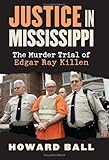
Howard Ball. Justice in Mississippi: The Murder Trial of Edgar Ray Killen. Lawrence: University Press of Kansas, 2006. 254 pp. $29.95 (cloth), ISBN 978-0-7006-1461-5.
Reviewed by Yasuhiro Katagiri (Department of American Civilization, Tokai University, Kanagawa, Japan)
Published on H-Law (February, 2007)
Fear Has Waned and Hope Abides: Mississippi's Remembrance, Redemption, and Reconciliation
In the hot and steamy summer of 1964, Mississippi was busy preparing to defend its segregated way of life from the upcoming "invasion" launched by the Council of Federated Organizations (COFO), a statewide coalition of civil rights organizations largely represented by the Congress of Racial Equality (CORE).[1] In early July, white Mississippians' animosity and resentment toward COFO's Mississippi Freedom Summer Project were at their boiling point. Summing up their indignation, the Meridian Star, in an editorial entitled "God Help the USA," warned its readers to prepare themselves for an ordeal to be caused by "outside agitators": "The student volunteers--the beatniks, the wild-eyed left[-]wing nuts, the unshaven and unwashed trash, and the just plain stupid or ignorant or misled--go on meddling and muddling with things about which they know nothing and which concern them not."[2]
Since the spring of that fateful year, reflecting the ominous revival of Ku Klux Klan activities in Mississippi, cross burning on weekends had been reported in such cities as Brookhaven, McComb, and Natchez. A total of twelve crosses were simultaneously burned in Neshoba County alone on the night of April 5.[3] On June 16, the Mount Zion Methodist Church (later, the Mount Zion United Methodist Church), a black church located in Longdale in the eastern part of Neshoba County, received a Klan-inspired baptism in kerosene and was burned to the ground. The church had been designated as a "Freedom School" site by COFO.
Five days after the Mount Zion Church was destroyed, on June 21, three young civil rights workers from CORE's Meridian office--Michael H. Schwerner and Andrew Goodman, white volunteers from New York; and James E. Chaney, a black civil rights activist from Meridian--drove to Philadelphia, the county seat of Neshoba County, to investigate the burning of the black church. Late in the afternoon, Chaney, who was driving a Ford station wagon, was stopped and then arrested, ostensibly for speeding, by Neshoba County Deputy Sheriff Cecil Price. Schwerner and Goodman were placed in custody for investigation. The three young men were immediately taken to the county jail in Philadelphia, and they were eventually released late in the evening. Outside the county jail, however, a posse of Klansmen from Neshoba County and neighboring Lauderdale County was waiting to fulfill their unsavory dreams of getting rid of Chaney and the "nigger-lover[s]."[4] Within an hour, after a heated car chase, Schwerner, Goodman, and Chaney were forever gone. Forty-four days later, the Federal Bureau of Investigation (FBI) discovered the decomposed bodies of the three missing civil rights workers in an earthen dam in Neshoba County.[5]
Having had one of the most notorious crimes in the civil rights era committed within its borders, Mississippi was destined to become an embodiment of brutality and a symbol of shame--a burdensome fate for the state, Neshoba County, and Philadelphia. The murders of Schwerner, Goodman, and Chaney also served, to borrow the words of Nicolaus Mills, as "the turning of the civil rights movement in America," propelling the passage of the Civil Rights Act of 1964 in Congress that, in turn, dealt a fatal blow to Mississippi's already cracking racial walls.[6]
In Justice in Mississippi: The Murder Trial of Edgar Ray Killen, Howard Ball painstakingly chronicles the Magnolia State's painful and long overdue process to illuminate a dark corner of its recent past through the 2005 indictment, trial, and eventual conviction of Edgar Ray "Preacher" Killen of Neshoba County, the mastermind of the slayings of Schwerner, Goodman, and Chaney. Only a year before the Killen trial, Ball--a law professor at the University of Vermont Law School who taught at Mississippi State University from 1976 to 1982--authored Murder in Mississippi: United States v. Price and the Struggle for Civil Rights as part of the University Press of Kansas' "Landmark Law Cases and American Society" series. In this 2004 work, Ball contended that "[f]or Mississippians living in Neshoba County, for the thousands of folk living in Philadelphia, Mississippi, the past will remain with them until justice is done." "It is past time for a final accounting," he concluded in his book, "[and] [t]here cannot be any peace or rest until justice is done."[7]
When an opportunity for the "final accounting" visited Mississippi in the early summer of 2005, Ball went back to the state and covered the Killen trial for the Burlington (Vt.) Free Press. In writing Justice in Mississippi as a sequel to his own Murder in Mississippi, Ball evaluates "the nature of change in Mississippi" through the Killen trial as "the prism," significantly contributing to our understanding of what Mississippi had gone through for forty some years to rectify and, sometimes to evade rectification of, its past wrongdoings (p. 195).
The Killen trial of 2005, to be sure, was not an isolated, unprecedented, and unpredicted incident in the recent South. A new, progressive, and more responsible generation of local and state officials in the South has been unwilling to let their ugly past of the civil rights era "remain buried."[8] As Ball notes, between 1989 and 2005, authorities in Mississippi and other southern states had reexamined a total of twenty-six white-on-black killings from the civil rights years. And besides the most recent conviction of Killen, twenty-one persons had been convicted of murder (p. 20).[9] Mississippi, in fact, leads the South in prosecuting these civil rights-era murders which went unpunished during the 1960s. Before the Killen trial, the most notable cases in Mississippi were the 1994 conviction of Byron De La Beckwith for the June 1963 assassination of Medgar W. Evers, state field secretary of the National Association for the Advancement of Colored People (NAACP); and the 1998 conviction of Sam H. Bowers, the Imperial Wizard of the White Knights of the Ku Klux Klan of Mississippi, who ordered the firebombing of the store and residence of a local NAACP leader in Hattiesburg, Vernon F. Dahmer, in January 1966.[10]
Among these civil rights-related incidents in Mississippi and the South, the Neshoba County murders occupied a special place. In many ways, the victims of the Neshoba County murders--Schwerner, Goodman, and Chaney--represented and symbolized the divergent hearts, minds, and souls who really made up the civil rights movement of the 1950s and 1960s: whites and blacks, northerners and southerners, Jews and Gentiles, and socially advantaged and denied. And it was this embodiment of divergence that descended on Neshoba County and launched a holy crusade to transform Mississippi--"a state sweltering with the heat of injustice, sweltering with the heat of oppression"--into "an oasis of freedom and justice."[11] The Neshoba County slayings, after all, represented the mournful legacies of the holy crusade waged during "an unholy era in Mississippi history" (p. 197). But as Florence Mars has observed, "[i]n Neshoba County, Mississippi, the basement of the past is not very deep."[12] And only four decades ago, in the mid-1960s, what Ball terms a "culture of impunity" prevailed in the county as well as the state at large (pp. 4, 10-11).
Mississippi's "culture of impunity" largely stemmed from its "closed society." In November 1963, a history professor at the University of Mississippi, James W. Silver, delivered his presidential address entitled "Mississippi: The Closed Society" at the annual meeting of the Southern Historical Association in Asheville, North Carolina. Later, Silver published a book based upon an expanded version of the address he delivered the previous winter. The publication date of Mississippi: The Closed Society happened to coincide with the nationally publicized disappearance of Schwerner, Goodman, and Chaney, and the book quickly became a bestseller.[13] In his book, Silver relentlessly criticized the Magnolia State's reckless commitment to the doctrine of white supremacy and described the cultural, mental, and intellectual restrictiveness of Mississippi society. Out of this restrictiveness and fear of speaking out emerged "Preacher" Killen, a lumber mill operator and a part-time Baptist minister, who "knew how to address the fears of his fellow Nishobans, freely lacing his talk with theories of racial determinism and snatches of Scripture." "He articulated ... that a titanic battle was under way to preserve the true America from integration and godless communism," Seth Cagin and Philip Dray have recounted, "and that tradition[-]bound Mississippi was the last line of defense."[14] For Killen, too, the fight to preserve Mississippi's segregated way of life was a holy one.
A month after the bodies of Schwerner, Goodman, and Chaney were discovered in September 1964 a Neshoba County grand jury sought, but was not afforded, a chance to indict the suspects of the brutal murders, not because the state of Mississippi resisted prosecution of the case, but because the Justice Department, through Acting Attorney General Nicholas Katzenbach, refused to "disclose before that Grand Jury any information relating to ... official Department of Justice Investigation" on the killings.[15] "For everyone working [on] the federal side of the murder case," Ball observes, "there was an absolute distrust of Mississippi justice officials" (p. 44). Unbeknownst to the Neshoba County grand jury, however, Mississippi Governor Paul B. Johnson, Jr. was the one who asked federal authorities to pursue the case, "endur[ing] the ignominy of acknowledging that local prosecutors most likely could not secure convictions on state charges of murder."[16] Pete Johnson, the governor's nephew, recollected in his January 1993 oral history interview that Governor Johnson asked an officer at the Mississippi State Highway Patrol to "take the files [on the Neshoba County murders] to the F.B.I.," for the governor "knew that if it [the files] went into a state court they probably would never been seen again and they [the suspected killers] would never be prosecuted."[17]
In December 1964, the FBI apprehended twenty-one suspects implicated in the murders of Schwerner, Goodman, and Chaney. Due to the lack of a federal statute, the Justice Department lawyers began their almost tortuous process of asking a federal grand jury in Mississippi to convict the men of "'conspiring' to take the constitutionally protected rights and liberties" of the three civil rights workers (p. 42). Thereafter, legal twists and turns ensued in the federal case. William Harold Cox, a segregationist federal district judge in Mississippi who had once referred to black civil rights protesters as "chimpanzees" in his own court, impeded the trial's process and progress with his every command.[18] Ultimately, in 1967, eighteen out of twenty-one suspects were prosecuted in federal court on conspiracy charges relating to the case. The trial's all-white jury convicted seven men, including Imperial Wizard Bowers and Neshoba County Deputy Sheriff Price. Bowers was identified as the one who had ordered Killen to "terminate" Schwerner. Among those who walked free without a day behind bars was "Preacher" Killen, over whose guilt the jurors deadlocked eleven to one when a lone holdout could not bring herself to convict a "preacher" (p. 139).
Two decades had passed by since the federal conspiracy trial and during the same period, Mississippi had undergone significant changes. While Neshoba County was getting busy to prepare for its celebrated county fair in the early summer of 1989--the year regarded as "a turning point for Mississippi" by Ball--an important event in modern Mississippi history was about to take place in the county's small community of Longdale (p. 14). With the twenty-fifth anniversary of the 1964 murders approaching, the families of the late Schwerner, Goodman, and Chaney began organizing a commemorative ceremony in Neshoba County.
On June 21, 1989, a memorial service was held on the lawn outside the Mount Zion United Methodist Church, whose burning had brought the three civil rights workers to Neshoba County a quarter century before. All three major national television networks--ABC, CBS, and NBC--devoted considerable broadcasting time to report on the service, and what set the tone for much of the media and press attention was a speech made by Mississippi Secretary of State Dick Molpus, who was born and raised in Philadelphia. Previously, during the winter of 1988, Molpus had been approached by the organizing committee for the twenty-fifth commemoration of the Neshoba County murders and asked to serve as its honorary chair.[19] A young and popular secretary of state, Molpus was cautioned by his closest advisors that his involvement in the planned commemorative ceremony would be not only politically unwise, but also risky. But he eventually decided that the committee's offer would be an appropriate opportunity for both him and his beloved community "to apologize to the parents, siblings and spouse of Messrs. Chaney, Schwerner and Goodman."[20]
Standing before the racially mixed audience of about a thousand people, Molpus delivered his short but profound speech. No sooner had he completed his welcoming remarks offered "[o]n behalf of the local steering committee and the citizens of Philadelphia and Neshoba County," than Molpus began to unleash what his community had kept to itself for twenty-five years: "My heart is full because I know that for a long time, many of us have been searching for a way to ease the burden that this community has carried for 25 years, but we have never known quite what to do or say. But today we know one way. Today we pay tribute to those who died. We acknowledge that dark corner of our past." "Listen to the words that will be said today," Molpus concluded, addressing his remarks to the families of Schwerner, Goodman, and Chaney: "But most of all, see what is around you. Draw strength and solace from it. Fear has waned--fear of the unknown, fear of each other--and hope abides" (pp. 14-15). Coming to grips with one of the most sordid events in recent Mississippi history, Molpus did what no one was sure any white elected official in the state would ever do.[21] In response, Chaney's mother, Fannie Lee Chaney, made a brief but soulful comment. "I'm so glad," she said peacefully, "that I lived long enough to see this day come."[22]
To be sure, some white residents in Philadelphia deeply resented the national attention given to their town's notorious past. "You know the saying, 'Let sleeping dogs lie?,'" one man reportedly said, "[thus] I don't see why you all want to keep bringing this up. You keep rubbing a sore and it will never get well."[23] "My apology had struck a cord," Molpus recollected in 1996, "and there was very little neutral ground." He was inundated with "a number of death threats and a host of bitter and sick correspondence." Nevertheless, asked if he had ever regretted what he did on the twenty-fifth anniversary of the Neshoba County murders, the former secretary of state answered unequivocally: "The apology hardly changed the world or even our state but it did speak for what I believe is a majority of our citizens who would never condone murder and who hope for racial understanding and reconciliation."[24]
During the same month when the twenty-fifth anniversary was observed in June 1989, the Jackson, Mississippi headquarters of the once all-powerful Citizens' Council--the most vocal and widespread segregationist organization in the civil rights South--closed its door. Robert Patterson, one of the pulling vehicles of the Council movement since its inception and the longtime secretary of the Citizens' Councils of America, explained the reason for its final closure: "Our program was based on legality. Every law supporting segregation has been struck down by the courts. We had no program left."[25] Amazingly, it had taken a quarter of a century for the Citizens' Council to realize that racial segregation had been legally defenseless since the 1964 Civil Rights Act.
A decade after Molpus's soul-searching speech, and following the 1994 conviction of Beckwith and the 1998 conviction of Bowers, then-Mississippi State Attorney General Mike Moore took the initiative in February 1999 to reopen the thirty-five-year-old Neshoba County murder case. But by the end of 2002, the case had gone back to the attorney general's "cold case" folders due largely to the untimely death of the state's star witness--former Neshoba County Deputy Sheriff Price (pp. 63, 70-71). All along, "Preacher" Killen, despite his modest lifestyle, had been enjoying life at least as a free man. Living in Union, Mississippi--a small community just south of Philadelphia--and operating a lumber mill which employed a number of black workers, Killen remained "a bitter, angry segregationist."[26]
On the Independence Day of 2004, only a six months before he was indicted by a Neshoba County jury for the slayings of Schwerner, Goodman, and Chaney, Killen granted an interview to the dean of the Nationalist Movement, a right-wing organization clinging to the South's past and headquartered in Learned, Mississippi. Killen told the interviewer, Richard Barrett, that there were two people whom he most admired; the late Mississippi Governor Ross R. Barnett and the late U.S. Senator James O. Eastland from Mississippi--the embodiment of white South's massive resistance to the civil rights movement (p. 126). While bragging about still possessing "a big picture of Barnett hanging on my wall" at his Union home, Killen praised "Big Jim" Eastland for his mastery of "bottle[ing] up [civil rights-related] laws [in the U.S. Senate] that were wrong." On the other hand, Killen castigated former Mississippi Secretary of State Molpus, who in the "Preacher's" opinion had sold Mississippi's honor to the memory of the "outside agitators," and called him "Little Dick" in contrast to "Big Jim."[27]
A few weeks after the Nationalist Movement interview in which Killen's defiance and rage were re-exposed to the light of day, the newly formed Philadelphia Coalition, a multiracial organization composed of the town's respected citizens, observed the fortieth anniversary of the Neshoba County murders on June 21, 2004. The Philadelphia Coalition--whose members included Deborah Posey, who was once married to the brother of one of the seven Klansmen charged and convicted in the 1967 federal conspiracy trial, Billy Wayne Posey--publicly urged Mississippi State Attorney General Jim Hood, Moore's successor, to pursue prosecution of those responsible for the murders of Schwerner, Goodman, and Chaney (p. 80).
Few people knew how the new state attorney general and Mississippi State District Attorney Mark Duncan could possibly revive and resurrect the case, which had gone back to the attorney general's office's "cold case" files a few years previously. But to the surprise of many, on January 6, 2005, a Neshoba County grand jury indicted Killen for orchestrating the 1964 slayings of the three civil rights workers. The seventy-nine-year-old "Preacher" was summarily arrested by the Neshoba County Sheriff's office. "I think this is a sad day for Mississippi," James McIntyre of Jackson, one of the two attorneys representing Killen, told a newspaper reporter: "This is going to open up old wounds. People [across racial lines] will look at one another differently. I never thought it would surface again."[28] Actually, the seventy-two-year-old attorney, who had been one of the principal speechwriters for Mississippi Governor Barnett during the early 1960s, just found himself representing another suspect in the Neshoba County murder case (p. 139). McIntyre, in the 1967 federal trial, defended the then-Neshoba County Sheriff, Lawrence Rainey, who was acquitted by the jury. Those days in the 1960s were tense and confusing, McIntyre once recalled, because "[t]he communists invaded the state of Mississippi."[29]
The day after the grand jury's indictment, Killen appeared at the Neshoba County Courthouse on January 7, and pleaded innocent to three counts of murder, facing the first-ever state charges in the case. The presiding judge was the seventy-three-year-old circuit judge, Marcus Gordon who, as Ball notes, was "as forthright, courageous, and committed to justice as the fictional lawyer Atticus Finch" featured in Harper Lee's 1962 book, To Kill a Mockingbird (p. 6). Five days later, Killen was released from the Neshoba County Jail after posting a $250,000 bond. Killen's murder trial was initially set for March 28, 2005, but due to his injury from a tree-cutting accident, it was postponed to the middle of June.
As the forty-first anniversary of the Neshoba County murders was approaching and with the familiar sweltering heat returning to Mississippi as in the summer of 1964, the long-awaited moment for the "final accounting," to borrow Ball's words, finally arrived. On June 13, 2005, Killen, now eighty, returned to the Neshoba County Courthouse to face his murder trial. Outside of the courthouse, a well-wisher from out of town greeted him. "Anything I can do?," asked J. J. Harper of Cordele, Georgia, imperial wizard of the American White Knights of the Ku Klux Klan, who eagerly shook Killen's hand. Harper sat in the courtroom, wearing a Klan lapel pin to "support [his] Christian brother."[30]
The Killen trial lasted for a week, in a proceeding whose participants, testimonies, and environment Ball recounts with much insight (pp. 123-169). During his closing summation on June 20, State Attorney General Hood literally pointed his finger at the defendant and called him a "coward." Defiant to the bitter end, Killen audibly muttered just as crisply and eloquently as the state attorney general had, but in his own perverse manner: "You son-of-a-bitch" (p. 171). Obviously, the passage of time had not mitigated Killen's recalcitrant stand. Rather, more than four decades after the Neshoba County murders, Killen's last public utterance indicated that he was prepared "to live and die in Dixie" as an unreconstructed racist, letting the "ghosts of Mississippi" hover around him.
Following the closing arguments, the jurors--composed of eight whites and four blacks (seven women and five men)--began deliberations but two hours later, they reported back to Circuit Judge Gordon that they had been "divided" by a vote of six to six. Ball reminds readers that the jurors were not deadlocked or "hung," as the press reported. All of them were convinced that Killen had played a critical role as the mastermind in the slayings, but only six jurors felt comfortable enough to find Killen guilty of murder (p. 173). Judge Gordon then gave instructions to jurors, informing them that they could consider convicting Killen of the lesser charge of manslaughter.
On June 21, 2005, exactly forty-one years after the brutal slayings, Killen was found guilty on three counts of manslaughter.[31] Referring to the coincidence that the jury's verdict was rendered on the forty-first anniversary, Stanley Dearman, former editor of the Neshoba Democrat, mentioned with deep emotion: "There's some sort of cosmic justice working somewhere."[32] Meanwhile, the day after the verdict, the Jackson Clarion-Ledger, once the state's powerful and leading segregationist daily, editorialized that the conviction's arrival on the anniversary day of the murders was "a fitting, ironic ending to the long search for justice in the case."[33]
Two days after the jury returned its verdict, on June 23, 2005, Circuit Judge Gordon sentenced Killen to twenty years for each of the three counts of manslaughter, with each sentence running consecutively. In giving Killen the maximum sentence of sixty years in prison, Gordon looked at the man who had presided over the 1965 funerals of the judge's parents, and told the "Preacher" that "there are three lives involved in this case, and the three lives should absolutely be respected and treated equally" (p. 176).[34] By mentioning that, Judge Gordon wanted to make sure that Killen recognized that the life of Chaney as a black person was equally as valuable as those of Schwerner and Goodman, who were white. It was anybody's guess whether the judge's words struck home.
Sadly but realistically, there may never be complete and comforting justice for every victim of the racial violence that occurred in the South during the civil rights years. Moreover, many of the sins committed by segregated societies--or by the "culture of impunity"--cannot be "swept away in a single swoop," to borrow the words of Curtis Wilkie, a reporter for the Boston Globe and a Mississippi native.[35] But Ball's narrative shows that the insistent pursuit of justice sends an important message to the present generation and those who are to come. Confronting the shame of our past, whether it needs to be done in Mississippi, the South, the United States, or elsewhere in the world, is part and parcel of envisioning and ensuring a better future for all concerned.
In this respect, Justice in Mississippi tells an important and inspiring story. Despite the book's significance, however, as long as crafting a book remains a human endeavor, there are bound to be mistakes. For instance, though the Mississippi State Sovereignty Commission--the state's "segregation watchdog agency" created in 1956--had kept its watchful eyes on Michael and Rita Schwerner before Michael's violent death, as Ball accurately observes, the state agency did not, and could not have even though it wished, tap the Schwerners' phone (p. 33). Despite the widespread belief entertained by the press and some historians, the historical fact is that the State Sovereignty Commission never possessed and operated state-of-the-art detective devices including wire-tapping equipment.[36]
This slight quibble aside, Ball's Justice in Mississippi, a superb blend of keen observations and intriguing eyewitness accounts, should be consulted by anyone who tries to understand Mississippi's unfinished journey of remembrance, redemption, and reconciliation--a journey which will not cease until, as Martin Luther King, Jr., proclaimed in 1963, "justice rolls down like waters."[37]
Notes
[1]. See generally Len Holt, The Summer That Didn't End: The Story of the Mississippi Civil Rights Project of 1964 (New York: William Morrow, 1965; reprint, New York: Da Capo, 1992); Doug McAdam, Freedom Summer (New York: Oxford University Press, 1988).
[2]. "God Help the USA," editorial, Meridian Star, July 12, 1964, 4A; Shirley Tucker, Mississippi from Within (New York: Acro, 1965), 33.
[3]. Florence Mars, Witness in Philadelphia (Baton Rouge: Louisiana State University Press, 1977), 80.
[4]. Seth Cagin and Philip Dray, We Are Not Afraid: The Story of Goodman, Schwerner, and Chaney and the Civil Rights Campaign for Mississippi (New York: Scribner, 1988; reprint, New York: Nation Books, 2006), 294.
[5]. See generally William Bradford Huie, Three Lives for Mississippi (New York: WWC Books, 1965; reprint, Jackson: University Press of Mississippi, 2000); Yasuhiro Katagiri, "Fifty Years Ago, Spy Agency Launched," commentary, Jackson Clarion-Ledger, Apr. 9, 2006, 5G.
[6]. Nicolaus Mills, Like a Holy Crusade: Mississippi 1964--The Turning of the Civil Rights Movement in America (Chicago: Ivan R. Dee, 1992).
[7]. Howard Ball, Murder in Mississippi: United States v. Price and the Struggle for Civil Rights (Lawrence: University Press of Kansas, 2004), 149.
[8]. "Belated Bombing Arrests Help U.S. Confront Ugly Past," USA Today, May 19, 2000, 14A.
[9]. See also "Remembering Reality," Intelligence Report, Summer 2000, online ed., Intelligence Project, Southern Poverty Law Center, Montgomery, Ala., consulted Sept. 8, 2006 <http://www.splcenter.org/intel/intelreport/article.jsp?aid=256&printable=1>; Sherry Ricchiardi, "Out of the Past," American Journalism Review, Apr./May 2005, 51.
[10]. See generally Adam Nossiter, Of Long Memory: Mississippi and the Murder of Medgar Evers (Reading, Mass.: Addison-Wesley, 1994); Reed Massengill, Portrait of a Racist: The Man Who Killed Medgar Evers? (New York: St. Martin's, 1994); Bobby DeLaughter, Never Too Late: A Prosecutor's Story of Justice in the Medgar Evers Case (New York: Scribner, 2001); Don Whitehead, Attack on Terror: The FBI against the Ku Klux Klan in Mississippi (New York: Funk and Wagnalls, 1970); Delmar D. Dennis, To Stand Alone: Inside the KKK for the FBI (Sevierville, Tenn.: Covenant House, 1991). For a history of more than five hundred lynchings inflicted upon black victims in Mississippi since the end of the Civil War until the mid-1960s, consult Julius E. Thompson, Lynchings in Mississippi: A History, 1865-1965 (Jefferson, N.C.: McFarland, 2006).
[11]. Martin Luther King, Jr., "I Have a Dream," in A Testament of Hope: The Essential Writings and Speeches of Martin Luther King, Jr., ed. James M. Washington (New York: Harper Collins, 1991), 219.
[12]. Mars, Witness in Philadelphia, 1.
[13]. James W. Silver, "Mississippi: The Closed Society," Journal of Southern History 30 (Feb. 1964): 3-34; Silver, Mississippi: The Closed Society (New York: Harcourt, Brace, and World, 1964); Silver, "Mississippi Must Choose," New York Times Magazine, July 19, 1964, 8, 54-55.
[14]. Cagin and Dray, We Are Not Afraid, 36-37.
[15]. Nicholas Katzenbach to O. H. Barnett [Mississippi circuit judge], telegram, Sept. 25, 1964, reproduced in William H. Johnson, Jr. [Mississippi district attorney] to Erle Johnston, Jr. [director, Mississippi State Sovereignty Commission], Dec. 4, 1967, p. 4, folder 3, box 141, Paul B. Johnson Family Papers, Archives and Manuscript Department, William D. McCain Library and Archives, University of Southern Mississippi, Hattiesburg.
[16]. Reid S. Derr, The Triumph of Progressivism: Governor Paul B. Johnson, Jr., and Mississippi in the 1960s (Ph.D. diss., University of Southern Mississippi, 1994), 363.
[17]. Pete Johnson, "An Oral History with Mr. Pete Johnson," recorded interview by Reid S. Derr, Jan. 26, 1993, vol. 441, transcript, pp. 28-29, Mississippi Oral History Program, Center for Oral History and Cultural Heritage, University of Southern Mississippi. The transcript can be read online at <http://anna.lib.usm.edu/%7Espcol/crda/oh/ohjohnsonpep.html>.
[18]. Jack Bass, Unlikely Heroes (New York: Simon and Schuster, 1981), 166.
[19]. Jesse Kornbluth, "The '64 Civil Rights Murders: The Struggle Continues," New York Times Magazine, July 23, 1989, 18, 54.
[20]. Dick Molpus, letter to the reviewer, May 9, 1996, 1.
[21]. Regarding Dick Molpus's June 1989 speech, see also "Miss. Court Convicts Killen in Deaths of Civil Rights Workers," Talk of the Nation, June 21, 2005, National Public Radio, Washington, D.C., consulted Oct. 12, 2006 <http://www.npr.org/templates/story/story.php?storyId=4712785>.
[22]. Bill Nichols, "Looking Back, Pushing Forward: In Mississippi, Remembrance for Three Slain Rights Workers," USA Today, June 22, 1989, n.p.
[23]. Peter Applebome, "Mississippi Anniversary Recalls Lessons in Blood," New York Times, June 22, 1989, A16.
[24]. Molpus, letter to the reviewer, May 9, 1996, 2.
[25]. Jerry Mitchell, "'Progress' Cited in Racist Council's Demise," Jackson Clarion-Ledger, Jan. 24, 1994, 1B, 3B.
[26]. Ball, Murder in Mississippi, 140.
[27]. Edgar Ray Killen and Richard Barrett, "The Edgar Ray Killen Interview," July 4, 2004, Crosstar, Nationalist Movement, Learned, Miss., consulted Oct. 10, 2006 <http://www.nationalist.org/docs/ideology/killen.html>.
[28]. Jerry Mitchell, "Grand Jury Indicts Killen in '64 Killing," Jackson Clarion-Ledger, Jan. 7, 2005, n.p., archived online ed.
[29]. Jerry Mitchell, "Forty-One Years Later, Lawyer Picks Up '64 Case Right Where He Left Off," Jackson Clarion-Ledger, June 18, 2005, n.p., archived online ed.
[30]. Jerry Mitchell, "KKK Wizard Greets Killen as Trial Unfolds in Slayings," Jackson Clarion-Ledger, June 14, 2005, n.p.; Mitchell, "Killen Lawyers: Bar Transcripts," Jackson Clarion-Ledger, June 15, 2005, n.p., both archived online ed.
[31]. Howard Ball, "Civil Rights Murder Trial: Historian/Political Scientist Howard Ball Discusses the Manslaughter Convictions of Edgar Ray Killen," telephone interview transcript, June 21, 2005, Civil Rights Murder Case, Court TV, Courtroom Television Network, New York, consulted Oct. 14, 2006 <http://www.courttv.com/talk/chat_transcripts/2005/0621killen-ball.html>.
[32]. "Quotes about the Killen Trial," Jackson Clarion-Ledger, June 21, 2005, n.p., archived online ed.
[33]. "Neshoba," editorial, Jackson Clarion-Ledger, June 22, 2005, n.p., archived online ed.
[34]. See also Harriet Ryan, "Ex-Klansman Receives Sixty Years for Three 1964 Killings," June 23, 2005, Civil Rights Murder Case, Court TV, consulted Oct. 14, 2006 <http://www.courttv.com/trials/killen/062305sentencectv.html>.
[35]. Curtis Wilkie, Dixie: A Personal Odyssey through Events That Shaped the Modern South (New York: Simon and Schuster, 2001; reprint, New York: Touchstone, 2002), 324.
[36]. Yasuhiro Katagiri, The Mississippi State Sovereignty Commission: Civil Rights and States' Rights (Jackson: University Press of Mississippi, 2001), 53.
[37]. King, "I Have a Dream," in A Testament of Hope, 219.
If there is additional discussion of this review, you may access it through the network, at: https://networks.h-net.org/h-law.
Citation:
Yasuhiro Katagiri. Review of Ball, Howard, Justice in Mississippi: The Murder Trial of Edgar Ray Killen.
H-Law, H-Net Reviews.
February, 2007.
URL: http://www.h-net.org/reviews/showrev.php?id=12874
Copyright © 2007 by H-Net, all rights reserved. H-Net permits the redistribution and reprinting of this work for nonprofit, educational purposes, with full and accurate attribution to the author, web location, date of publication, originating list, and H-Net: Humanities & Social Sciences Online. For any other proposed use, contact the Reviews editorial staff at hbooks@mail.h-net.org.

